S&P 500 Stock Market Gamma Trading Levels Based on Options Open Interest
FOR OPTIONS TRADERS
See What The Market Is Pricing In Before You Trade
The SpotGamma Volatility Dashboard gives you an instant read on whether options are cheap or expensive — across every strike, every expiration, and every stock you trade.
as seen in

The Missing Layer for Understanding Volatility
"Watching 0DTE skew in the Volatility Dashboard is an insane cheat sheet.”
- steve h., SpotGamma Subscriber
If You Trade Options, You
Are Trading Volatility
However you trade options — buying them, selling them, or structuring multi-leg positions — volatility is the single most important factor in your trades. Have you ever bought call options ahead of a company’s earnings, the stock moves sharply upward, and your trade still loses money?
How can you tell if options are too expensive and the premium is actually worth selling?
SpotGamma’s Volatility Dashboard helps you capitalize on opportunities — and avoid common pitfalls.
With intraday data covering 3,500+ US stocks, ETFs, and indices, the Volatility Dashboard brings you a precise look at how the options market is pricing in every strike and expiration.
Implied Volatility: Your Options Pricing Guide
Implied volatility (IV) measures how the market is pricing in specific options contracts. High IV means options are expensive — the market is nervous and charging a premium. Low IV means options are cheap — the market is experiencing calm conditions with less expensive pricing.
The Volatility Dashboard surfaces four distinct charts, revealing what you need to know to trade options with confidence.
Chart
What It Shows
How It Supports Your Trading
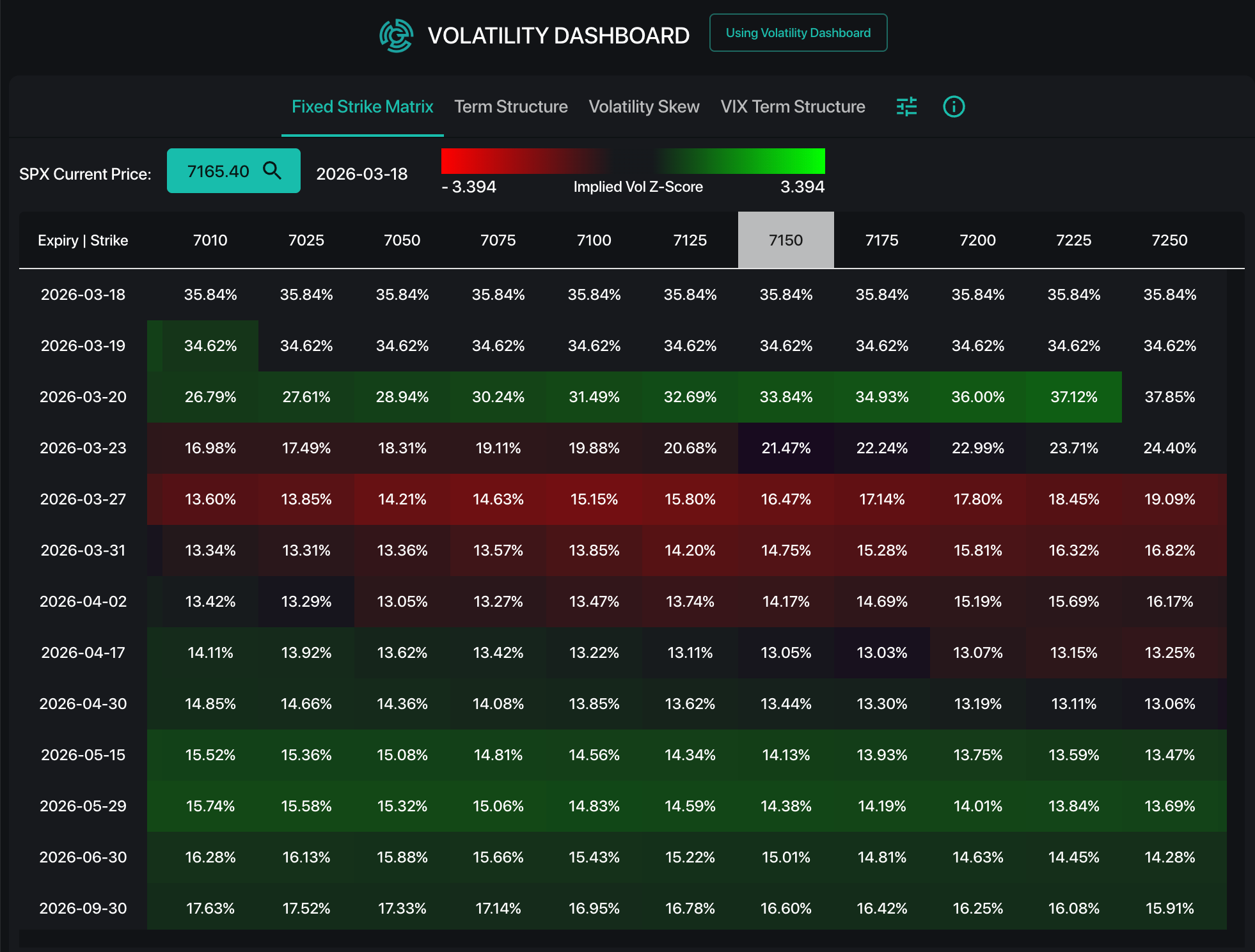
Fixed Strike Matrix
How Implied volatility changes across all strikes and expirations for a given name
Whether options at a specific strike are cheap, expensive, or mispriced relative to nearby contracts
Term Structure
How at-the-money IV shifts across expiration dates for a each stock, ETF, or index
Whether a specific date carries event risk, and if the premium for that date might be justified or inflated
Volatility Skew
Whether the market is skewed towards puts or calls, and how that compares to historic values
Know whether the market is bullish or bearish for any given expiration
VIX Term Structure
What the options market is pricing in for VIX futures contracts for the next 9 months
See where the expectation for broader market volatility is raised or compressed over future timeframes
Using the Volatility Dashboard
Think of the Volatility Dashboard as a weather map for your options trades. Before you buy or sell, you can see whether you're walking into calm skies or an approaching storm — and whether the cost of that storm is already priced in, or completely missed by the market.
Here are three simple steps to help you effectively use the Volatility Dashboard in your options trading.
The Fixed Strike Matrix’s default Statistical Mode enables you to see if IV is elevated or compressed for the ticker you are exploring. High IV may point towards premium-selling strategies, while lower IV favors buying relatively cheap options. The “Show Highlights” feature unveils potential mispriced options contracts that are worth consideration.
The Term Structure reveals if IV spikes at specific expirations, or sits lower than its recent range. You can overlay earnings dates to understand macro or stock-specific events directly on the chart, helping you immediately see why a spike or compression in volatility is expected.
Before entering a trade, the Skew Tab can confirm how IV at your target strike compares to its recent range. Use this chart to see how the market is pricing in calls vs. puts for a given expiration — so you can avoid buying options when they are at extremes, or selling options for sub-optimal premiums.
Combine Volatility with Complementary SpotGamma Tools
The Volatility Dashboard provides a powerful lens you can use to view the options market — and the value of this tool compounds when used alongside SpotGamma's broader product selection.

Alongside HIRO
HIRO tracks the real-time impact of options flow, showing you the strength of buying or selling pressure for options-driven names. When HIRO points to bullish or bearish setups, the Volatility Dashboard helps you decide what strikes and expirations to target so you can capitalize on the move.
Alongside Equity Hub
Equity Hub's key levels show you where the options market is creating structural support and resistance levels for thousands of US tickers. When paired with the Volatility Dashboard, you can confirm what options structures make sense for a range-bound market.
Alongside Options Calculator
The Volatility Dashboard shows you where options may be overpriced or underpriced. SpotGamma’s Options Calculator helps you put that view into action using real-time data to visualize the PnL for your positions across strike and time. You can even model changes to volatility within the options calculator to see the impact on your trade’s return profile.
SpotGamma Alpha:
Institutional Precision For Today's Trader
$299/mo
join spotgamma
The Volatility Dashboard is your starting point for knowing how options are truly priced.
Start placing options trades with a clear understanding of the market’s expectations — helping you uncover new trading opportunities. The Volatility Dashboard is included within a SpotGamma Alpha subscription.
unlock spotgamma ALPHA
Subscribe now to get instant access.
Related Resources
Volatility Dashboard FAQ
What is implied volatility, and why does it matter for my trades?
Implied volatility (IV) is the options market's forward-looking estimate of how much a stock might move. It's derived from the current price of options — not from historical data. When IV is high, options are expensive because the market is pricing in a larger potential move. When IV is low, options are cheap. Every options trade you place is affected by IV, whether or not you're tracking it.
What does the Fixed Strike Matrix show me?
The Fixed Strike Matrix shows IV across all strike prices and expiration dates simultaneously — with color-coded cells allowing you to compare IV against the past 60 days. This enables you to know instantly where options are historically cheap or expensive, where potential mispricings exist, and which strike-and-expiration combinations carry the most or least relative premium.
What is the Term Structure chart, and what does it show me?
The Term Structure chart plots at-the-money implied volatility (IV) across different expiration dates for any stock, ETF, or index. This shows you whether the market is pricing in increasing or decreasing volatility over future time periods.
What does the Volatility Skew chart show me?
Volatility Skew shows how IV differs between puts and calls — revealing where the options market is anticipating risk, whether participants are paying a premium for downside protection or upside exposure, and whether the premium you're about to buy or sell is cheap or expensive relative to the broader surface.
Do I need to understand complex math to use the Volatility Dashboard?
No — the Volatility Dashboard translates volatility data into a visual, color-coded interface designed for practical decision-making. The more comfortable you become with options and implied volatility, the more depth you'll extract — but you don't need a quant background to start using the Volatility Dashboard effectively.
How do I know if a specific expiration date is unusually expensive?
Check to see if IV spikes for a specific date while surrounding expirations stay flat. This kink in the curve is oftentimes related event volatility — and it tells you exactly which dates the market is treating as high-stakes. The Term Structure chart allows you to toggle on events so you can understand whether traders are pricing in significant movement around specific catalysts.
How do I know whether the IV I'm seeing is historically high or low?
The Volatility Dashboard features Statistics on each chart, showing you how the current levels of IV compare to the prior 30, 60, or 90-day range. The Volatility Dashboard also flags relevant economic events directly on the chart, so the source of any spike is oftentimes immediately visible.
What's the difference between implied volatility and the VIX?
The VIX is a specific measure of IV — it represents 30-day implied volatility for SPX options. The VIX can be a useful barometer for overall market anxiety. The Volatility Dashboard goes much further: it shows IV across specific strike prices and expiration dates for any stock, ETF, or index. The VIX tells you how calm or fearful the broad market is. The Dashboard tells you the precise cost of any option you're considering, relative to its own history and neighboring strikes.
What is “Vol Crush” and how does SpotGamma help me anticipate it?
Vol crush, also known as IV crush, is the rapid collapse in options prices that typically follows a market event, such as earnings. Before an event, uncertainty inflates IV. Once the event passes and uncertainty resolves, IV drops sharply — often faster and further than the stock itself moves. A trader who buys calls before earnings can be directionally correct and still lose money if IV falls. The Term Structure view in the Dashboard shows you exactly which expirations carry event-related volatility, so you can make an informed choice about whether to buy into that premium, sell it, or wait it out.
How can I use the Volatility Dashboard to decide whether to buy or sell premium?
High IV suggests selling premium — you're collecting elevated prices and banking on volatility subsiding. Low IV suggests buying — you're paying less, and you benefit if volatility rises. The Fixed Strike Matrix's Statistical Mode shows where current IV sits relative to its recent history, so you can quickly assess whether any given options contract is more favorable on a relative basis for buyers or sellers of premium.
How is the Fixed Strike Matrix different from just looking at an options chain?
An options chain shows you current prices and IV at a point in time. The Fixed Strike Matrix shows you whether those IV levels are historically high or low, color-codes them for instant interpretation, and displays them across multiple expirations simultaneously. This turns a wall of numbers into a structured, visual read on the entire volatility surface — preemptively flagging potential mispricings to reduce any manual effort or math required.
How often does the data in the Volatility Dashboard update?
IV data in the Volatility Dashboard updates every 1 minute during market hours. Term structure, Fixed Strike Matrix, and Skew views reflect current market conditions as options are being priced and traded.
Is the Volatility Dashboard useful for index traders, not just equity traders?
Yes — the Volatility Dashboard covers major indices including SPX, SPY, and QQQ, as well as 3,500+ US-listed individual equities and ETFs.
What subscription tier includes the Volatility Dashboard?
The Volatility Dashboard is available to SpotGamma Alpha subscribers. It can be accessed at dashboard.spotgamma.com/ivol.