GameStop (GME) is attracting renewed attention following an aggressive wave of insider buying led by CEO Ryan Cohen. Since September, company insiders have purchased nearly $100 million in shares, signaling growing confidence as GME rallies from recent lows.
However, the options market tells a more complicated story. Elevated implied volatility suggests traders are pricing substantial uncertainty, while SpotGamma’s negative gamma estimates indicate dealer hedging could amplify price swings as GME approaches key technical levels.
1. Insider Buying: Ryan Cohen Leads the Charge
According to recent OpenInsider disclosures and SEC filings, Ryan Cohen has accumulated approximately 4.14 million additional GME shares across five separate buying sessions since September 10, representing roughly $97.2 million in purchases.
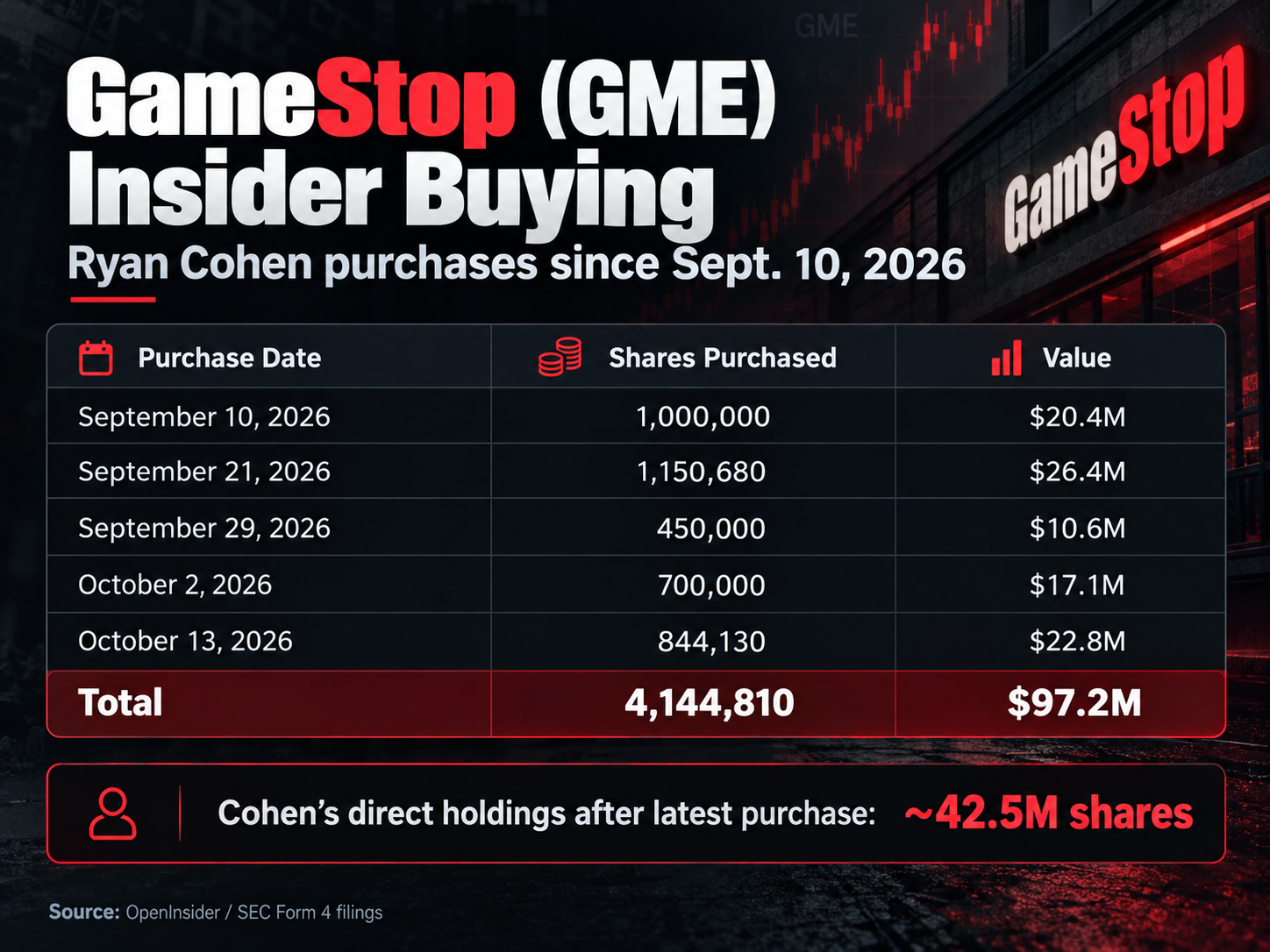
Cohen’s latest purchase on October 13 totaled approximately $22.8 million at prices between $26.75 and $27.00, bringing his direct holdings to roughly 42.5 million shares. Directors Lawrence Cheng, Alain Attal, and Nat Turner also participated in the recent buying, contributing approximately $1.7 million in additional purchases.
The takeaway: Cohen has repeatedly increased his exposure at progressively higher prices, while multiple directors have demonstrated similar conviction. This broad participation strengthens the bullish insider signal, although it does not guarantee continued upside.
2. Options Positioning: Elevated Volatility Signals Big Moves
GameStop’s options market is pricing substantial uncertainty, with implied volatility elevated across both upside and downside strikes.
SpotGamma’s November 20 volatility skew shows IV near 68–70% around GME’s share price, rising toward 80% at the $35 calls and above 90% at far downside strikes.
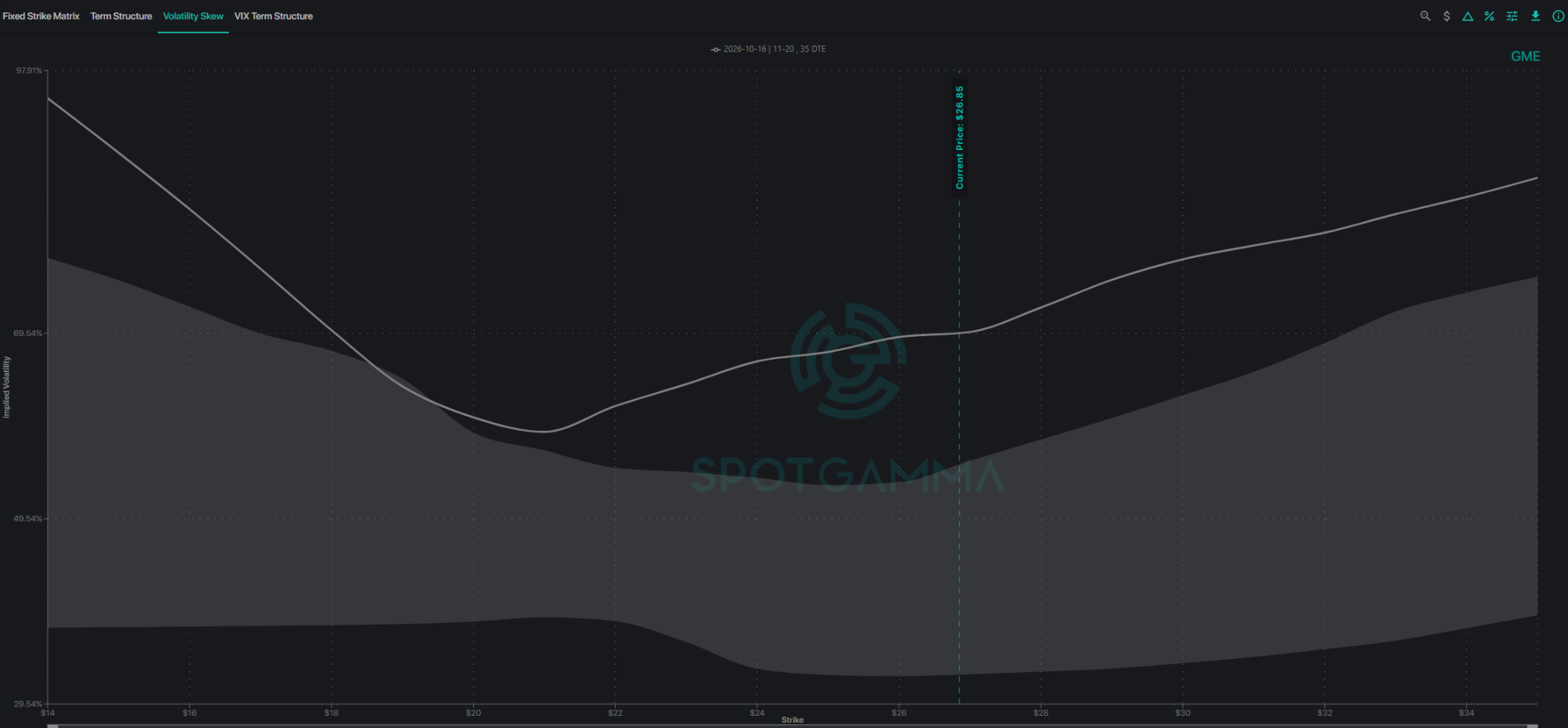
This pronounced volatility smile suggests traders are paying substantial premiums for exposure to large moves in either direction, rather than exclusively positioning for a bullish breakout.
For options traders, elevated IV makes outright calls expensive while creating opportunities for premium sellers. However, rich premiums come with meaningful directional and gap risk, particularly when dealer positioning could amplify volatility.
The takeaway: Insider buying provides a bullish signal, but options prices already reflect expectations for substantial movement. Traders must weigh the opportunity for upside against the cost of volatility exposure.
3. Fundamentals: A Different GameStop Is Emerging
Beyond the familiar meme-stock narrative, GameStop’s financial profile has improved considerably.
Second-quarter operating income climbed to $160.2 million from $66.4 million a year earlier, while collectibles revenue jumped 57%. Management also raised its fiscal 2026 adjusted EBITDA outlook above $650 million.
However, overall quarterly revenue declined approximately 19%, highlighting the ongoing challenges facing its traditional retail business.
What Might Cohen Be Positioning For?
Beyond its retail turnaround, GameStop is increasingly pursuing an unconventional capital allocation strategy. The company held approximately $4.9 billion in eBay shares as of August 1, following its unsuccessful acquisition proposal, while also expanding into digital assets through Bitcoin purchases and Bitcoin-backed covered-call strategies.
These moves suggest Cohen may envision GameStop as more than a traditional retailer, potentially transforming it into a broader investment and operating company.
Whether his recent insider purchases reflect confidence in that strategy, anticipation of another corporate transaction, or plans for additional cryptocurrency exposure remains uncertain. However, the company’s evolving investment portfolio adds another dimension to the bullish insider-buying narrative.
4. Short Interest: Squeeze Potential Remains in Focus
GameStop’s history of explosive short squeezes makes its current short positioning particularly relevant, especially alongside recent insider accumulation and elevated options volatility.
As of September 30, 42.7 million GME shares were sold short, representing approximately 10.3% of the tradable float, according to FinViz. Short interest increased 9.2% from the previous reporting period, with a days-to-cover ratio near 6.0.
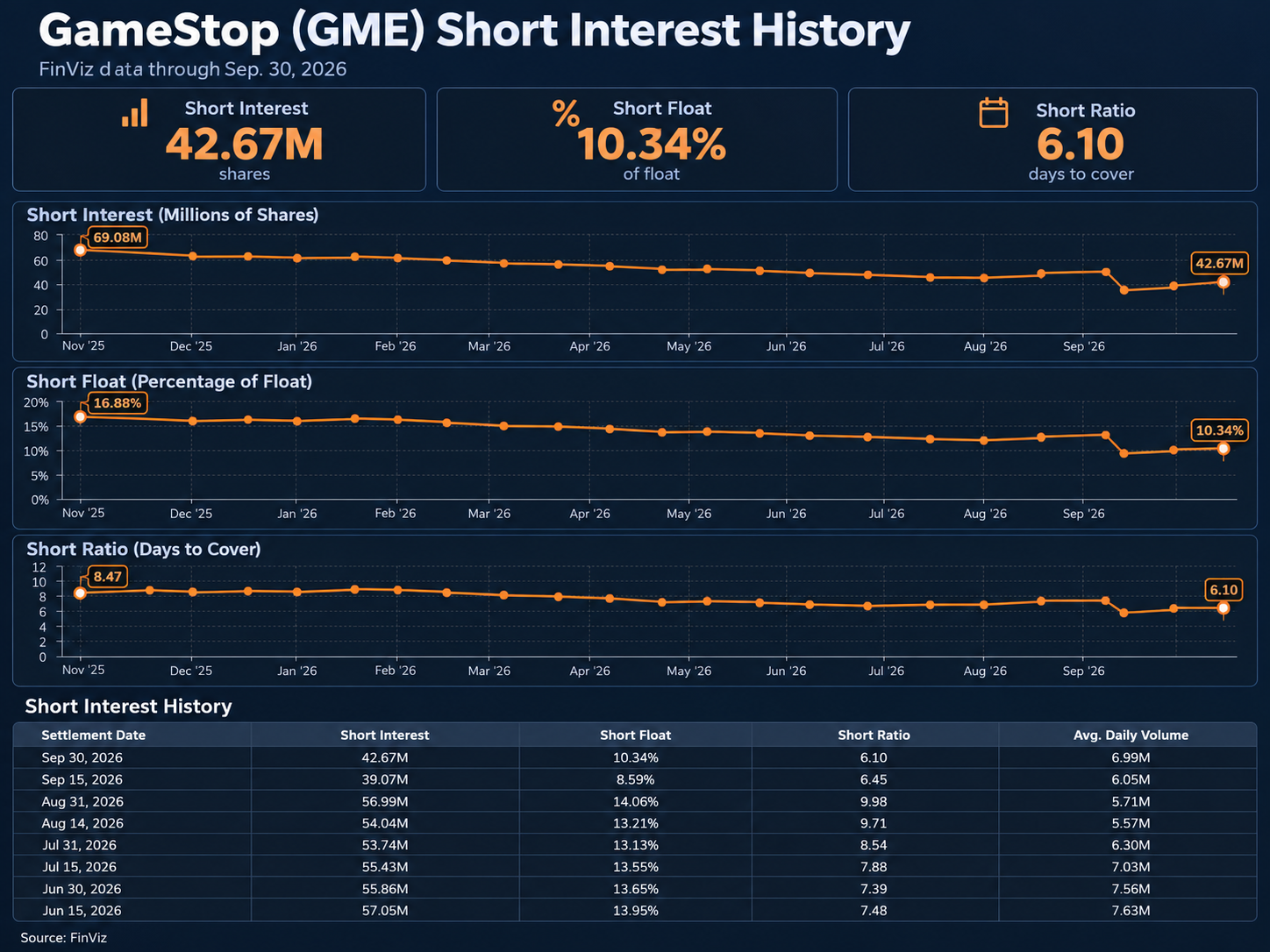
Despite the recent 9.2% rebound, short interest remains approximately 25% below its late-August level of 57 million shares, suggesting overall short positioning has moderated considerably.
While meaningful, today’s positioning is substantially less crowded than the January 2021 episode, when short interest exceeded 120% of the float.
Still, a sustained upside move could encourage short covering, adding incremental buying pressure. Combined with negative dealer gamma exposure, those flows could amplify momentum if GME breaks through the $29-$30 region.
The takeaway: Short interest provides another potential source of upside fuel, but current positioning does not suggest the same extreme squeeze conditions seen in 2021. A meaningful increase in short interest, tighter stock-borrow availability, and accelerating upside volume would strengthen the squeeze thesis.
5. Technicals & Trader Takeaway
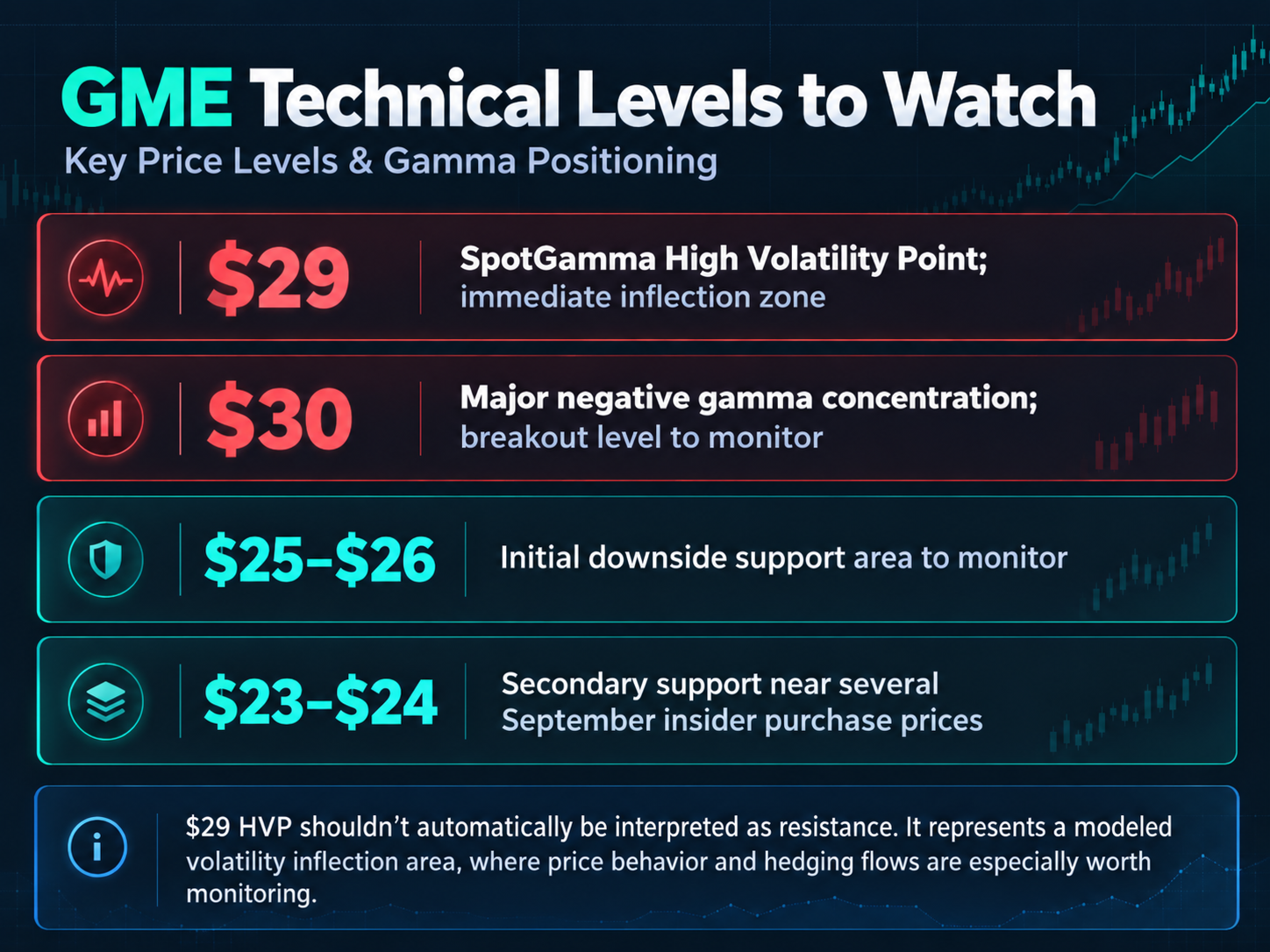
GME has rallied sharply from its September lows near $18, although shares pulled back to $26.81 at Friday’s close following a recent test above $28. Attention now turns to the $29-$30 region, where SpotGamma’s earlier gamma exposure snapshot identified important volatility concentrations.
Gamma Positioning: $29-$30 Becomes the Key Battleground
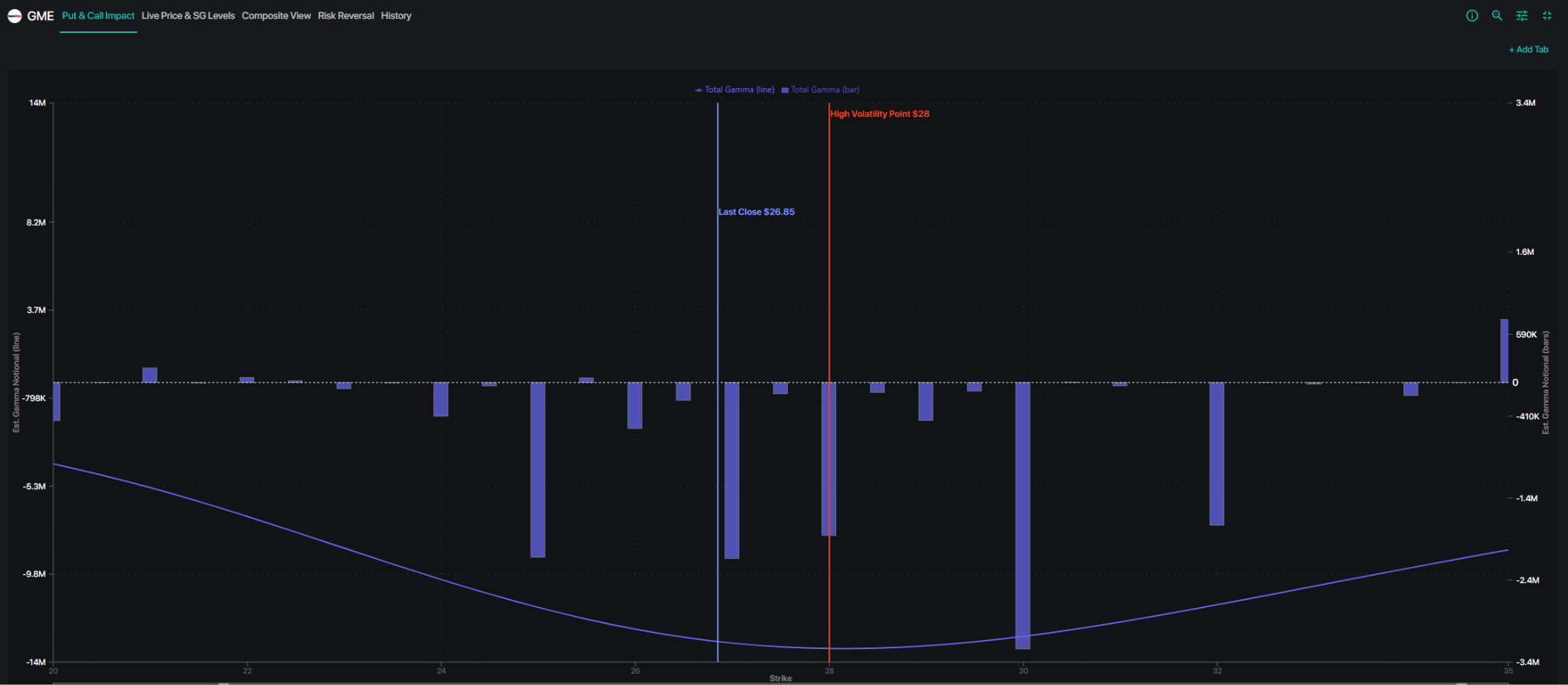
SpotGamma’s October 16 gamma exposure snapshot showed predominantly negative estimated dealer gamma, with $29 identified as the High Volatility Point (HVP) and a significant negative gamma concentration near $30.
Negative gamma positioning can lead to procyclical dealer hedging, potentially amplifying price movements in either direction.
For bullish traders, a sustained move through $29-$30 could encourage further upside momentum. Conversely, rejection near these levels may leave GME vulnerable to an accelerated pullback toward the $25-$26 support region.
The takeaway: Insider accumulation supports the bullish thesis, but negative gamma positioning suggests the path higher could remain volatile rather than orderly.
Bottom Line: Nearly $100 million in insider buying underscores growing confidence in GameStop’s outlook. However, elevated implied volatility and negative gamma positioning suggest the options market is already anticipating substantial price swings.
The $29-$30 region is the critical area to monitor. A sustained breakout could encourage further upside momentum, while rejection risks a sharp reversal.
For premium sellers, rich option prices present opportunities, but defined-risk structures and disciplined position sizing remain especially important.