Cytokinetics (CYTK) is setting up as an interesting event-driven biotech trade into November. Just as the options market is beginning to position around a major FDA decision while the stock sits near the lower end of its recent range. One trader has already positioned for upside with 1,500 November $70/$90 call spreads.
The key catalyst is November 14, when the FDA is scheduled to rule on Cytokinetics’ supplemental NDA for MYQORZO (aficamten) based on the MAPLE-HCM Phase 3 trial. The November 20 options expiration lands just six days later. This makes it the cleanest expiration for traders looking to isolate the regulatory event.
Importantly, this is not an entirely new clinical-data binary. MYQORZO is already approved for symptomatic obstructive hypertrophic cardiomyopathy, and the MAPLE-HCM data are known. The November decision is centered on expanding the drug’s label using results that showed aficamten outperforming metoprolol across key measures.
The question for traders is therefore less about whether the drug works and more about how much commercial value the FDA allows Cytokinetics to extract from those results.
Options Market Is Pricing a Big Move — But IV Isn’t Extreme
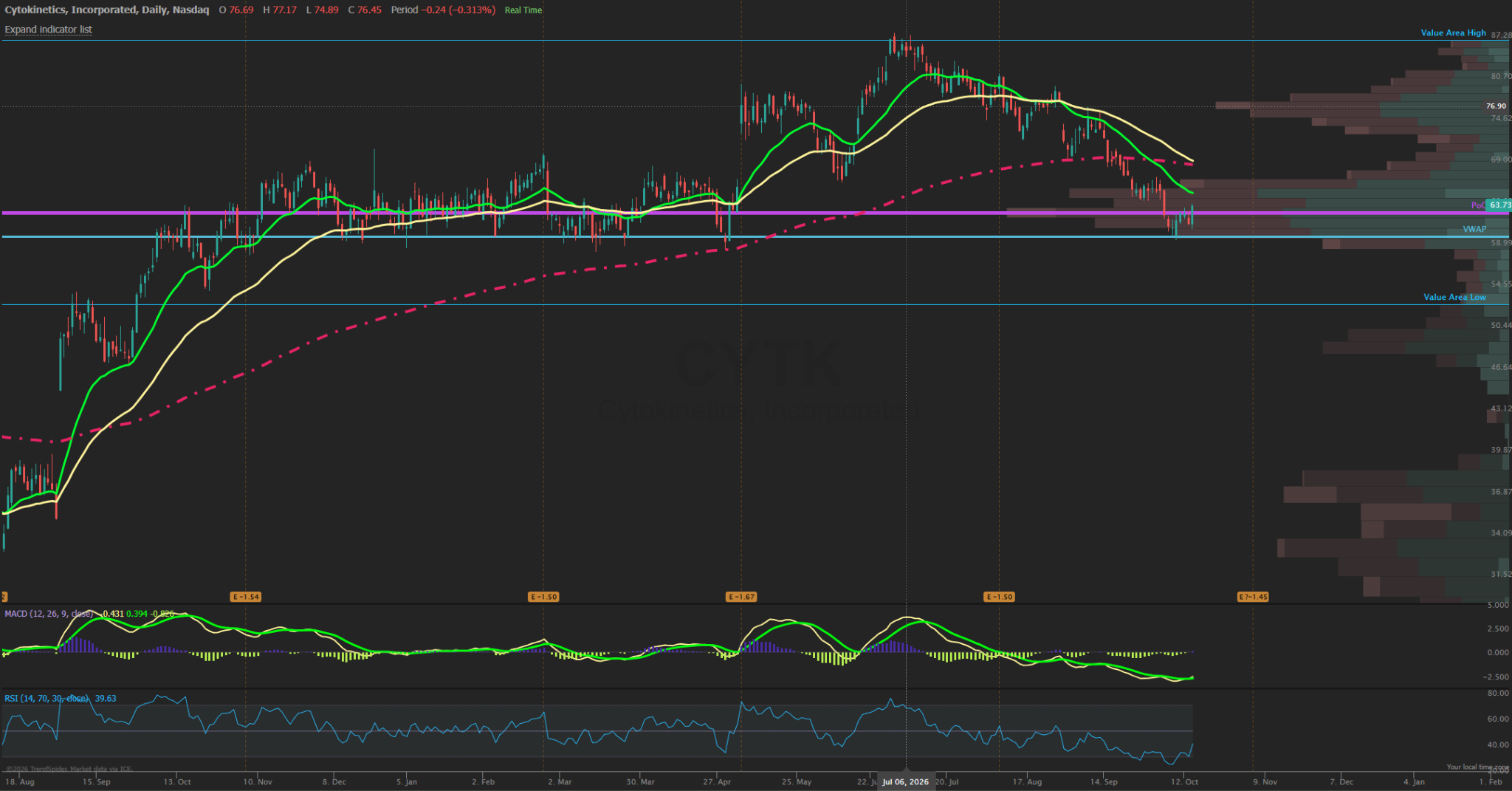
CYTK recently traded around $63 after falling roughly 15% over the previous month, with its 14-day RSI near 33. More intriguing is the stock retesting the one year point of control (POC) on the above volume profile. This represents the most traded price for CYTK in the past year. Or the area buyers and sellers have tended to agree on price most often.
Despite the looming binary event, options volatility is not particularly expensive when measured against CYTK’s own history.
As of October 12, at-the-money IV was approximately 59.8%, while CYTK’s IV Rank sat at only 7 out of 100. In other words, absolute volatility is high—as we would expect for a biotech—but relative to where CYTK options have traded over the past year, premium remains near the lower end of the range.
That is an important distinction for traders considering long-volatility structures into the event.
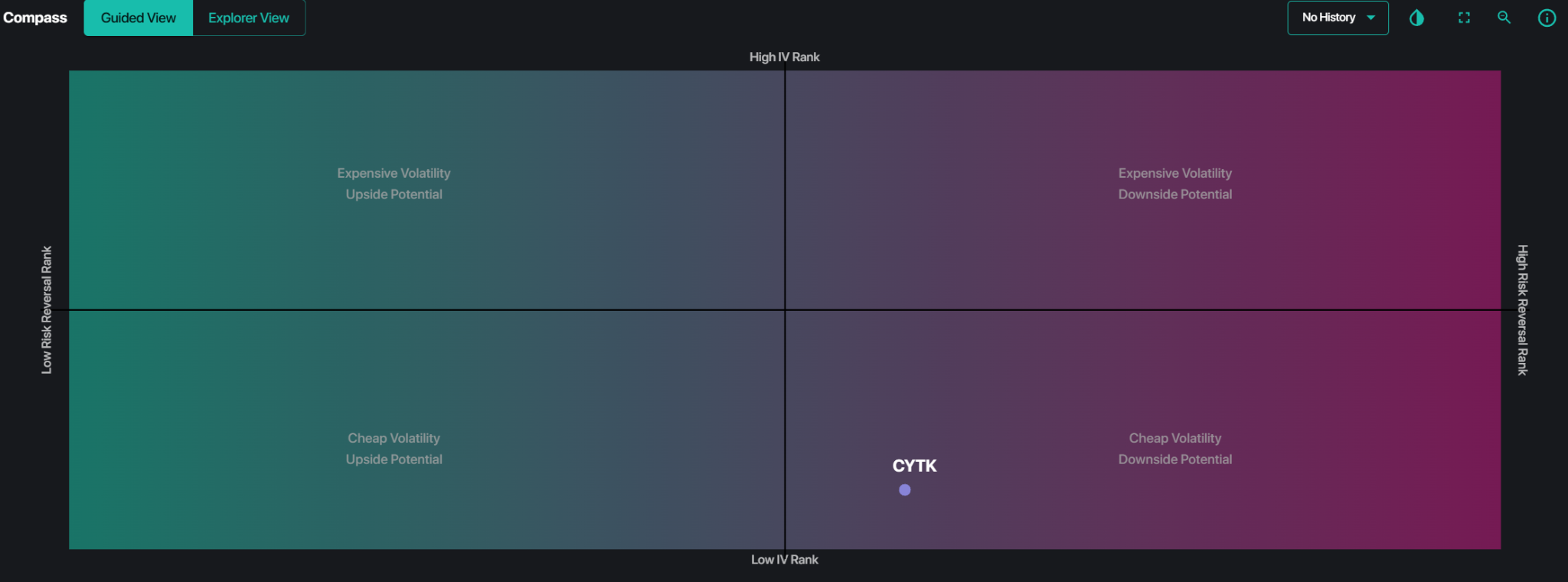
The SpotGamma Compass places CYTK in the lower-right quadrant, reflecting relatively inexpensive implied volatility compared with its own one-year range.
November 20 options currently imply a range of approximately $49.40 to $74.20, or roughly -21%/+18% from the October 12 close.
That is a substantial expected move, but $90 still sits far outside the market’s roughly one-standard-deviation November range, highlighting just how aggressive the upside target is.
A Large Trader Targets $70-$90
One transaction stands out.
On September 29, with CYTK around $64.80, a trader initiated approximately 1,500 November $70-$90 call spreads for a $2.60 debit. The $70 call leg traded in a 1,500-contract block at the ask when existing open interest was only 84 contracts, supporting the idea that new bullish exposure was being opened.
At $2.60, the structure represents roughly $390,000 of premium at risk.
The expiration breakeven is $72.60, while the spread reaches its maximum $20 value at $90. That means the position can return roughly $2.61 million in profit if CYTK finishes at or above $90 on November 20.
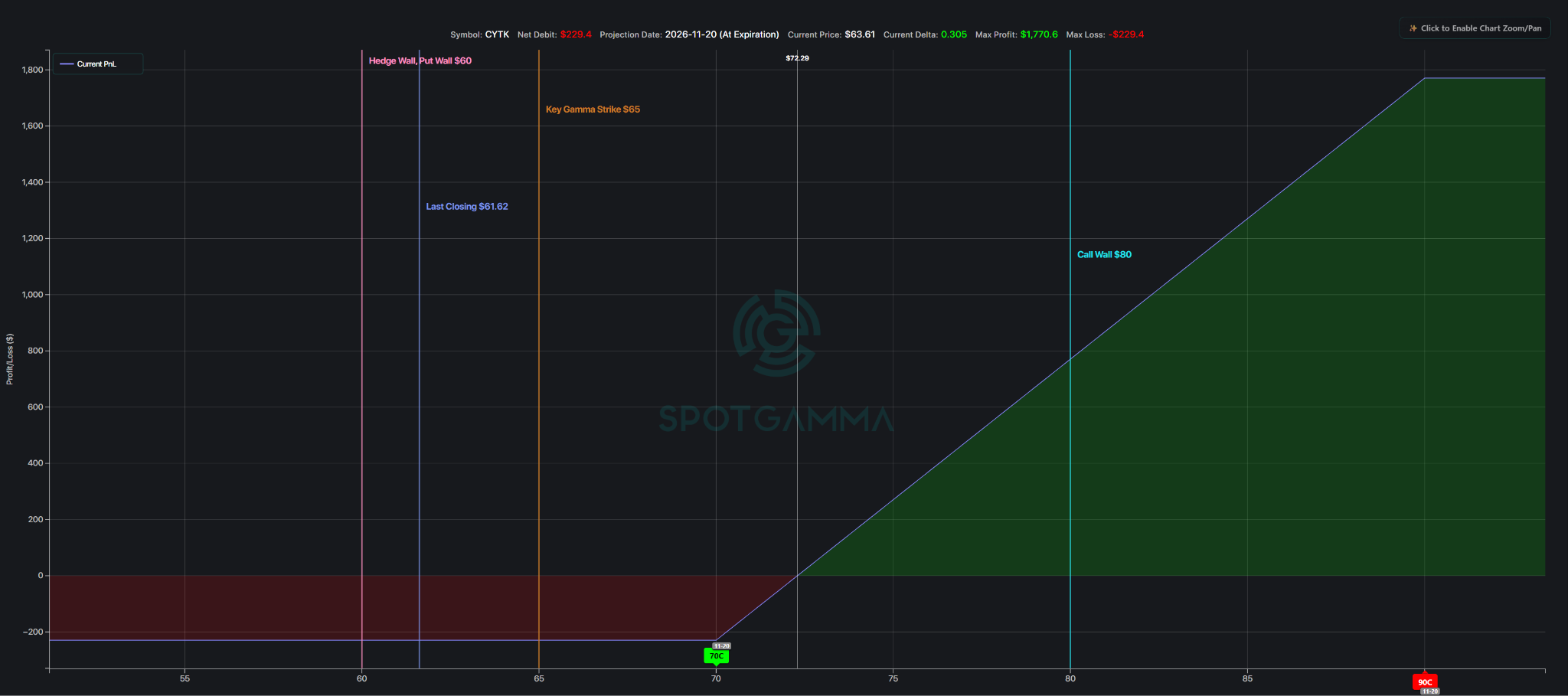

The structure is notable because $72.60 sits within the market’s current implied November range, while $90 is well outside it.
In other words, the trader isn’t simply betting that CYTK rebounds. The structure appears designed to maintain inexpensive exposure to a large positive regulatory reaction while limiting the cost of owning elevated-event volatility.
Skew Is Muted, But Upside Positioning Stands Out
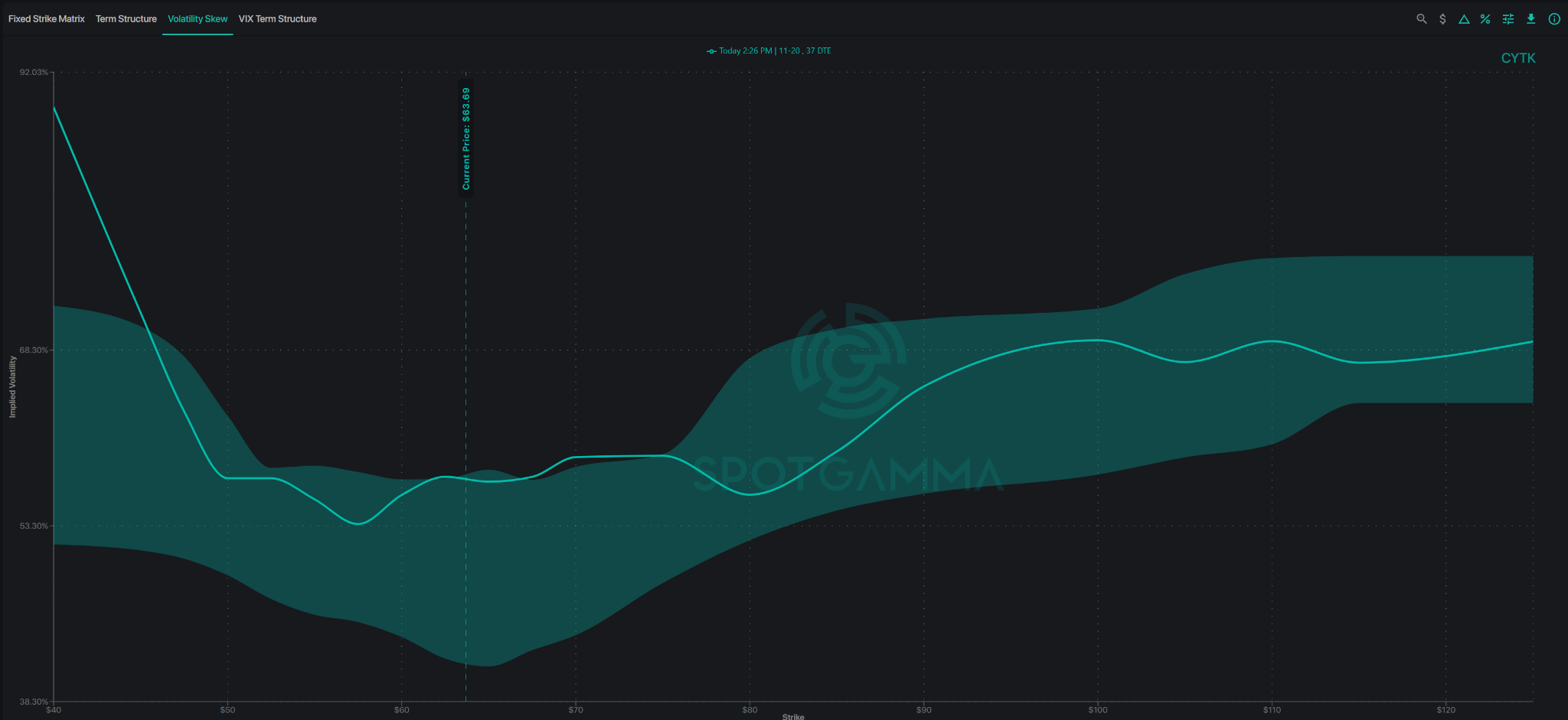
The November options positioning also has a clear upside bias.
The November $70 calls now carry roughly 2,650 contracts of open interest, while the $85 calls have more than 1,100 contracts and the $90 strike carries roughly 1,930 contracts.
Interestingly, the raw near-the-money volatility skew isn’t especially aggressive. Recent November $65 calls were around 60% IV and the $70 calls around 59% IV.
That suggests the more interesting signal isn’t simply elevated call IV. It is where traders are choosing to concentrate their convexity.
Large open-interest pockets well above spot show traders maintaining exposure to a potential upside tail even though CYTK has been trending lower.
Gamma Creates Some Important Levels
The options positioning also gives traders several levels to watch heading into November.
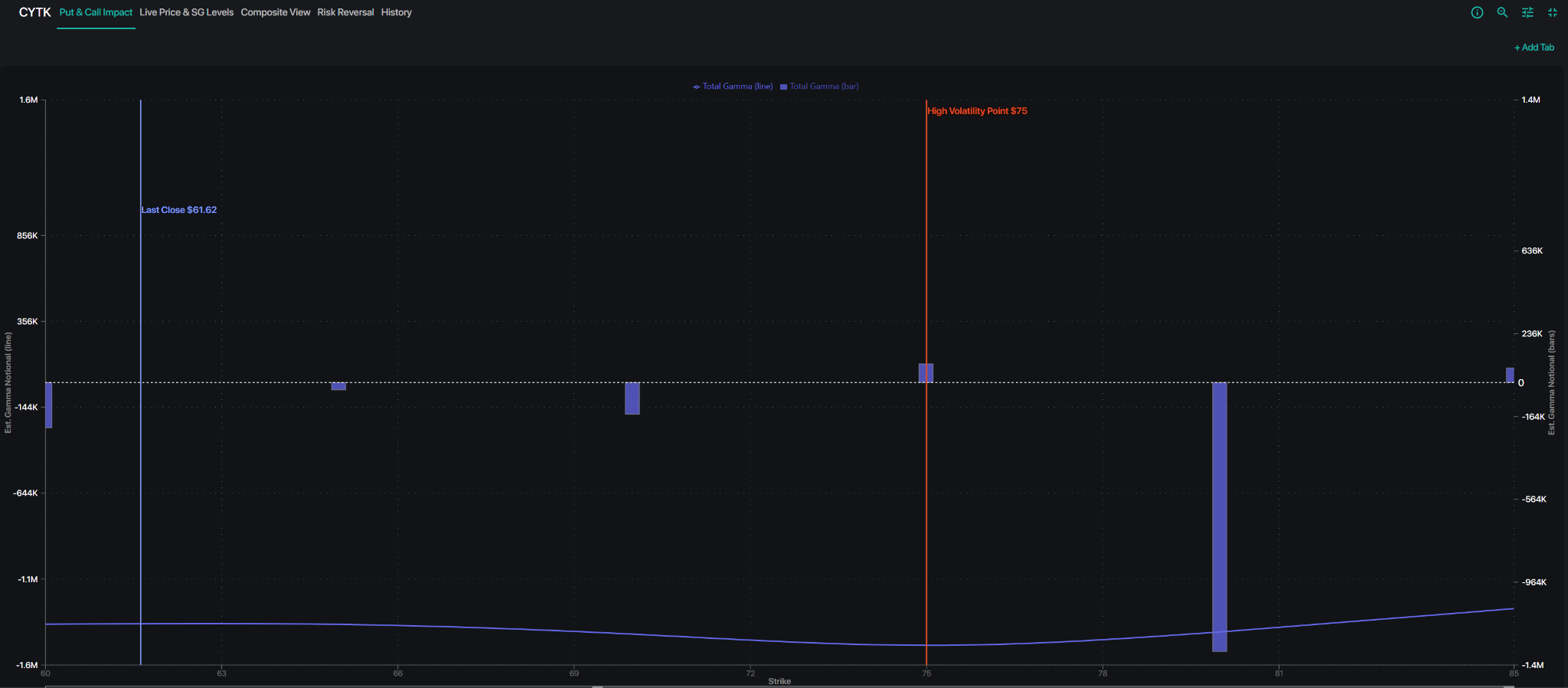
Current chain-based gamma data identifies the $60 strike as the largest put-side level and $80 as the largest call-side level, with roughly $2.55 million of net dollar gamma in the model as of October 12.
That creates an interesting framework.
With CYTK around $63, the stock is currently sitting much closer to the $60 downside options concentration. The first bullish test is therefore reclaiming the $65-$70 zone.
The $70 strike is particularly important because of the heavy November call open interest.
If CYTK can move above that level as the FDA date approaches, those options become increasingly sensitive to changes in the stock price, potentially increasing the sensitivity of dealer hedging flows as the stock approaches the larger $80 concentration.
Conversely, a loss of $60 would put the stock through its largest put-side options level and weaken the technical setup considerably.
Open interest alone cannot tell us whether dealers are net long or short a particular strike. These levels should be viewed as areas where gamma sensitivity and hedging activity may increase, rather than guaranteed support or resistance.
The Setup
CYTK therefore enters the November catalyst window with several things lining up.
The stock has become technically oversold after a sharp pullback. November options capture both the expected early-November earnings and November 14 FDA decision. Implied volatility remains relatively inexpensive versus CYTK’s own history, and traders have accumulated significant upside call exposure.
Short interest also remains meaningful at roughly 16% of float as of September 30. Elevated short interest could add incremental fuel to a positive reaction, but it is not central to the thesis.
The levels to watch: $60 remains the key downside options level, $65-$70 is the first bullish hurdle, and $80 marks the larger upside call-gamma concentration. A sustained move through $70 into the FDA window would make the upside positioning increasingly relevant, while a break below $60 would weaken the setup.
The buyer of the November $70/$90 call spread appears to be positioning for exactly that type of scenario: limited risk, a defined catalyst and significant upside convexity should the FDA decision trigger a re-rating.
For traders willing to speculate on binary biotech events, CYTK is one to watch closely into November.