The Timeline: 439% to Zero Public Exposure in Six Days
The fund launched in late 2024 with roughly 5 million, built on Aschenbrenner’s “Situational Awareness” AGI thesis, and grew to an estimated –24 billion by mid-2026 — backed by Stripe’s Patrick and John Collison, Nat Friedman, Daniel Gross, and, unusually, Jane Street. On July 24, the FT reported the fund’s H1 investor letter: up 439% net, amplified by borrowed money. Then July’s AI infrastructure selloff hit its book squarely: reports indicate core holdings — Nebius, SanDisk, Micron, CoreWeave — each fell somewhere between 27% and 54% on the month, the Nasdaq 100 dropped more than 10%, and Korea’s Kospi (home to holding SK Hynix) lost roughly a third of its value. By this week, prime brokers at Bank of America, Goldman Sachs, and JPMorgan were marketing holdings from both the long and short sides of the book. This morning, Faber reported the fund had exited all of its public investments in one enormous block trade to a single fund — later identified by the Wall Street Journal as Citadel.
The Book: Concentration as a Feature, Then a Bug
The fund’s Q1 2026 13F (as of March 31) shows exactly the kind of portfolio that produces a 439% run — and exactly the kind that cannot survive a drawdown at leverage. The disclosed U.S. long book — .86 billion across just 26 positions — was concentrated in second-derivative AI infrastructure: the “picks and shovels” bottlenecks of power, compute, and storage, rather than the mega-caps:
| Position | Theme | % of 13F Book | % of Shares Outstanding |
|---|---|---|---|
| Bloom Energy (BE) | Power generation | 22.8% | 2.3% |
| SanDisk (SNDK) | Storage / memory | 18.8% | 0.8% |
| CoreWeave (CRWV) | GPU cloud | 14.4% | 1.7% |
| IREN (IREN) | Miner-turned-HPC | 10.4% | 3.5% |
| Core Scientific (CORZ) | Miner-turned-HPC | 10.1% | 8.2% |
Top five positions: over 76% of the disclosed book. The rest of the filing reads like a map of the AI build-out’s physical layer: Applied Digital (8.3%), Riot Platforms, CleanSpark, Bitdeer, and HIVE among the miners-turned-datacenters; Solaris Energy, T1 Energy, Power Solutions, Babcock & Wilcox, and ProPetro on power; WhiteFiber on connectivity — with only token positions in the semiconductor names themselves (AMD, Intel, TSMC and an SMH line together under 1.5% of the book). Just as striking is the float ownership: the fund held 8.2% of Core Scientific’s shares outstanding, and roughly 4–5% of Applied Digital, CleanSpark, and WhiteFiber. Beyond the 13F, reporting points to SK Hynix in Korea, a large Nebius position built after the March filing date, and — per Blockspace — put exposure reported at roughly .0 billion notional against the SMH semiconductor ETF and .6 billion against Nvidia, alongside short positions in software names including Adobe. The disclosed .86 billion long book versus a reported + billion AUM also tells you how much of the fund’s true gross exposure lived outside the 13F — in swaps, international names, options, and leverage.
The structure tells you the thesis: long the physical bottlenecks of AGI (power, storage, GPU capacity), short the incumbents the market had already priced for AI. It was a magnificent trade for eighteen months. It was also, in options terms, a massively correlated book pretending to be hedged — the SMH and NVDA puts were “hedges” from the same macro factor as the longs. When the AI infrastructure complex broke in July, the second-derivative longs fell two to four times harder than the first-derivative hedges, and the software shorts reportedly moved against the fund at the same time. Long book down, short book up: the long/short double whammy.
The Margin Math
Why does a fund up 439% get margin-called into oblivion weeks later? Leverage arithmetic is unforgiving. At roughly 4x gross exposure, a 30% decline in the long book is a ~120% hit to equity before shorts and hedges — and in July, the hedges were the wrong hedges and the shorts added to losses rather than offsetting them. Once equity burns down toward prime-broker maintenance thresholds, the fund faces the classic sequence we’ve written about in every deleveraging episode: margin call → forced reduction → selling begets lower prices in concentrated names → further calls. Reports say the fund first sought fresh capital from investors and lenders — described as ad hoc rather than a coordinated raise — and offered assets to some investors directly, including marketing its crown-jewel private stake in Anthropic (acquired in May’s billion Series H). When that wasn’t enough, the entire public book went.
What the Tape — and FinTwit — Are Saying
The real-time reporting came fastest through X. CNBC’s David Faber, as live-noted by Barron’s alum Tae Kim, said the fund “got to billion AUM at near highs” and was “levered. Heavily so… as much as four times.” When the block sale crossed, the reaction was immediate and telling: “THE UNWIND IS OVER. Let’s go” captured the dominant read — that the forced seller’s exit removes the overhang that had been crushing the AI infrastructure complex all month.
One more detail from the filing trail, flagged by unusual_whales: the fund’s most recent 13F update showed it adding into the space right before the break — new positions in TSMC, Intel, ASML, Nvidia, and Corning, fresh call positions on Micron, TSMC, and SanDisk layered alongside its semiconductor puts, while trimming Core Scientific and Bloom Energy. Whatever the intended structure, the fund went into July leaning further into memory and semis — the exact segment that then fell hardest.
The story has also become must-watch content beyond the terminals — TBPN’s segment on the unwind is one of the better breakdowns of how a 439% year turns into a forced sale:
FULL INTERVIEW: @MartinShkreli breaks down the collapse of Leopold Aschenbrenner’s Situational Awareness, and how Citadel capitalized on the liquidation.
01:00 Why Situational Awareness collapsed
03:00 SALP’s 4x leverage, firms that were tapped to buy
08:00 Why Citadel did… pic.twitter.com/nqWWT93TV2— TBPN (@tbpn) July 30, 2026
Why the Single-Block Sale Matters
The most interesting market-structure detail is that the whole book — longs and shorts — went to one buyer in a single block. From a positioning perspective, this is the least-bad outcome for the market. A piecemeal liquidation of positions this size — including 8% of Core Scientific’s float — would have meant days of relentless, price-insensitive selling — the kind of flow that overwhelms dealer liquidity, drags implied volatility higher across the whole AI complex, and forces sympathetic de-risking from every fund holding overlapping positions. A block transfer to a single counterparty largely neutralizes that: the positions didn’t hit the tape as supply; they changed hands. That’s why the immediate reaction in the affected names this morning was not another leg down — and why some traders greeted the news with “the unwind is over.” The forced seller is out. And the buyer’s identity — Citadel, per the WSJ — reinforces the point: one of the deepest-capitalized multi-strategy platforms in the world, presumably buying at a meaningful concession, now holds the book as a willing owner with enormous risk capacity. That is close to the ideal counterparty for containing contagion: Citadel can warehouse, hedge, or work out of the positions on its own schedule rather than the market’s.
That doesn’t mean the episode is consequence-free. The July selloff itself was likely amplified on the way down by this exact fund reducing exposure — concentrated deleveraging is reflexive, and the 27–54% July declines in its top names are hard to explain by fundamentals alone. And the short side of the transferred book matters too: any squeeze pressure in the software shorts now depends on what the new owner does with them.
Intraday Update: The Liquidation Discount Reprices Out
Updated mid-afternoon, July 30. The market wasted no time pricing out the forced-seller overhang. By roughly 3 PM ET, every long position in the transferred book was up 20–27% on the session: Nebius +27.1%, IREN +26.5%, Bloom Energy +25.6%, SanDisk +24.6%, Riot +23.7%, CoreWeave +22.0%, CleanSpark and Applied Digital +21.4%, Core Scientific +20.7%. For scale: the equal-weight S&P 500 (RSP) was flat, SPY was up 1.8%, and QQQ’s +3.5% was largely Microsoft’s post-earnings surge.
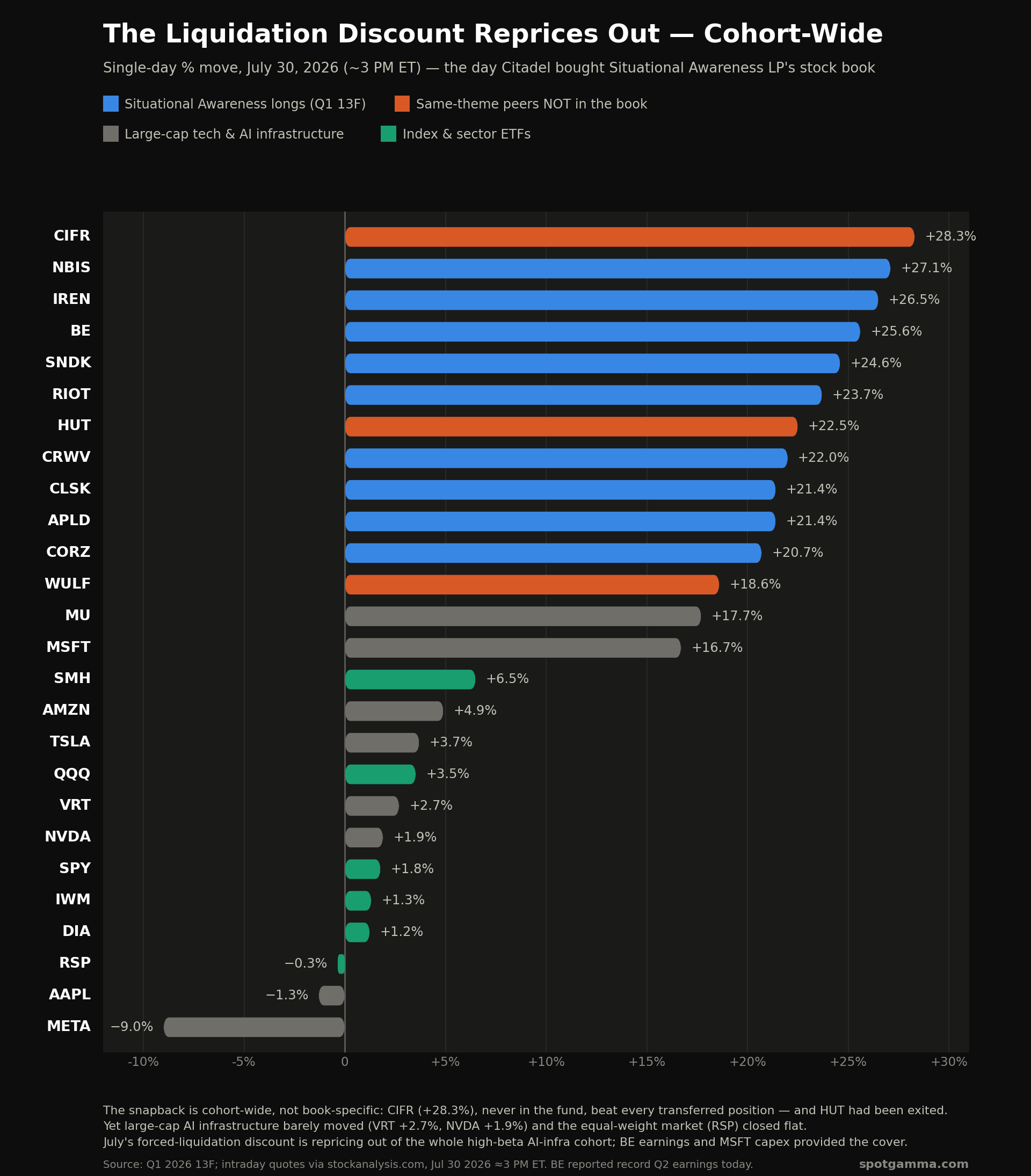 Two details sharpen the read. First, the snapback is cohort-wide, not book-specific: Cipher Mining (+28.3%) — a name that was never in the fund — outperformed every transferred position, and Hut 8 (+22.5%), which the fund had exited, and TeraWulf (+18.6%) ripped alongside it. July’s contagion never respected the boundary of the fund’s actual holdings — sympathetic de-risking and front-running crushed the entire high-beta AI-infrastructure cohort — so the relief repriced the entire cohort the moment the forced seller cleared. Second, the large-cap expressions of the same theme barely moved: Vertiv +2.7%, Nvidia +1.9%, the SMH semiconductor ETF +6.5%. If this were a fundamental re-rating of AI infrastructure, Vertiv should be flying. It isn’t — the move lives precisely in the names that carried the liquidation discount.
The honest caveats: Bloom Energy reported record Q2 earnings this morning, so its move has a genuine fundamental engine, and SanDisk (with Micron, +17.7%) is riding a memory-shortage narrative ignited by Microsoft’s capex guide and Samsung’s results. But that’s what makes the cross-section so telling — the earnings name (BE, +25.6%) and the zero-news names (IREN +26.5%, NBIS +27.1%) moved identically. When idiosyncratic catalysts produce no idiosyncratic dispersion, the common factor is doing the work, and the common factor here is the removal of a forced seller. This is the discount side of the trade Citadel struck: the block was priced against yesterday’s distressed tape, and today’s repricing marks the gap between what a forced seller receives and what a willing owner holds.
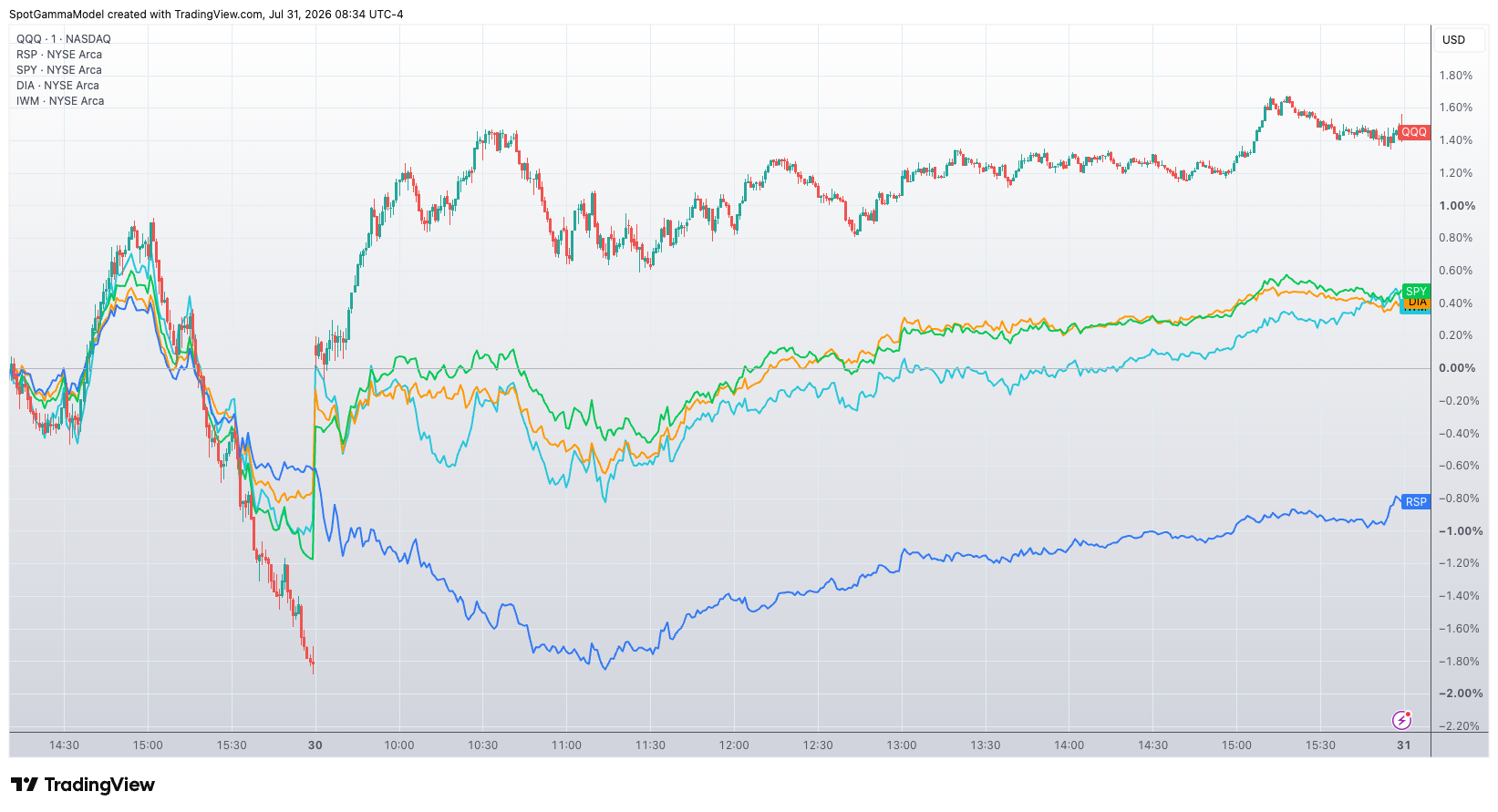
The intraday tape tells the same story in sequence: the cohort based through the evening of July 29 as rumors spread on X, gapped violently at the July 30 open once the block trade hit the news, and the bid has extended straight through the July 31 premarket — SK Hynix, SanDisk, Bloom, and IREN all holding +18–22% from the lows while Nvidia sits near flat and Vertiv is down over the same window. The repricing is persistent, not a one-session squeeze.
The SpotGamma Lens: What This Episode Teaches
First, crowding and concentration are volatility signals before they are performance signals. When a single leveraged fund owns 8% of Core Scientific’s float and 4–5% of several other names in the same theme, those stocks carry structural gap risk that shows up in skew and borrow rates before it shows up in headlines. Second, correlated “hedges” fail exactly when needed: puts on SMH against longs in neoclouds is a beta hedge across very different vol regimes — in a stress event, the high-beta longs crash through the hedge. Third, forced flows are direction-agnostic information: the same dispersion framework we applied to this month’s Mag 7 setup applies here — July’s collapse in implied correlation reversed violently as the AI complex sold off together, and single-name vol in the affected infrastructure names exploded while the fund fought its margin calls.
What to watch from here: whether implied volatility and skew across the high-beta AI-infra cohort — the book names plus peers like CIFR, HUT, and WULF that traded with them — normalize now that the forced seller is gone; how the software shorts trade as Citadel digests the book; and whether this becomes the AI trade’s capitulation marker. Forced liquidations of leveraged, crowded books have historically clustered near local extremes — but “the forced seller is done” and “the fundamental repricing is done” are different statements, and only one of them was settled this morning.
Frequently Asked Questions
What happened to Situational Awareness LP?
After steep July losses in its leveraged AI infrastructure portfolio, the fund faced margin pressure and sold its entire public equities book — long and short positions — in a single block before the market open on July 30, 2026, according to CNBC. The buyer was Citadel, per the Wall Street Journal. The fund retains private holdings, including a stake in Anthropic, and is reportedly seeking fresh capital.
Why did a fund that was up 439% get margin-called?
Leverage and concentration. With gross exposure reportedly as high as 4x and its top five positions making up over three-quarters of its disclosed long book, a ~30%+ July decline across its core holdings was enough to consume the fund’s equity cushion, triggering margin calls despite its extraordinary prior gains.
What did Situational Awareness own?
Its Q1 2026 13F showed .86 billion across 26 concentrated AI-infrastructure positions: Bloom Energy (~23%), SanDisk (~19%), CoreWeave (~14%), IREN (~10%), and Core Scientific (~10%) led the book, followed by miners-turned-datacenters (Applied Digital, Riot, CleanSpark, Bitdeer, HIVE) and power names (Solaris, T1 Energy, Babcock & Wilcox). Reporting adds SK Hynix, a large Nebius stake built after March, reported put exposure of roughly billion notional on SMH and .6 billion on Nvidia, and software shorts including Adobe.
What is a liquidation discount?
The price concession a forced seller accepts to move a large position quickly — and the shadow that forced selling casts over market prices while it is underway. When the seller clears, the discount reprices out: on July 30, the entire high-beta AI-infrastructure cohort jumped 18–28% while the broad market was roughly flat.
Sources
- Wall Street Journal, Citadel buys Situational Awareness’s stock portfolio after big losses in AI
- CNBC, AI investor Leopold Aschenbrenner forced to unwind all public stock positions after steep losses (David Faber reporting)
- Yahoo Finance / CNBC, Situational Awareness sells public equities book following steep losses
- Bloomberg, Situational Awareness seeks capital after loss, FT says
- Situational Awareness LP Form 13F, Q1 2026 (as of 3/31/2026), via Bloomberg equity filing summary
- Blockspace, Situational Awareness sells public equities book: position and put detail
- The Block, IREN, Core Scientific and more surge as fund liquidates portfolio
- Crypto Briefing, Margin-fueled fire sale details
- Capital Brief, AI hedge fund forced to sell assets after chip stock rout
- Tae Kim on X: Faber on AUM and leverage and the block-sale report
- unusual_whales on X, latest 13F position changes
- Financial Times on X, capital raise report
- TBPN on X, video segment on the unwind
- Intraday quotes via stockanalysis.com, July 30, 2026 ≈3 PM ET
Details of the fund’s positions, leverage, and the transaction are drawn from the reporting cited above; figures marked “reportedly” have not been independently verified by SpotGamma. Nothing here is investment advice.