What Are 0DTE Options?
0DTE options are contracts that expire on the same day they are traded, the term is literal and stands for “zero days to expiration.”
Same-day trading now dominates index options volume, with Cboe data showing that 0DTE contracts accounted for 59% of all SPX options volume in 2025. This is an annual record, at an average of 2.3 million contracts per day. 0DTE contracts are now also offered for a select few highly liquid single stock names, such as Apple (AAPL) and Amazon (AMZN).
Because these contracts have only hours left before they expire, 0DTE options can move fast. A small move in the underlying can swing their value sharply, which makes them popular with traders who want to act on a single day’s price action.
The wider market impact of 0DTE’s comes from the way dealers manage the risk of these contracts. Same-day options force a large amount of hedging activity into a single session, and that activity can push the underlying price.
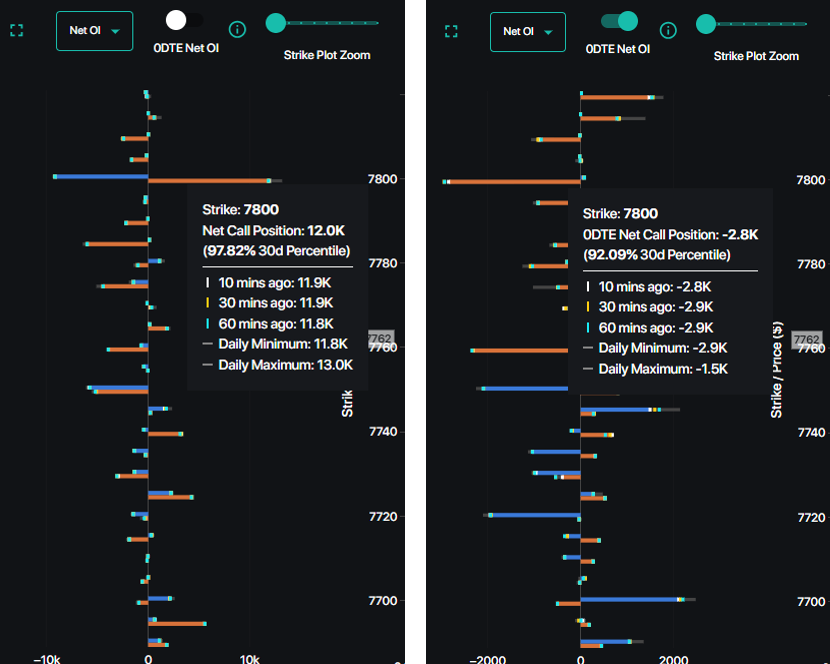
A side by side comparison of Net Open Interest for 0DTE contracts (right), and all expiry contracts (left). The pop up box shows the disparity at the 7800 strike. This image is from SpotGamma’s TRACE.
| Term | What it is | Why it matters |
|---|---|---|
| 0DTE option | A contract on its final day before expiration. | Moves fast and drives intense, fast-changing hedging demand. |
| Options expiration (OPEX) | The point at which a contract settles and its optionality ends. | Removes hedging demand from the board, which can shift how the market behaves. |
| Pinning | Price gravitating toward a heavily traded strike into expiration. | A visible expiration effect, but only when dealers are positioned to hedge counter-trend. |
What Happens at Options Expiration
At expiration, an option’s optionality ends. If the contract finishes in the money, it is exercised or cash settled for its value, and if it finishes out of the money, it expires worthless.
Either outcome removes the contract from the board, along with the dealer hedging demand attached to it. To understand why this matters, it helps to know the different expiration cycles and how often each one occurs.
Monthly Expiration
Monthly expiration falls on the third Friday of each month and has long been the anchor of the options calendar. For decades it was the single most important expiration date, and it still carries the largest concentration of longer-dated open interest.
Open interest is the number of contracts that are currently open and have not yet been closed or have expired. Because so many longer-dated positions are set to expire on the monthly date, a large block of open interest rolls off at once, which can change how the market is positioned heading into the following week.
Quarterly Expiration
Quarterly expirations fall in March, June, September, and December. These dates are often called triple witching, because stock options, index options, and index futures all expire at the same time.
Triple witching dates carry the heaviest open interest of the year and can bring elevated volume and trading activity as large positions are closed or rolled forward.
Weekly Expiration
Weekly options expire on Fridays outside of the monthly and quarterly dates. They were introduced to give traders more frequent, shorter-dated contracts than the monthly cycle allowed.
Daily Expiration
Daily expiration means a set of contracts expires every trading day. This is what makes 0DTE trading possible in the first place, and it now sets the rhythm of the index options market.
Trading 0DTE Options
The reason 0DTE options have such a large effect comes down to one measure, that being gamma.
Firstly, delta measures how much an option’s price is expected to move for every $1 move in the underlying. Gamma then measures how quickly that delta itself changes.
In plain terms, delta is how much the value of the option is moving, and gamma is how quickly that movement is speeding up or slowing down. For the full mechanics of how dealer gamma adds up across the market, see our guide to GEX.
Why Gamma Spikes Into Expiry
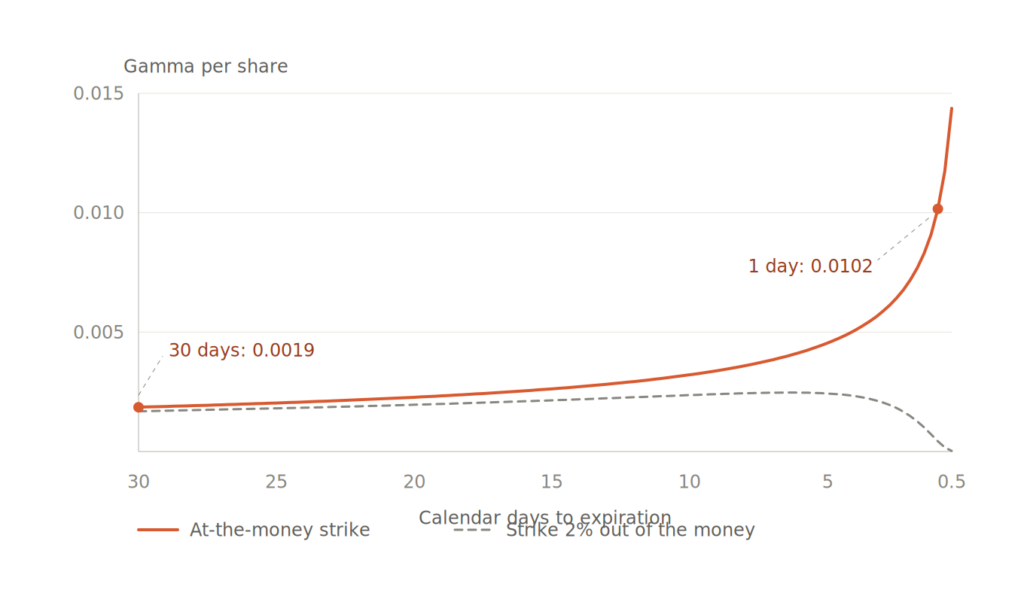
It is important to understand that gamma is not constant across time, it rises sharply as expiration approaches, and the effect is strongest for options that are close to the current price.
Of course, an option with a month left has time for the underlying to move, so its behavior changes gradually. An option expiring in hours has no such buffer, and a small move can flip it from out of the money to in the money, so its sensitivity to price can swing dramatically over a very narrow range.
This explains why same-day contracts are so reactive. On any given day, the options most sensitive to price are the ones expiring that afternoon.
Example: 0DTE Gamma in Action
If we take an option priced at the money on a $5,000 index, with 15% implied volatility. With 30 days to expiration, its gamma is roughly 0.0019 per share.
Shrink the time to a single day and that same gamma rises to roughly 0.0102 per share. That is about five and a half times higher for an otherwise identical contract.
Multiply that across thousands of contracts, and the hedging response required for a 1% move is several times larger for the same-day contract than for the monthly. A small move near a heavily traded 0DTE strike can therefore trigger a hedging response out of proportion to the move itself.
Dealer Positioning and 0DTE GEX
Options Dealers (also called market makers) take the other side of most customer options trades. This leaves them holding risk they do not want, so they buy or sell the underlying to stay balanced. This activity is called hedging, and is responsible for price movements in the underlying. To understand the overall picture on these mechanics, see our guide on Options Dealer Hedging.
Because 0DTE gamma expires at the close, expiration continually rewrites the positioning map for dealers. The gamma governing this afternoon’s hedging is gone by the following morning, and a new set of contracts builds through the next session.
How Dealers Behave in Different Scenarios
A strike with heavy 0DTE activity does not automatically stall price. What happens depends on which side dealers are holding.
When dealers are net long gamma at a strike, their hedging works against the trend. They sell the underlying into rallies toward the level and buy into dips away from it, which can slow, stall, or cap price around the strike.
When dealers are net short gamma, the behavior reverses. They buy into rallies and sell into dips, which tends to push price through the level rather than hold it there.
This is why the same strike can behave in opposite ways on different days.
SpotGamma Tools to Understand 0DTE
0DTE is only one layer of the overall gamma picture. Same-day contracts are the most reactive, but the longer-dated book holds the bulk of open interest and dealer exposure.
Reading 0DTE activity in isolation is one of the most common mistakes traders make with this data. A level that forms at midday may sit beneath a far larger monthly concentration that matters more for the week ahead. SpotGamma recommends establishing the full gamma profile first, before then narrowing to same-day activity.
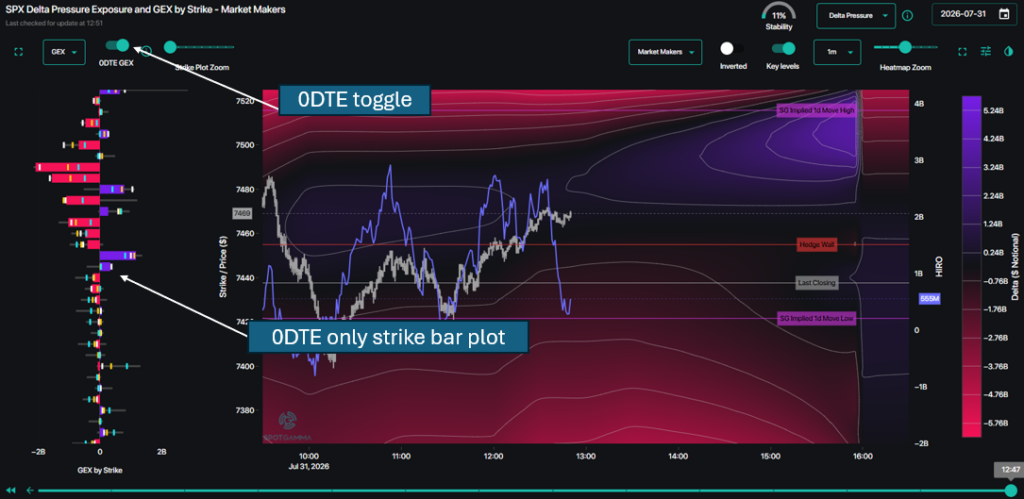
TRACE visualizes SPX dealer positioning with 1-minute updates. A 0DTE toggle and a dedicated 0DTE strike plot isolate same-day gamma from the longer-dated book, so you can see which strikes are accumulating same-day activity and check them against the full book on the same screen.
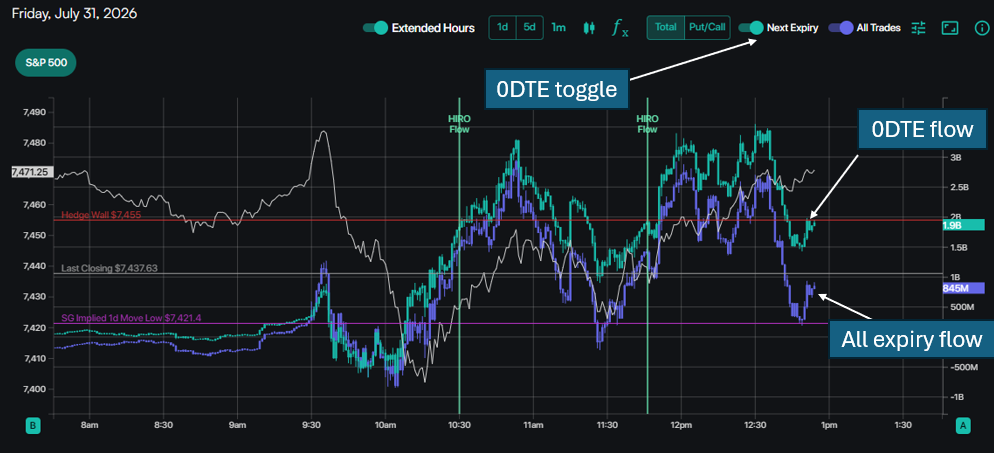
HIRO measures the net delta, or directional exposure, being transferred to dealers in real time. It has both an all-expiry view and a 0DTE-only view, so traders can see the real-time hedging flows for both sets of expirations and confirm whether a level is being defended or broken.
The daily Founder’s Note pulls these readings together, setting out the key levels and positioning context for the session ahead. For many traders it is the fastest way to frame the day before turning to the live tools.
Subscribe to SpotGamma
Every SpotGamma plan includes the Total OI Model and key levels for 3,500+ US stocks, ETFs, and indices, along with the daily Founder’s Note and live options data via Tape. We also support our community with multiple weekly sessions providing market analysis and education, alongside an engaged Discord community.
Essential Membership
For active traders who want the key dealer-positioning levels and daily market structure briefing.
- Daily Founder’s Note (morning and evening)
- Key Levels: Call Wall, Put Wall, Zero Gamma, Volatility Trigger
- SPX/SPY/QQQ/IWM GEX charts
- Equity Hub: Proprietary daily dealer positioning for +3,500 stocks
- Options Calculator
- Education Library
- Tape: real time options prints in +3,500 stocks
- Multiple live training sessions each week
Alpha Membership (Most Popular)
For intraday, options, and futures traders who need the deepest, real-time 0DTE and dealer positioning data.
- Everything in SpotGamma Essential
- TRACE: Intraday SPX hedging heatmaps updated every 1-minute
- 0DTE strike plot and key levels
- Gamma, Delta & Charm Pressure heatmaps
- Synthetic OI Model: Proprietary positioning for 3,500+ names
- HIRO: Real-time hedging impact for options-driven stocks, ETFs, and indices
- Advanced Volatility Dashboard
Same-day expiration reshapes dealer positioning every session, and SpotGamma is built to show you where it concentrates. Trusted by thousands of traders, you can see plans at spotgamma.com/subscribe.
0DTE Options FAQ
What are 0DTE options?
0DTE options are contracts that expire on the same day they are traded. The term stands for “zero days to expiration.” Because they expire within hours, they move fast, which makes them popular for trading a single day’s price action and gives them an outsized effect on the market.
What does 0DTE mean?
It stands for “zero days to expiration.” Any option becomes a 0DTE contract on its final day. Because the major indices and ETFs now expire daily, and a handful of large single stocks expire Monday to Friday, a fresh set of 0DTE contracts exists in every trading session.
Which stocks and indices have 0DTE options?
The major index and ETF products, including SPX, SPY, QQQ, and IWM, have same-day expirations every weekday. A small group of large single stocks, such as TSLA and NVDA, now offer Monday-to-Friday expirations as well, though their same-day volume is far smaller than the index products.
What happens to an option at expiration?
If it finishes in the money, it is exercised or cash settled for its value. If it finishes out of the money, it expires worthless. Either outcome removes the contract from the board, along with the hedging demand attached to it.
What is OPEX?
OPEX is shorthand for options expiration. It usually refers to the monthly third-Friday expiration and the quarterly triple witching dates, when large blocks of open interest roll off at once. Daily expirations spread a smaller version of the same process across every session.
What is the difference between daily, weekly, monthly, and quarterly expiration?
Monthly expiration falls on the third Friday and carries the largest longer-dated open interest. Quarterly expirations, in March, June, September, and December, are triple witching dates with the heaviest open interest of the year. Weekly options expire on other Fridays. Daily expiration means a set of contracts expires every trading day, which is what enables 0DTE trading.
What is gamma, in simple terms?
Delta measures how much an option’s price moves for every $1 move in the underlying. Gamma measures how quickly that delta changes. High gamma means the option’s sensitivity to price is changing rapidly, which forces dealers to adjust their hedges more aggressively.
Why do near-expiry options have the highest gamma?
An option expiring within hours has no time buffer, so a small move can flip it from out of the money to in the money, and its sensitivity to price swings rapidly. Gamma scales with the inverse square root of time to expiry, so cutting 30 days down to one day multiplies it by roughly the square root of 30, regardless of the index level or volatility assumption.
How is 0DTE GEX different from regular GEX?
0DTE GEX isolates the gamma exposure of same-day-expiring contracts. A standard model built from overnight open interest largely cannot see it, because same-day contracts open and expire within one session and are mostly absent from the prior night’s snapshot. Reading 0DTE GEX requires an intraday model.
Should traders only watch 0DTE gamma?
No, and it is a common mistake with this data. Same-day contracts are the most reactive, but the longer-dated book holds the bulk of open interest and dealer exposure. 0DTE shows how reactive the current session is, while the full gamma profile shows the structural conditions around it. Both are needed.
What percentage of SPX volume is 0DTE?
Cboe data show that same-day contracts accounted for 59% of SPX options volume in 2025, a record, at an average of 2.3 million contracts per day.
Do 0DTE options cause volatility?
This is contested. Same-day flow concentrates intraday hedging and can sharpen moves around specific strikes. Research to date has found limited evidence that 0DTE has raised broad market volatility, so the market-wide claim remains unproven.
What is pinning at expiration?
Pinning describes price gravitating toward a heavily traded strike into expiration. It tends to occur when dealers are net long the gamma at that strike, so their hedging pulls price back toward it. If dealers are net short, the same strike can act as an acceleration point instead.
What can 0DTE GEX not tell you?
It cannot predict direction, prove that same-day flow caused a particular move, reveal an individual dealer’s inventory, or guarantee that a level will pin or cap. High 0DTE volume also does not reveal net dealer exposure, because heavy two-way trading can net out to a small position. Volume indicates activity, not the size or direction of the resulting hedging pressure.