A box spread is an options position that combines a bull call spread and a bear put spread on the same two strikes, producing a payoff that is exactly the width of the strikes at expiration — no matter where the underlying goes. Because the terminal value is fixed, a box bought below its width earns the difference as a nearly risk-free return, making it a synthetic zero-coupon bond built from options. It is a financing trade, not a directional one, and it belongs exclusively in European-style, cash-settled index options.
Key Takeaways
- A long box buys a bull call spread and a bear put spread on the same strikes; the combined payoff equals the strike width at expiration at every possible price.
- Bought below that fixed value, the discount is the return — the implied rate on boxes tracks short-term risk-free rates closely.
- Institutions use SPX boxes to lend and borrow: buying a box lends cash at the implied rate; selling one borrows against the options margin.
- American-style single-stock boxes can be destroyed by early assignment. Boxes are safe only in European-style, cash-settled index options like SPX.
How the Box Spread Works
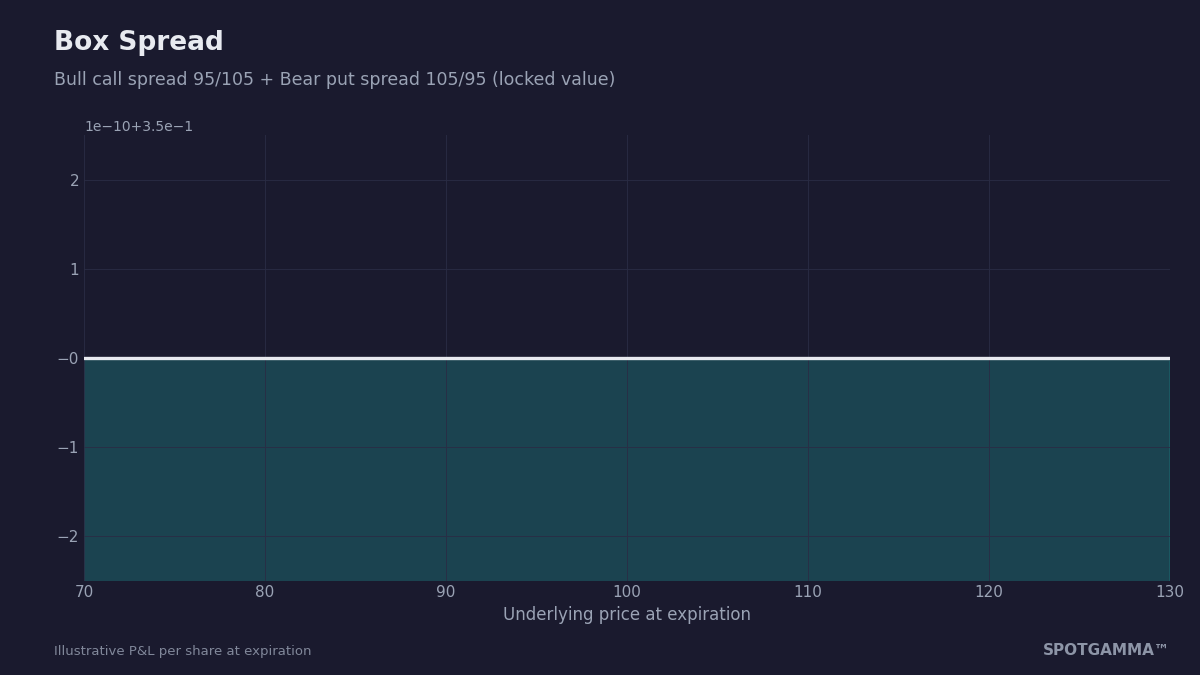
Take two strikes, 95 and 105. The bull call spread (long 95 call, short 105 call) is worth between $0 and $10 at expiration depending on price. The bear put spread (long 105 put, short 95 put) is worth between $10 and $0 over the same range — the exact complement. Add them together and the directional exposure cancels completely: above 105 the call spread is worth $10 and the put spread $0; below 95 the reverse; in between, the two sum to $10 at every price.
So the box is a claim on exactly $10 per share at expiration. Its fair price today is $10 discounted at the prevailing interest rate for the time remaining. If one-year boxes trade at $9.65, the market is lending at roughly the rate that turns $9.65 into $10.00 over the year. That is the entire trade: no delta, no gamma, no vega to speak of — just a rate.
This is why boxes are described as the options market’s bond. Large traders use deep, European-style SPX boxes to park cash (buy the box) or raise it (sell the box) at rates competitive with Treasury bills, with the exchange’s clearinghouse standing behind settlement.
Example
With the stock at $100:
- Buy the 95/105 bull call spread (buy 95 call, sell 105 call).
- Buy the 95/105 bear put spread (buy 105 put, sell 95 put).
- Total paid: $9.65.
At expiration the package is worth exactly $10.00 whether the index finishes at 80, 100, or 130 — the payoff graph is a flat line. The $0.35 difference on $9.65 committed is the return for the holding period. There is no scenario analysis to run; the only questions are the implied rate versus alternatives, and transaction costs. If you want to verify the flat payoff yourself, assemble all four legs in SpotGamma’s free Options Calculator and watch the P&L line go horizontal.
Box Spreads vs. Related Structures
- Vs. vertical spreads: a box is simply two verticals — one in calls, one in puts — whose directional risks are equal and opposite. Each vertical alone is a trade on price; together they are a trade on rates.
- Vs. synthetic stock: both are put-call parity in action. A synthetic long (long call, short put, same strike) reconstructs the stock; a box reconstructs the bond. Parity is the common engine: calls, puts, stock, and cash are interchangeable building blocks.
Using Positioning Data to Trade It Better
A box has no direction, so dealer positioning does not change its payoff — but positioning context still matters for execution and sizing. This post is part of our options strategy library:
- Execute where the liquidity lives. Boxes require filling four legs near fair value. Strikes carrying heavy open interest and dealer gamma exposure (GEX) — the same strikes that show up as the Call Wall and Put Wall — tend to carry the tightest, deepest markets, reducing the slippage that is the main enemy of a thin-margin rate trade.
- The implied rate is the whole trade. Compare the box’s implied yield against T-bills and your broker’s cash rate after commissions on four legs. A box that looks attractive gross can be a loser net.
Risks
- Early assignment is the killer. In American-style single-stock options, the short legs can be assigned before expiration, dismantling the box and leaving naked exposure. This is not theoretical: a retail trader’s 2019 blow-up — selling boxes in American-style options and losing many multiples of the expected “risk-free” profit after assignment — made the lesson famous. Use European-style, cash-settled index options (SPX, XSP) only.
- Transaction costs on four legs. The gross edge is a fraction of the strike width; crossing four bid/ask spreads can consume it entirely.
- A “free money” box on your screen is usually a stale or crossed quote. Mid-market marks on four legs routinely imply phantom arbitrage that disappears when you try to trade it.
- Rate and mark-to-market risk before expiry. The locked value holds at expiration; before then, the box’s market price moves with rates, and a short box is a borrowing whose cost is set at entry.
FAQ
How does a box spread earn a return?
The box’s expiration value is fixed at the strike width, so buying it at a discount earns the difference over the holding period. That discount reflects prevailing short-term interest rates — the box is effectively a zero-coupon bond assembled from options.
Why must box spreads use European-style options?
European-style options cannot be exercised early, so the four legs stay intact until expiration and the locked payoff holds. American-style short legs can be assigned at any time, breaking the structure and exposing the trader to outright directional and dividend risk.
Why is my broker showing free money in a box spread?
Almost always stale or crossed quotes. A box priced off mid-market marks on four separate legs often implies a riskless profit that no counterparty will actually fill. If a genuine mispricing existed in liquid index options, professional arbitrageurs would close it long before a retail order arrived.
This article is for educational purposes only and is not financial advice. Options involve substantial risk and are not suitable for all investors.