A risk reversal is an options strategy that sells an out-of-the-money put to finance the purchase of an out-of-the-money call (bullish version), or sells a call to finance a put (bearish version), usually for close to zero net cost. The position delivers stock-like gains if the underlying rallies through the call strike and stock-like losses if it falls through the put strike, with a flat zone in between. Because equity put premium typically trades richer than call premium, the bullish structure is often financed by the very downside fear it is fading.
Key Takeaways
- A bullish risk reversal sells an OTM put and buys an OTM call; between the strikes at expiration, both expire worthless and only the small credit or debit remains.
- The trade monetizes skew: in equities, downside puts usually carry more implied volatility than upside calls, so selling the put can fully pay for the call.
- Upside participation is uncapped above the call strike; downside exposure below the put strike is equivalent to owning stock from that level.
- It is a capital-efficient directional expression — but the short put means real, stock-like risk, not a defined-risk trade.
How the Risk Reversal Works
Every equity options chain carries a volatility skew: strikes below the market are typically priced on higher implied volatility than strikes above it, because the natural flow in equities is downside hedging. A risk reversal is the cleanest way to trade that asymmetry while expressing a direction.
In the bullish version you are a seller of the expensive thing (the downside put) and a buyer of the cheap thing (the upside call). When skew is steep, the put premium covers the call entirely — you take on long exposure for no outlay, and sometimes a credit. The position’s delta is modest at entry but grows as the stock approaches either strike: toward the call, you pick up the winner’s delta; toward the put, the loser’s.
The flat zone between the strikes is worth understanding. If the stock drifts sideways and expires between 95 and 105, both legs expire worthless. You keep the small credit, having risked real downside for a near-zero result — the opportunity cost of the structure versus simply owning shares.
Example
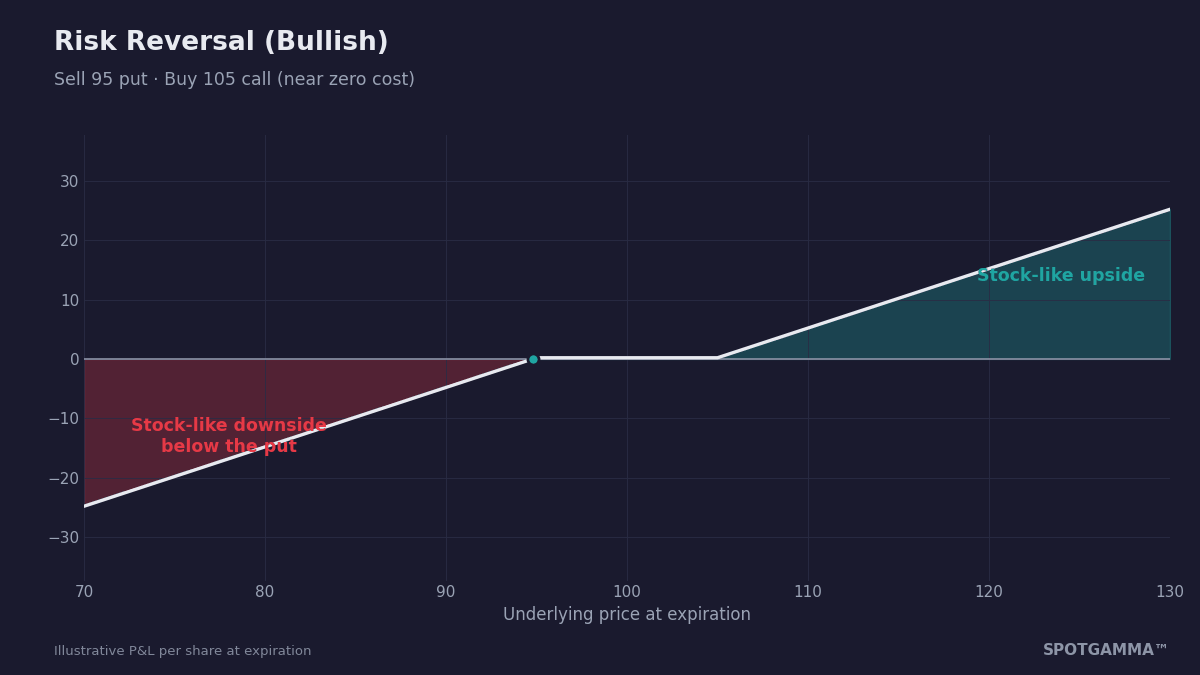
With the stock at $100:
- Sell 1× the 95 put.
- Buy 1× the 105 call.
- Net credit: $0.20 — the richer put slightly out-earns the call.
The outcomes at expiration:
- Above 105: the call delivers point-for-point gains, like stock bought at 105 (less nothing — the trade cost you a negative $0.20).
- Between 95 and 105: both options expire worthless; you keep the $20 credit.
- Below 95: the short put puts stock to you at 95; losses track the shares point-for-point from there.
Model the structure at your actual strikes in SpotGamma’s free Options Calculator — it makes the flat zone and the two stock-like tails easy to see before you commit margin to the short put.
Risk Reversal vs. Synthetics, Collars, and Jade Lizards
- Vs. synthetic long stock: the synthetic uses the same strike for both legs and mirrors shares exactly. The risk reversal splits the strikes apart, creating the flat middle zone and typically a better financing rate from skew.
- Vs. the collar: the same two option legs with the opposite intent — a collar wraps them around existing stock to cap risk, while the risk reversal stands alone to create exposure.
- Vs. the jade lizard: both sell a downside put, but the lizard sells a call spread above rather than buying a call — income with no upside risk versus direction with uncapped upside.
Using Positioning Data to Trade It Better
A risk reversal is two decisions — where to sell the put, and whether the financing is attractive. Positioning data informs both. This post is part of our options strategy library:
- Sell the put at structural support. A bullish risk reversal with its short put at or below the Put Wall places the obligation at the strike where concentrated put gamma has historically slowed declines — dealer hedging there mechanically leans against further selling, supporting the level you need to hold.
- Check skew before entry. The trade’s financing comes from put richness. When skew is steep relative to its own history, the put you sell is at its most expensive versus the call you buy; when skew is flat, the zero-cost construction may not be there and the structure loses its edge.
- Mind the gamma regime on the downside tail. In negative gamma (GEX) regimes, dealer hedging amplifies selloffs — exactly the tape that takes price through your short put fast. The short-put leg is most comfortable in positive-gamma conditions where moves are dampened.
Risks
- Full downside below the put strike. This is not a defined-risk trade: below 95 the position loses like stock, all the way down, on margin.
- Zero cost is not zero risk. The absence of a debit can disguise the fact that you have sold a naked put; size it like the share exposure it can become.
- Assignment. The short put can be assigned early once in-the-money, converting the position into long shares plus a call — fine if intended, startling if not.
- Vega and skew shifts. A volatility spike marks the short put against you faster than the long call helps, even before price breaks the strike.
FAQ
What does a risk reversal position express?
A directional view financed by skew. The bullish version profits from a rally through the call strike and is indifferent to modest chop, in exchange for accepting stock-like losses below the put strike — essentially a commitment to buy the dip at 95 that pays for upside participation above 105.
Why can risk reversals be put on for zero cost?
Because equity index and single-stock skew usually prices downside puts on higher implied volatility than equidistant upside calls. Selling the richer put funds the cheaper call; when skew is steep enough, the package nets to zero or a small credit.
What is the margin requirement like?
The short put is margined like any naked put — brokers typically require a meaningful percentage of the strike value, far more than the trade’s net cost. Capital efficiency versus stock is real but comes from margin treatment, not from the absence of risk.
This article is for educational purposes only and is not financial advice. Options involve substantial risk and are not suitable for all investors.