Brent Kochuba, founder of SpotGamma, joined CNBC Thursday morning to cover three positioning stories: the SpaceX share unlock with potential upside resistance, a volatility cycle turning over, and what the options market expected from Walmart earnings.
The SpaceX Unlock: Shares Come On the Market, Not Into Existence
Roughly 300 million SpaceX shares came on the market Thursday. A far larger tranche cleared on August 6 — 911.5 million shares, about 43% more than the 638.9 million floated at the June IPO.
None of that stock is new. No new shares were created, and there is therefore no dilution as a result — existing holders simply gained the right to sell shares they already owned.
This distinction matters because several previews framed the unlock as dilutive and treated the large supply as an automatic drag. Shares closed at $108.27 before the August 6 unlock, well under the $135 IPO price, before price actually increased 6% on the unlock itself. By August 10 the stock closed back above $135 for the first time in weeks.
Why the Supply Has Not Pressured Price Yet
Legal eligibility and actual availability run on different clocks. Many SpaceX holders own through stacked special purpose vehicles, four or five layers deep, and each layer needs roughly 30 days to distribute. Technical rules and corporate trading windows can add more delay.
Seventeen separate tranches run into mid-2027, and Elon Musk’s 6.4 billion shares stay locked until June 2027. The overhang schedule remains notable, yet the supply headlines are just one piece of the puzzle when analyzing SPCX.
The $150 SPCX Ceiling: Significant Call Selling Above Spot
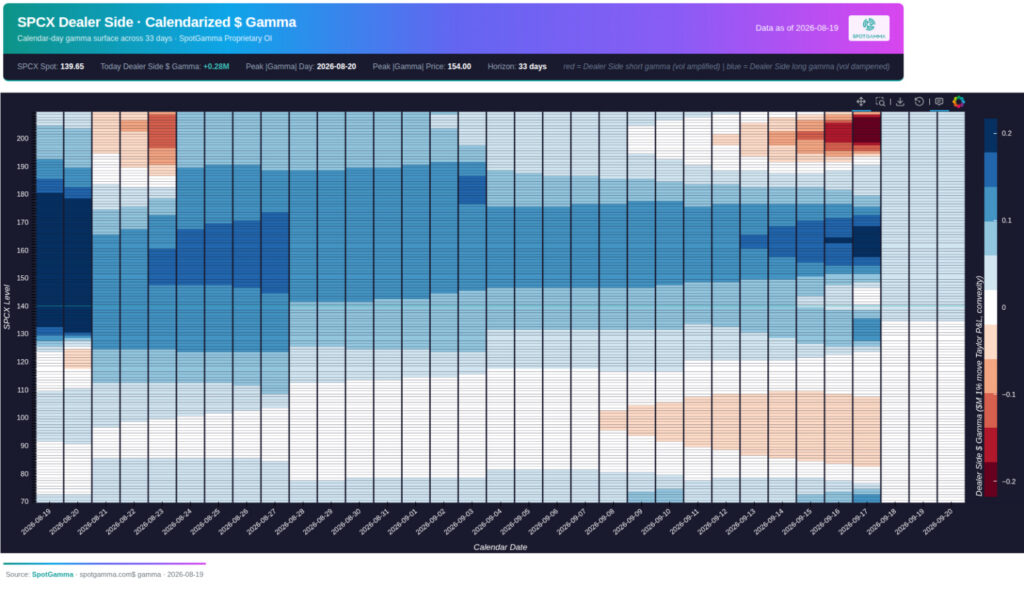
The binding constraint sits higher, and the options market shows why. SPCX traders have been selling calls at and above spot while buying puts below, leaving dealers with positive gamma above the current price and negative gamma below. Positive dealer gamma generally dampens realized movement and firms resistance at the strikes carrying those calls.
SpotGamma flagged resistance near 120 in early August. Traders then capitalized on the rich call skew at higher strikes, which established positive dealer gamma with $150 becoming the new ceiling. SpaceX stock touched $150 on heavy call selling in mid-August before closing last week at $140.
Volatility: Suppression Rolls Off Into a Dense Calendar Ahead
Index positioning transitioned meaningfully over this past week as roughly 42% of total VIX contracts expired Wednesday. The 16 strike held the largest near-spot open interest as VIX approached 15.5. Traders selling volatility into a VIX expiration can keep index movement down, and the unwind of this volatility selling can expand volatility.
The OPEX cycle can be considered the options market breathing in and out again. Friday’s monthly expiration clears a second layer of options positioning for SPX and single stocks.
Next week supplies several potential market catalysts. Core PCE lands Wednesday morning, Nvidia reports after Wednesday’s close, and Jackson Hole runs August 27 through 29. Notable, the volatility-suppressing positions expire before these events arrive. As a result, next week could make for interesting movement in the markets as traders carefully analyze any new information that hits the tape.
Catch Brent’s full CNBC segment from this morning here.