Two senior executives make substantial purchases amid an AI infrastructure selloff, while options positioning points to an intriguing potential recovery setup.
Insider buying can offer valuable clues about management’s confidence, particularly when purchases involve millions of dollars during periods of market weakness.
That’s exactly what happened at Applied Digital (NASDAQ: APLD), where CEO Wes Cummins and President Jason Gechen Zhang collectively purchased approximately $6.66 million in company shares on October 16, 2026.
The timing is notable. APLD has been caught in a broader pullback across AI infrastructure stocks as investors question aggressive capital expenditures, financing costs, and the sustainability of the AI spending boom.
Yet two executives closest to the business are putting substantial personal capital to work.
1. Breaking Down the Insider Purchases
According to SEC Form 4 filings submitted October 19, both executives made purchases classified as open-market transactions rather than option exercises or compensation awards.
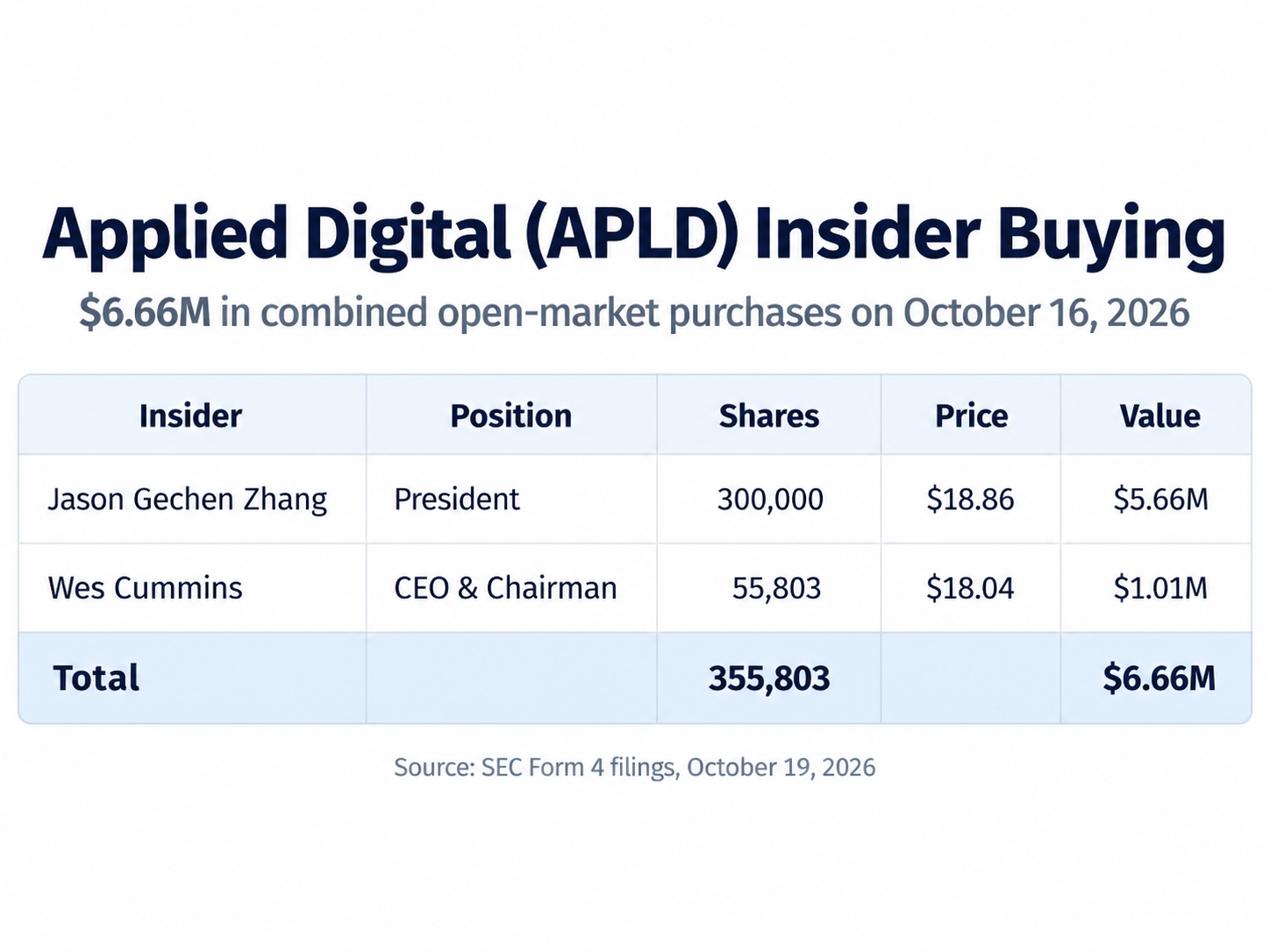
Zhang’s purchase increased his reported holdings approximately 12%, while Cummins added another $1 million to his already substantial ownership position.
Unlike insider selling, which can happen for numerous reasons, voluntary open-market buying generally carries a more straightforward message: management sees value in owning additional shares.
While insider purchases don’t guarantee a bottom, the combination of two executives buying on the same day makes this a meaningful development worth monitoring.
2. The Bullish Thesis: Billions in Contracted AI Demand
Applied Digital is building data-center infrastructure designed to support high-performance computing and artificial intelligence workloads.
Its growth story increasingly revolves around securing power capacity, constructing specialized facilities, and leasing that infrastructure to hyperscale customers.
And importantly, the company already has substantial contracted demand.
In its October earnings release, Applied Digital reported:
- $36 billion in contracted base-term revenue across HPC hosting leases.
- 1.41 gigawatts of critical IT load under lease across five campuses.
- $341.9 million in fiscal Q1 revenue, up 322% year over year, but the company’s HPC hosting segment included $183.5 million in tenant fit-out services versus $65.8 million in base rental revenue.
- $64.4 million in adjusted EBITDA.
These figures highlight a company transitioning from an infrastructure development story into one with increasingly visible long-term revenue.
However, contracted revenue is not the same as realized profit. Applied Digital must still construct and deliver facilities efficiently while managing considerable financing requirements.
The opportunity is substantial, but execution remains critical. The company also reported $6.4 billion in debt and $3.7 billion in cash, cash equivalents, and restricted cash as of August 31.
3. What Does the Options Market Tell Us?
Because APLD options can carry substantial implied volatility, traders should also evaluate premium costs before pursuing directional exposure.
Options Positioning: Negative Gamma Raises the Stakes
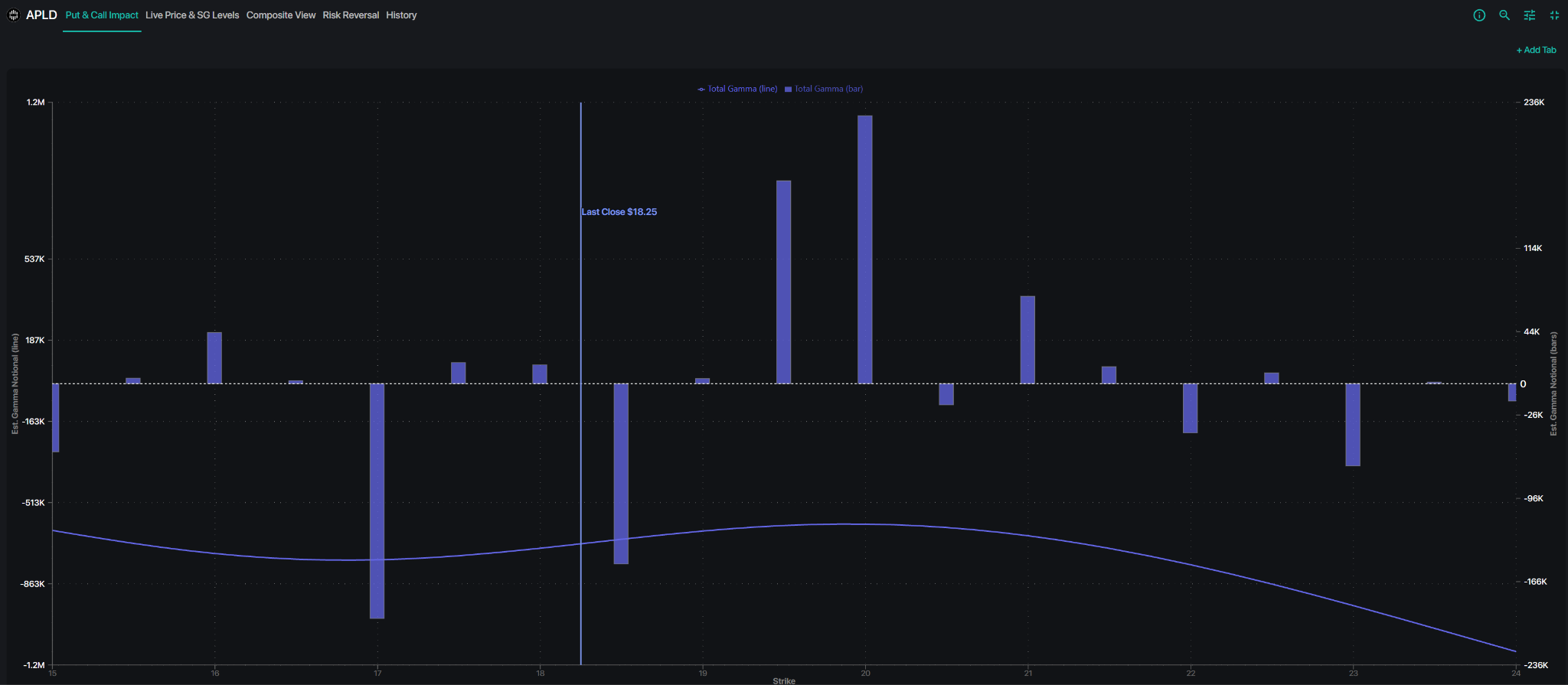
SpotGamma’s updated Synthetic Open Interest gamma map reveals a notable shift in APLD’s options positioning. With shares closing near $18.25, aggregate dealer gamma estimates have turned negative across the displayed strike range, suggesting hedging flows could amplify price movements rather than stabilize them.
On the downside, sizable negative gamma concentrations around $17 and $18.50 highlight the potential for increased selling pressure if shares continue weakening. Conversely, substantial positive strike-level gamma around $19.50-$20, with additional exposure near $21, may provide localized stabilization or resistance during a recovery.
For bullish traders, reclaiming $19.50-$20 becomes an important hurdle. A sustained breakout, supported by fresh call buying, could accelerate upside in the broader negative-gamma environment. However, failure to recover that area leaves APLD vulnerable to additional volatility.
With insiders recently purchasing nearly $6.7 million in shares around $18-$19, the contrast between management’s conviction and increasingly fragile options positioning creates an intriguing potential reversal setup.
Volatility Skew: Both Tail Risks Remain Expensive
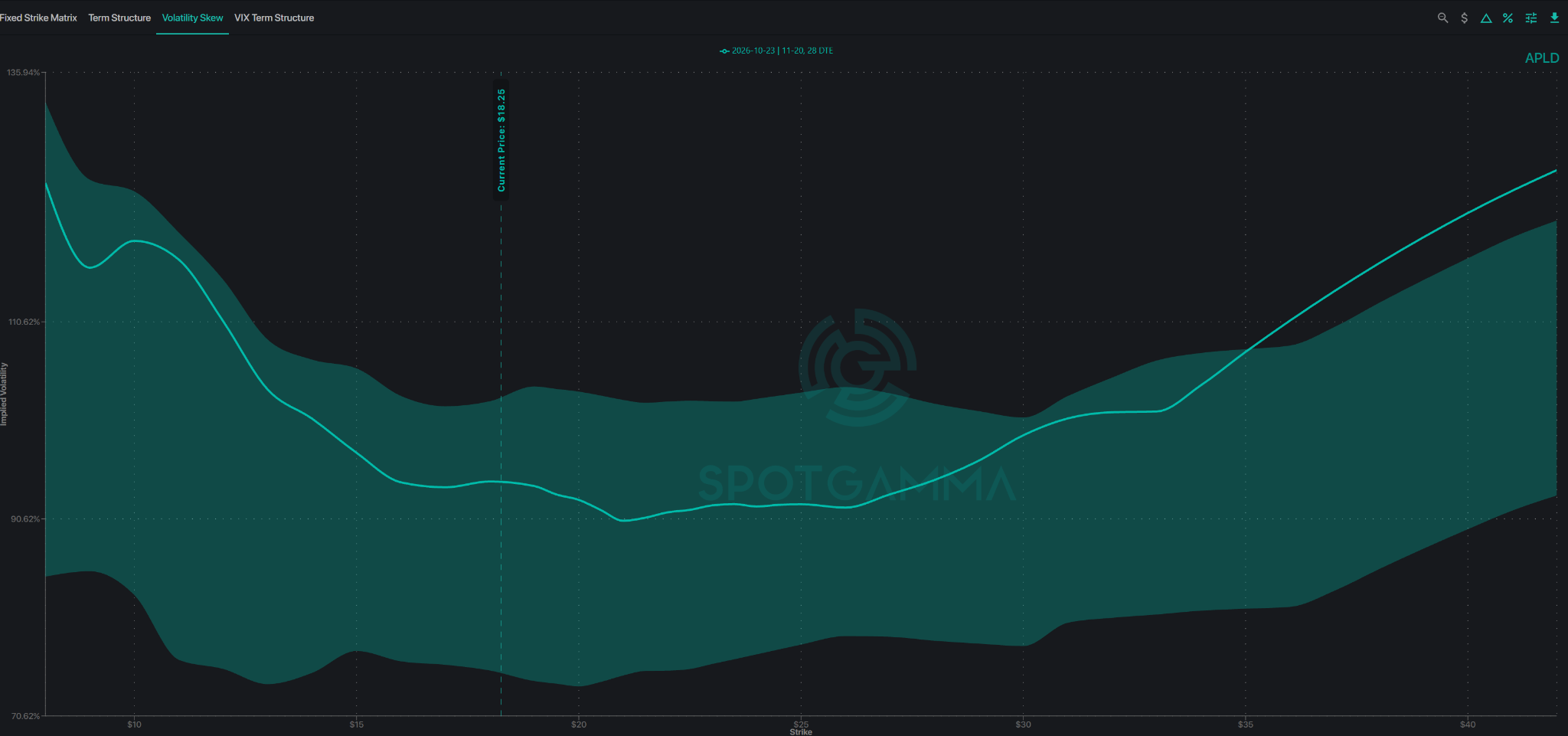
APLD’s updated November 20 volatility skew continues to display a pronounced volatility smile, with implied volatility elevated across both downside puts and far-out-of-the-money calls.
Despite the recent decline in shares to $18.25, the skew structure remains largely unchanged. Downside protection continues to command significant premiums, while upside volatility also rises sharply beyond the $30-$35 strikes, highlighting the market’s expectations for potentially substantial price swings in either direction.
Interestingly, implied volatility remains relatively lower around the $20-$25 strikes. Combined with SpotGamma’s updated negative-gamma positioning, this creates an environment where directional moves could accelerate if shares break out of their current trading range.
For bullish traders, defined-risk call spreads may offer a more capital-efficient alternative to outright calls, particularly when higher-strike options carry richer implied volatility.
The takeaway: Insider buying supports the bullish fundamental narrative, but the options market continues to price considerable two-sided risk rather than a confirmed bullish reversal.
Buying outright calls at approximately 90–95% IV requires a fairly substantial move to overcome the premium paid.
One potential structure worth evaluating would be a November $20-$25 call debit spread, rather than a far-OTM outright call. The $20 strike sits near a major gamma concentration, while the $25 strike offers a defined upside objective. Whether the spread provides attractive value depends on the net debit, breakeven, and potential return relative to the probability of reaching that level before expiration.
4. What Catalysts Could Drive APLD Higher?
Several developments could help restore investor confidence over the coming months.
Additional capacity coming online: Applied Digital expects initial operations at Polaris Forge 2 to help lift delivered critical IT load across its North Dakota campuses to approximately 300 MW by year-end 2026.
New hyperscaler agreements: Additional long-term leases could strengthen revenue visibility and reinforce demand for the company’s AI infrastructure.
Improving financial performance: Investors will be watching for contracted capacity to translate into recurring revenue, stronger cash flow, and improving margins.
The broader AI infrastructure sector also remains sensitive to shifts in market sentiment. If concerns surrounding financing and capital expenditures ease, heavily sold infrastructure names could experience sharp recoveries.
5. The Bottom Line: Insider Conviction Meets a Negative-Gamma Setup
With nearly $6.7 million in recent insider purchases, $36 billion in contracted base-term revenue, and an expanding AI infrastructure business, APLD presents an intriguing potential recovery opportunity.
However, SpotGamma’s updated Synthetic Open Interest map now shows negative aggregate dealer gamma across the displayed strike range, suggesting that hedging flows could amplify price movements in either direction. Meanwhile, elevated implied volatility across both wings of the options skew reinforces the market’s expectations for substantial two-sided risk.
For bullish traders, the $18-$19 region where executives purchased shares remains an important reference area. A sustained recovery above $19.50-$20, supported by strengthening call demand, could create conditions for accelerating upside momentum. Conversely, continued weakness below $18 raises the possibility of a sharper decline toward $17.
Insider buying doesn’t guarantee a bottom, but the combination of executive conviction, substantial contracted AI demand, and increasingly sensitive options positioning makes APLD a compelling stock to monitor for a potential bullish reversal.