 August 6th, 2026
Strategy (MSTR) filed an 8-K Monday morning lifting its USD reserve another $250 million to $4.0 billion — funded under a framework that monetizes bitcoin — while repurchasing $81 million of its STRC preferred stock.
Read that sentence again: the company that spent five years converting every available dollar of capital-markets demand into bitcoin is now converting bitcoin into dollars to retire its own securities.
In July it sold BTC for the first time in its history — 3,588 coins at an average of $60,197, against a remaining cost basis of $75,476 — and it has bought none since.
The question everyone asks is “why is Saylor selling?” We think the options market answered it months ago, and the answer is written across MSTR’s volatility surface: the machine ran on call skew, and the call skew is gone.
The Trade Underneath the Treasury
Strategy was never just a leveraged bitcoin holder. Structurally, Strategy was also massively short its own upside volatility — and that upside volatility short was the funding engine for its massive Bitcoin purchases. Every financing channel the company used was, at bottom, a sale of MSTR upside optionality at extraordinarily rich prices.
A thirty-second primer before the mechanics. A convertible note is a loan with a lottery ticket stapled to it: investors lend the company cash at little or no interest, and in exchange get the right to swap the bond for MSTR common shares at a preset conversion price set well above where the stock trades at issuance. If MSTR rallies through that price, the bond converts into stock and the lender rides the upside; if it never gets there, they’re left holding a low-coupon IOU with a maturity date. Preferred stock is a different animal: a share class that pays a fixed cash dividend in perpetuity, ranks ahead of common shareholders (but behind bondholders) if things go wrong, and — in most of Strategy’s versions — never converts into anything. One sells its buyer a claim on MSTR’s upside. The other just promises cash, month after month, forever. Keep that distinction in mind, because the story of this company is the migration from the first instrument to the second:
The convertible notes, more than $8.2 billion issued from 2020 through early 2025, at coupons of 0% to 2.25%, were bonds stapled to out-of-the-money calls on MSTR. With implied volatility running at 80–150% and a steep call wing, that embedded option was worth so much that convert-arb buyers accepted zero coupons for it.
Interestingly, how does one hedge these zero coupon convertible bonds? Mechanically these convert-arb positions are long the embedded call feature of the bond vs a short stock hedge. That hedge is dynamically adjusted by selling further stock into rallies, structurally smashing the upside volatility that Strategy was seeking to monetize.
Strategy was selling calls on itself at some of the highest vol marks in large-cap history, and using the proceeds to buy bitcoin. The ATM equity programs monetized the mNAV premium (MSTR equity value/its BTC holdings value) is worth — at 2x net asset value, every share sold bought two shares’ worth of bitcoin, and that premium was itself an upside-volatility claim: the market paying today for the reflexive convexity of tomorrow.
Sell optionality, buy bitcoin, watch bitcoin lift MSTR more than one-for-one, which validated the volatility, which let you sell more optionality. The loop worked as long as one input stayed rich: the market’s willingness to pay up for MSTR’s upside.
The Coupon Ladder Traces the Skew’s Death
Strategy stopped issuing convertible bonds in early 2025 and replaced them with an escalating series of preferred stocks. Each new preferred security contained less optionality and paid more cash, which is exactly what you’d expect if the value of MSTR’s upside volatility was draining away in real time:
| Instrument | Era | Cost of Capital | Option Content | What It Sells |
|---|---|---|---|---|
| Convertible notes | 2020 – early 2025 | 0% – 2.25% | Embedded OTM calls on MSTR | The right tail |
| STRK | Jan 2025 | 8% cumulative | Convertible (10:1) — a distant call | Tail + credit |
| STRF | Mar 2025 | 10% cumulative (18% penalty rate if missed) | None | Senior credit |
| STRD | Jun 2025 | 10% non-cumulative | None | Junior credit |
| STRC | Jul 2025 | Variable monthly — whatever defends $100 (now 12%) | None | Pure credit, price-pegged |
| STRE | Late 2025 | 10%, euro-denominated | None | Credit, new buyer base |
Why did the converts stop?
Three reasons, all of which relate to upside volatility.
First, the old converts busted: their conversion strikes sit multiples above today’s share price, so the embedded calls Strategy sold are near-worthless and the $8.2 billion of notes now trade as straight credit with real maturity dates — a refinancing wall beginning in 2028 that the USD reserve build is partly about. A convert buyer burned once doesn’t pay up for the next embedded call.
Second, the option was worth less each month: as the call skew flattened and the mNAV premium compressed, the embedded call in any new convert priced smaller, meaning a new issue would have needed a real coupon — defeating the entire magic of 0% money.
Third, maturities are a liability when the machine slows: perpetual preferreds never come due, so the pivot to preferred traded refinancing risk for a permanent dividend burden.
The preferred parade that followed is the skew decay made visible. STRK (January 2025) still clung to a conversion feature — one last partial sale of the right tail — and priced at 8%. Two months later STRF dropped the option entirely and paid 10%. STRD followed at 10% non-cumulative and junior. Then STRC, the purest expression of the new regime: a variable-rate instrument whose monthly dividend is administratively adjusted to hold the price near $100 — a corporate liability engineered to impersonate a money-market fund. The elegance cuts both ways: whatever rate it takes to defend the peg is, by construction, the market’s live read on Strategy’s credit. That rate was ~9% at launch, 11.5% by spring, and 12% as of July 1.
The coupon ladder — 0% → 8% → 10% → 12% — is the inverse of the call skew: as the market’s willingness to pay for MSTR’s upside collapsed, the cash Strategy had to pay for capital rose to replace it.
In essence, the company has transitioned from selling volatility to selling credit — about $7.7 billion of it across the preferred stack — and today it’s buying that credit back at a discount with the proceeds of bitcoin sales.
What the Volatility Surface Says Now
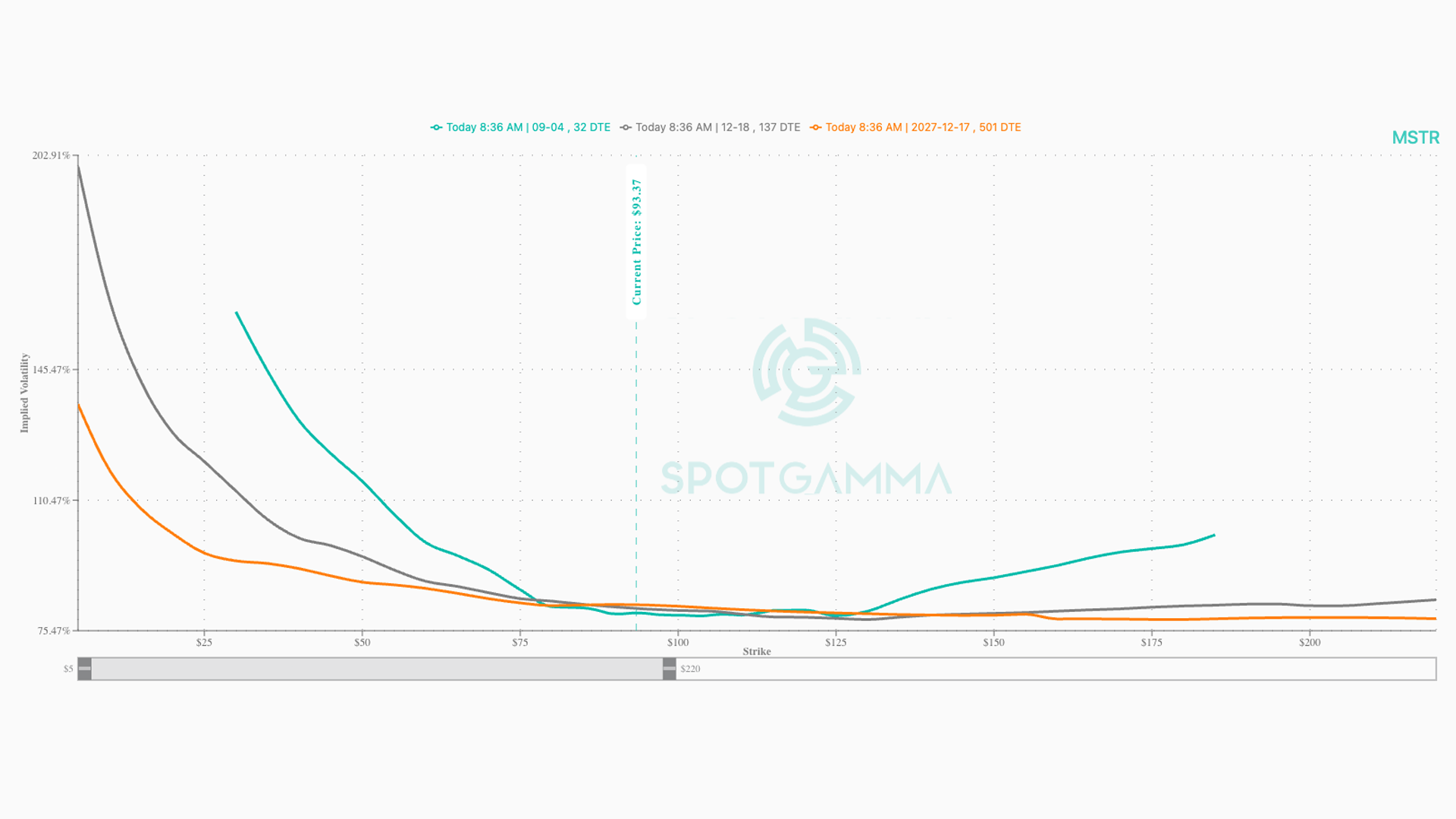
Here is MSTR’s implied volatility skew today — 32-day, 137-day, and 501-day tenors:
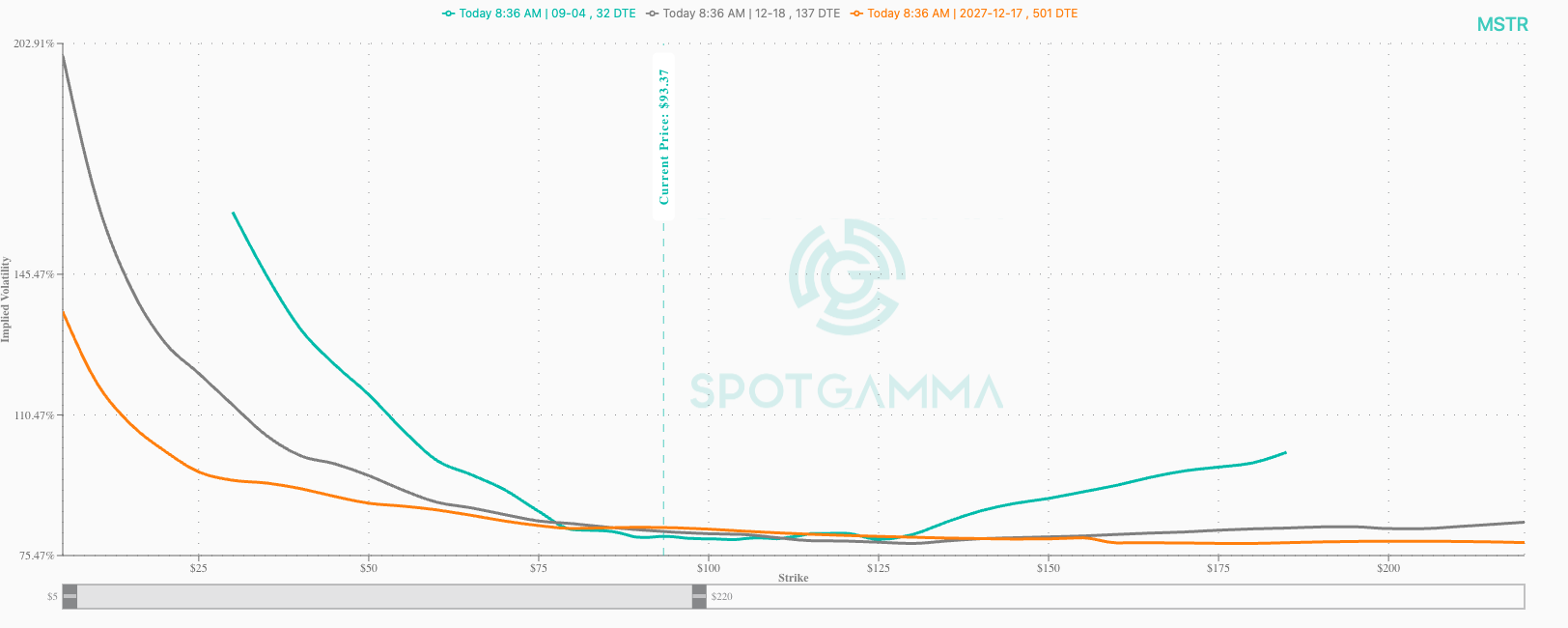
The short-dated line still carries a violent put wing — roughly 160% vol at deep downside strikes against high-70s at the money, the signature of a market pricing gap risk lower. But look at the upside, and especially at the longer tenors. From the spot price out to $220, the 137-day and 501-day curves are dead flat in the mid-to-high 70s. There is no call skew. None. For a stock whose entire capital-markets identity was upside convexity, the market now prices its long-dated upside at the same volatility as its at-the-money — the options market’s way of saying it no longer believes in the right tail.
It helps to see what died. Here’s the same surface in September 2023, which is as far back as our skew data goes:
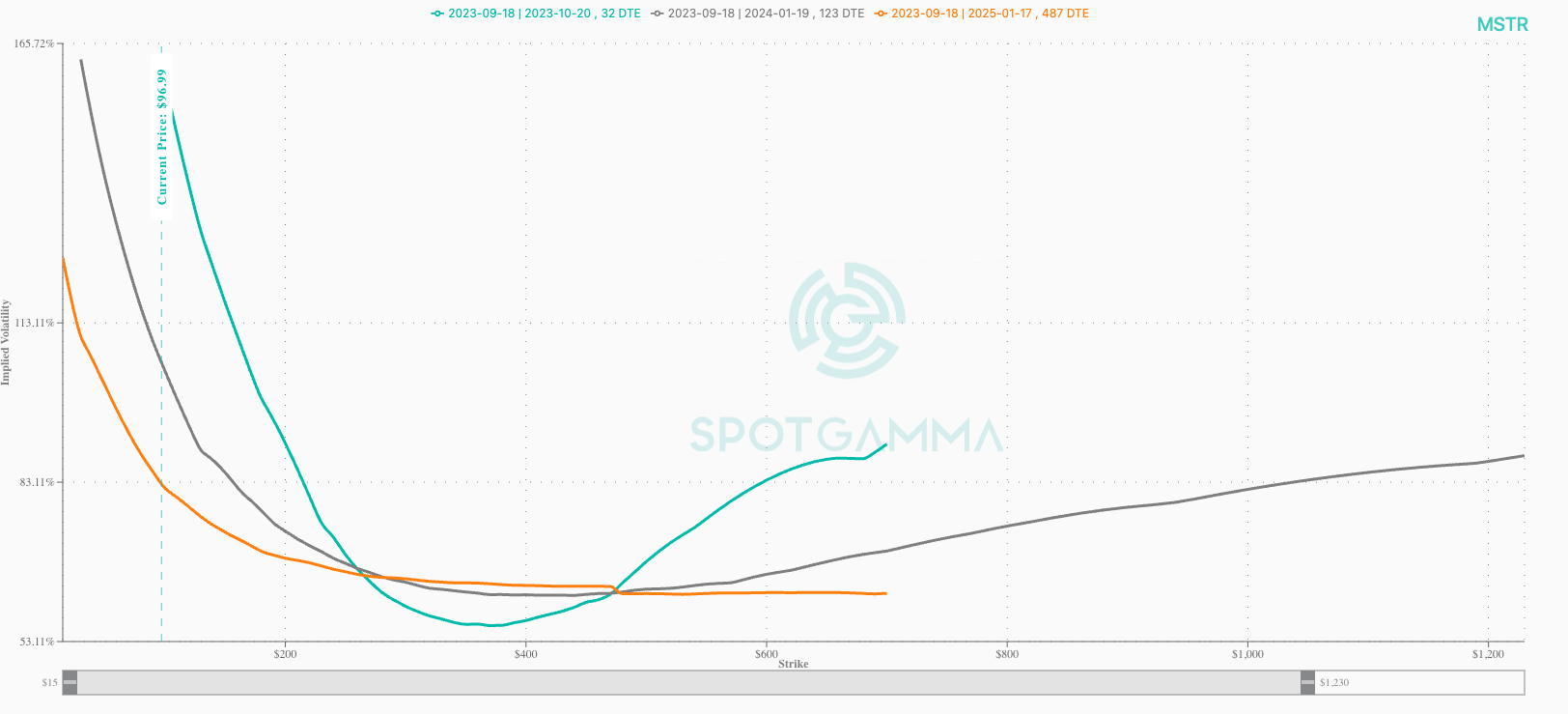
The stock traded within a few dollars of where it trades today — $96.99 then, $93.37 now — and yet the surface is unrecognizable. In 2023 the 32-day and 123-day upside wings climbed out of the mid-50s at the vol trough to nearly 90% at deep out-of-the-money strikes: a market paying up, persistently, for calls struck at multiples of spot.
Today the long-dated skews are dead flat. The right tail was repriced as it is what Strategy sold for five years at 0% coupons, and this snapshot predates the 2024 issuance wave that drove it to its extremes.
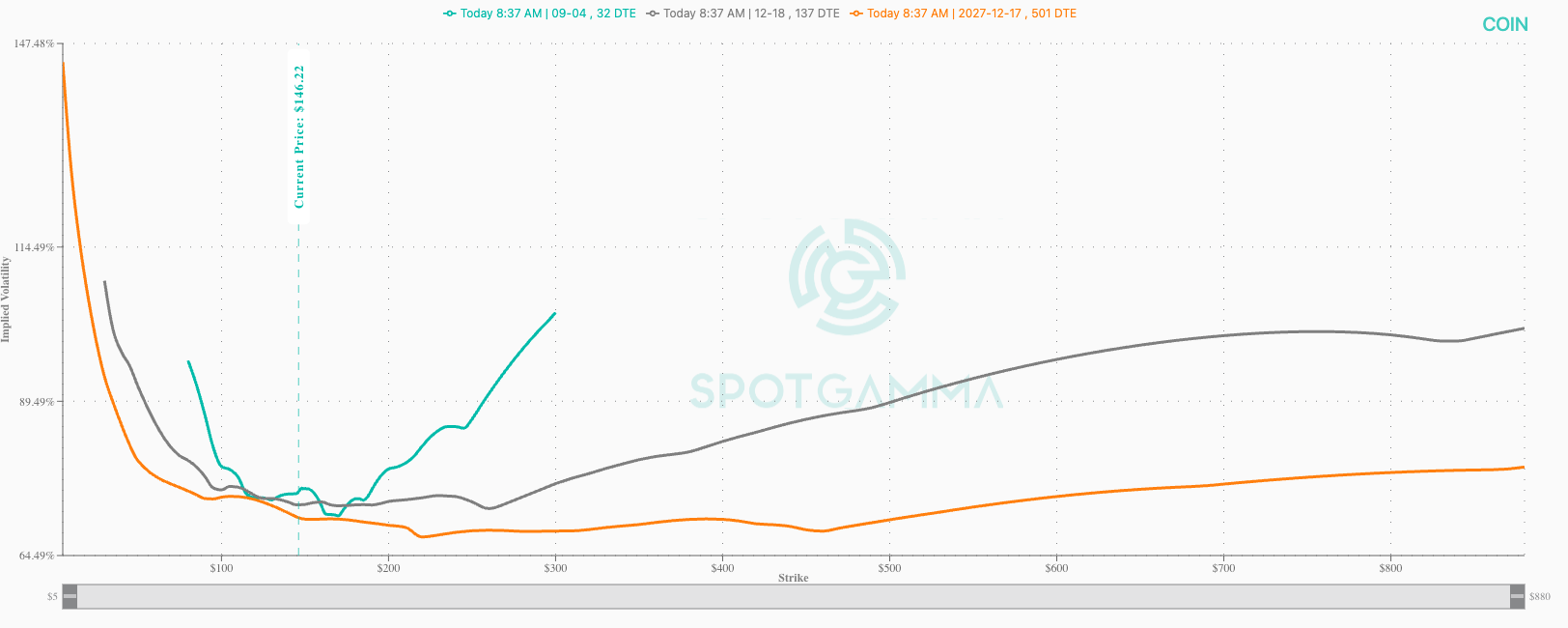
Now compare the rest of the crypto-equity complex, same tenors, same morning:
Coinbase retains a steep, persistent call wing at every tenor — short-dated upside strikes trade 30 vol points over the money.
Circle’s surface is a full smile with a violent upside wing. SPY shows the textbook index put skew it always shows.
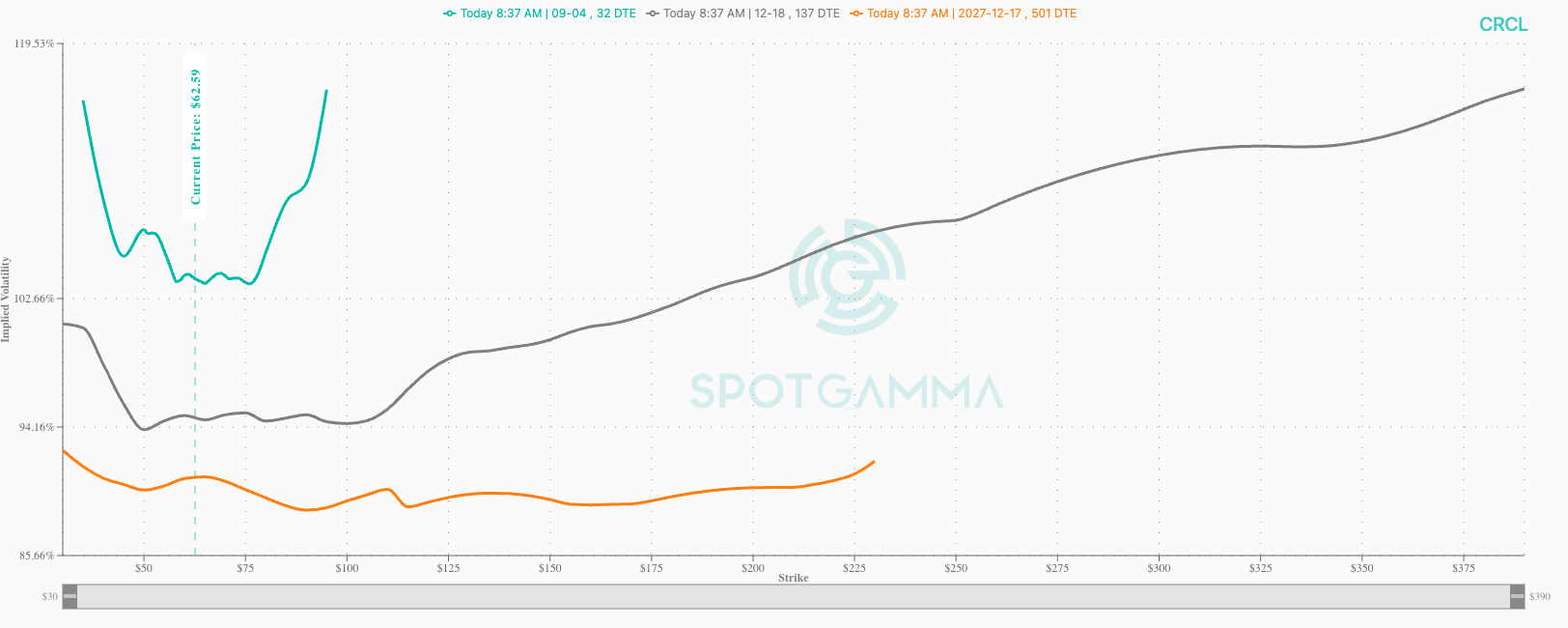
MSTR is the outlier — and it’s the outlier in the most damning direction possible. The one company whose business model was selling its own upside volatility is the one with no upside volatility left to sell.
How the Skew Died
This wasn’t one event; it was the trade consuming itself. First, supply: every convert and convertible preferred Strategy issued translated to sold calls into the market, and the arb funds who bought that paper hedged it by trading — and overwriting — MSTR options and shares. Years of that flow are a permanent, structural seller of MSTR upside vol. Dealers and funds accumulated warehouses of MSTR optionality that they recycle into the listed market every time vol ticks up. Second, the premium died: as bitcoin traded near $60,000 and MSTR compressed toward (and through) 1x mNAV, the reflexive story — issue high, buy BTC, NAV accretes — stopped working arithmetically.
A stock at or below NAV has no accretive equity to sell, and without accretive issuance there is no incremental BTC bid, and without the BTC bid there is no convexity story for the right tail. The call skew wasn’t killed by sentiment; it was killed by the disappearance of the mechanism that justified it.
Third, the regime flipped: a company managing a $1.76 billion annual preferred dividend and interest load against a depreciating collateral base trades like credit, not like a call option — and credit has put skew, not call skew. The 32-day put wing at 160% and the flat long-dated upside are exactly what a distressed-credit vol surface looks like.
The Machine in Reverse
Once you see the vol surface, every announcement in the last five weeks reads as a single coherent story. On June 29, Strategy adopted its “Digital Credit Capital Framework” — the first authorization in company history to sell bitcoin: up to $1.25 billion to build the USD reserve, plus up to $1 billion for repurchases of its Digital Credit securities and up to $1 billion for common buybacks, with the reserve required to cover at least 12 months of preferred obligations.
STRC’s dividend was hiked to 12% to defend its $100 peg. In early July came the first sale: 3,588 BTC at $60,197 — a realized loss against the $75,476 average basis — taking holdings to 843,775 coins. Through July the company sold $263.5 million of MSTR stock via the ATM and bought no bitcoin with it. And today: reserve to $4.0 billion, another $81 million of STRC retired.
Each action is the exact mirror image of the 2024 machine.
Then: sell securities, buy bitcoin. Now: sell bitcoin, buy back securities.
And the derivatives lens explains why the reversal is forced rather than chosen. With a flat 76-vol upside and no call skew, a new convert’s embedded option fetches a fraction of its old price — the 0% coupon financing is gone because the thing that paid for it was the call wing, and the $8.2 billion of busted converts already outstanding poisoned the well for the buyers who would fund a new one.
With the stock at or below mNAV, ATM equity issuance destroys NAV per share instead of accreting it. With STRC’s peg requiring 12% to hold $100, the preferred channel prices Strategy as deep credit risk, and servicing the stack costs more per year than the market currently credits bitcoin with returning. Every funding pipe the company built requires rich upside volatility as an input, and the input is gone. Buying back STRC below par is, in fact, the rational trade left on the board — retiring a 12% obligation at a discount is the best “yield” available to them — but it is the arithmetic of retreat.
Saylor’s Answer — and What the Surface Says Back
Saylor, for his part, has addressed the sale directly. In a recent Diary of a CEO interview, he framed it as a demonstration rather than a retreat: short sellers had long argued the model was fragile because Strategy “could never sell bitcoin” without crashing the market, so liquidating a small amount to fund preferred dividends proved that bitcoin directly supports the credit structures — without, he says, diluting common equity.
That’s vintage Saylor: the machine isn’t broken, you’re just watching it get stress-tested on purpose.
The details don’t cooperate. “Without diluting common equity” is hard to square with the $263.5 million of MSTR sold through the ATM in the same month. A demonstration doesn’t require a $4.0 billion war chest built under a standing authorization to sell up to $1.25 billion of bitcoin, and it certainly doesn’t require realizing losses against a $75,476 basis.
And the cleanest arbiter is the one this article is about: if the market read the sale as proof of strength, the long-dated call wing would be re-steepening as the reflexive trade got re-underwritten. It is not. The surface is pricing the sale the way it prices everything else about Strategy now — as credit management, not showmanship. And notice where his story and ours actually agree: the thing being defended is no longer the equity premium, it’s the preferred stack and its peg. That is exactly the regime change the coupon ladder traced.
Who Is the Marginal Buyer of Bitcoin?
This is the question the vol surface forces, and it’s much bigger than one company. During the peak of the machine, Strategy routinely absorbed multiples of daily mined supply — at times it was, by a wide margin, the single largest bid in the market, and dozens of copycat “bitcoin treasury companies” ran the same reflexive trade behind it.
That entire complex has the same problem: the trade only works at a premium to NAV, and the premiums are gone. The marginal buyer of bitcoin for much of 2024–2025 was not a person with a view on bitcoin; it was a volatility arbitrage — capital-markets demand for MSTR optionality, transformed into spot BTC. When the optionality bid died, the bitcoin bid died with it.
So who’s left? The spot ETFs are real but procyclical — they amplify flows in both directions and provide no valuation anchor. The remaining treasury companies are mostly smaller versions of the same broken machine, several now below their own mNAV and facing the same sell-to-service math. Miners are structural sellers. Long-horizon institutions and sovereigns move too slowly to be the marginal bid on any given week. Bitcoin near $60,000 with its largest historical buyer now a confirmed seller is the market conducting exactly this search in real time — and the honest answer is that nobody knows who the new marginal buyer is, which is itself the most important fact in crypto right now. Markets can go a long way looking for a bid that used to be automatic.
The SpotGamma Lens
Three takeaways for traders. First, the vol surface is balance-sheet telemetry. MSTR’s call skew didn’t fade after the funding machine broke — it faded as the machine broke, because the machine and the skew were the same object viewed from two sides. Anyone watching the upside wing flatten through the spring had the fundamental story before the press releases confirmed it. Second, watch the skew for the restart. If MSTR’s long-dated call wing ever re-steepens, that is the market re-underwriting the reflexive trade — it would precede any resumption of accretive issuance, and it is the single cleanest indicator that the machine is being rebuilt. Until then, flat upside vol means no convert economics, means no BTC bid from this complex. Third, STRC’s price is the new mNAV. The equity premium used to be the machine’s health gauge; now the binding constraint is credit, so the gauge is whether STRC holds its $100 peg at a 12% dividend. Today’s $81 million repurchase tells you management agrees. For bitcoin itself: the removal of a structural, price-insensitive buyer changes the flow regime — expect BTC rallies to find supply faster (treasury companies selling into strength to fund dividends) and an options market that, like MSTR’s, has to relearn what the right tail is worth without the reflexive bid underneath it.
Frequently Asked Questions
Why is Strategy (MSTR) selling bitcoin?
Under its Digital Credit Capital Framework adopted June 29, 2026, Strategy sells bitcoin to fund a USD reserve (now $4.0 billion) covering its roughly $1.76 billion in annual preferred dividends and interest, and to repurchase its own securities. Its first-ever sale — 3,588 BTC at an average $60,197 in July 2026 — came in below the company’s $75,476 average cost basis.
What does Michael Saylor say about the bitcoin sale?
In a Diary of a CEO interview, Saylor described the sale as deliberate proof that bitcoin can directly support Strategy’s credit structures — rebutting short sellers who claimed the company could never sell without crashing the market — and said it avoided diluting common equity. The options market prices it differently: MSTR’s long-dated call skew has not re-steepened, and the company sold $263.5 million of stock via its ATM in the same month, a profile consistent with credit-driven balance-sheet management rather than a demonstration of strength.
What happened to MSTR’s call skew?
Years of convertible and preferred issuance flooded the market with MSTR upside optionality while the collapse of the mNAV premium removed the reflexive story that justified paying for the right tail. Long-dated MSTR implied volatility is now flat near 76–80% across upside strikes — no call skew — while short-dated options carry a steep put wing, a profile that resembles distressed credit rather than a convexity story. As recently as September 2023, MSTR’s upside wings climbed toward 90% at strikes many multiples of spot.
Why does MSTR’s volatility skew matter for bitcoin?
Strategy’s bitcoin buying was funded by selling its own upside volatility — converts, preferreds, and premium equity issuance. Flat call skew means those funding channels no longer price attractively, which is why the company has shifted from buying bitcoin to selling it. Removing what was at times the market’s largest structural buyer raises the open question of who the marginal buyer of bitcoin now is.
Why did Strategy stop issuing convertible bonds?
Three reasons: its more than $8.2 billion of existing converts “busted” as MSTR fell far below their conversion strikes, burning the arb buyers who fund new issues; fading implied volatility and call skew shrank the value of any new embedded call, so zero-coupon pricing was no longer achievable; and convert maturities beginning in 2028 created refinancing risk. From January 2025 Strategy pivoted to perpetual preferred stock — STRK, STRF, STRD, STRC, and STRE — trading maturity risk for a permanent, and rising, dividend burden.
What is STRC?
STRC (“Stretch”) is Strategy’s variable-rate perpetual preferred stock, designed to trade near $100 with a monthly dividend that is adjusted to defend that level — raised to 12% annualized effective July 2026. Because the rate is whatever the peg requires, STRC’s dividend is effectively the market’s live quote on Strategy’s credit. Strategy repurchased $81 million of STRC on August 3, 2026, retiring a 12% obligation, likely at a discount — currently its most accretive use of capital.
Sources
Strategy, 8-K: USD reserve increased to $4.0 billion; $81 million STRC repurchase (August 3, 2026)
CoinDesk, Strategy opens the door to selling bitcoin under new capital plan (June 29, 2026)
The Crypto Times, Why Saylor’s Strategy is selling bitcoin after years of buying — first sale and dividend-load detail
The Block, Strategy sells $263.5 million in MSTR shares, buys no bitcoin
The Block, From STRK to STRC: Strategy’s securities explained — instrument terms and issuance totals
IFR, Struck by STRC: Strategy should unwind its failed preferred stock gamble
The Diary of a CEO, Michael Saylor interview — Saylor’s explanation of the July bitcoin sale
SpotGamma volatility skew data: MSTR, COIN, CRCL, SPY surfaces as of August 3, 2026, 8:37 AM ET; historical MSTR surface as of September 18, 2023
Figures are drawn from company disclosures and the reporting cited above. Volatility readings reflect SpotGamma data as of the morning of August 3, 2026 (and, for the historical comparison, September 18, 2023) and change continuously. Nothing here is investment advice.