Oil prices drove headlines this past week amidst flare-ups in the ongoing Iran conflict. WTI crude broke above $100 on September 15, and diesel fuel hit an all-time high of $6.31 per gallon. The mystery is that despite the price spike, the options market for oil remains unusually subdued.
The CBOE Crude Oil Volatility Index (OVX), which tracks implied volatility in oil options, sits at less than half the level we saw in March, closing near 50 versus a high of 125 from six months ago. Crude is back near its March and April highs, yet oil options are pricing in significantly less expected price movement.
Why should index and equity traders care? As shown below, oil and stocks have exhibited largely negative correlation since the Iran conflict broke out. At that same time, oil and VIX have shown positive correlation.
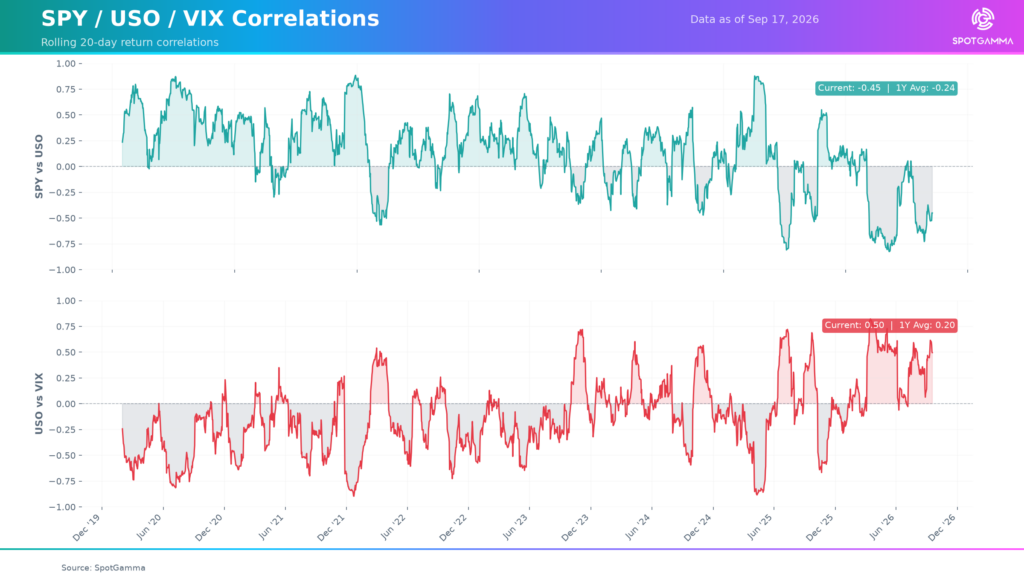
The last time crude jumped to a three-month high, the equity market pulled back. If oil volatility wakes up, that stress could spill over into the equity market. The data suggests this spillover channel is worth watching, even while index volatility remains subdued.
Mixed Positioning in Oil-Related Options
Options positioning in oil-related names remains mixed, which is itself informative. In USO, the crude oil ETF, positioning is skewed toward puts. While single-stock positioning remains net bullish with relatively heavy call skew, there is nuance along the supply chain.
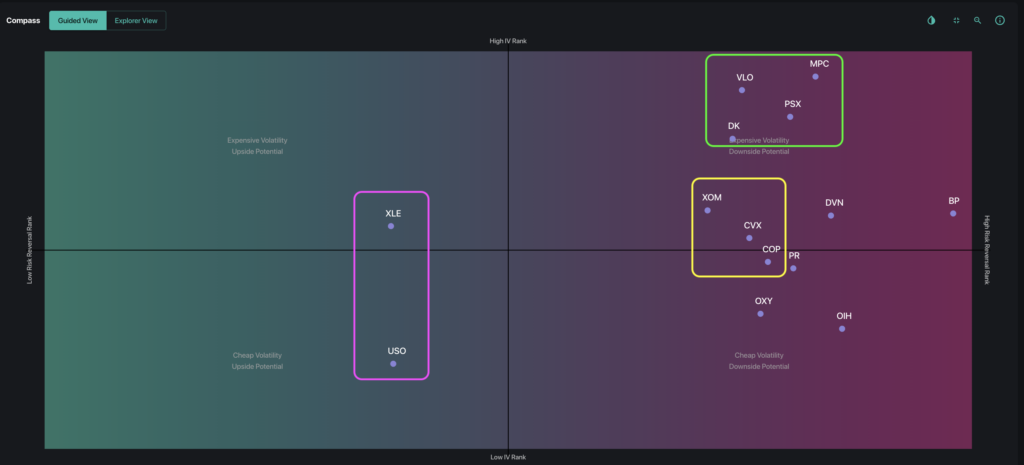
In downstream refiners such as DK and VLO, implied volatility is now quite high as traders have bid up call positions. Refiners earn the spread between crude input costs and fuel output prices, so record diesel prices could be a direct margin story.
Upstream producers are still experiencing call skew, yet options demand appears reigned in compared to their downstream counterparts. Producers such as COP, XOM, and CVX are highly sensitive to crude prices, and they now show more moderate IV Rank.
For these names, our Synthetic OI Model shows sizable short-call positions. Several contracts in particular stood out to us:
- COP November 150 calls were sold 10K lots
- XOM December 185 calls were sold 10K lots
- CVX November 230 calls were sold 10K lots
This positioning could serve to cap upside, reflecting premium selling as a result of oil’s rally over the past three weeks. On the whole, the options market has begun to treat oil producers and refiners as two different trades.
Tail Demand on Both Sides of USO
From the perspective of positional analysis, tail exposure for USO options stands out as perhaps the most interesting story.
While USO shows put skew on the whole, several long positions were also opened that indicated a bullish stance. These included a 29K-lot USO October and March 120 puts, and a 10K-lot USO October, November and December 185 calls. With USO trading around 154 on Friday, That puts both positions far out-of-the-money: the calls sit roughly 21% above spot, the puts 22% below.
This resembles classic tail-risk positioning, with the participants behind these trades seeking exposure to the possibility of a large move in either direction. With demand appearing in both tails while USO implied volatility remains well below its spring highs, the options market suggests that protection against a large oil shock remains relatively inexpensive.
Looking at USO’s volatility term structure, we see two spikes in Forward IV during October without obvious known events attached to them. This poses the question of how much USO could realistically move in this timeframe.
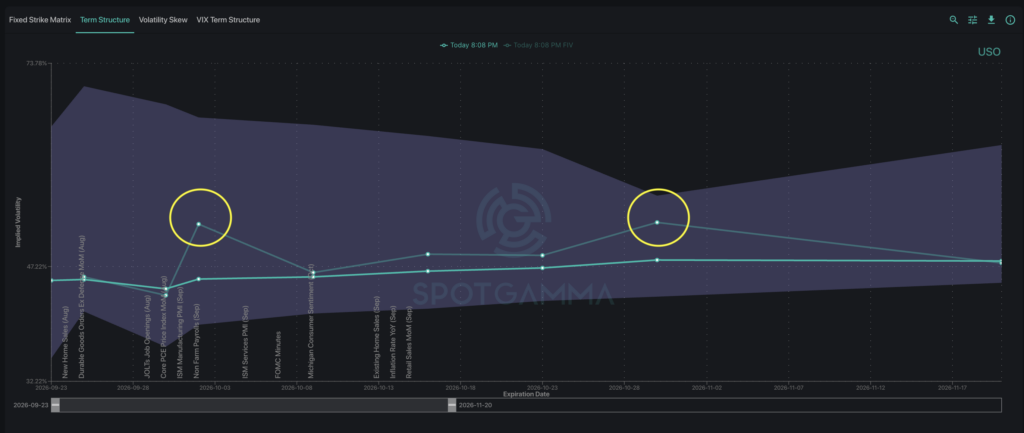
With options now relatively cheap in the context of underlying crude prices, there may be an opportunity to play a change in volatility dynamics for USO. Calendar spreads or similar structures could be used to capitalize on lower near-term volatility while bracing for potential longer-term price movement.
With oil options remaining quiet for now, long vol trades may also be of interest — particularly for those with a directional view. And for those not trading oil or energy options directly, oil volatility still deserves continued attention given the recent correlation with the broader market.