A call backspread is an options strategy that sells one call and buys two (or more) higher-strike calls in the same expiration, typically for little or no net cost. It is a long-convexity position: profits are unlimited if the stock rallies hard, the small credit is kept if the stock falls, and the worst case is a defined loss if the stock finishes pinned at the long strikes. Traders use it when they expect a move to not just happen, but to keep going.
Key Takeaways
- The 1×2 call backspread sells one lower-strike call and buys two higher-strike calls — the mirror image of a front ratio spread.
- Upside profit is unlimited: beyond the long strikes you are net long one call, and the position gains point-for-point with the stock.
- Opened for a credit, the trade also wins if the stock falls — the loss zone is confined to a valley around the long strikes at expiration.
- Worst case lands exactly at the long strike at expiration, where the short call has full spread value against you and the long calls expire worthless.
How the Call Backspread Works
The backspread uses the premium from a short in- or at-the-money call to finance two cheaper out-of-the-money calls. Because you sell rich and buy cheap(er) twice, the package can often be put on for roughly even money or a small credit.
The result is a position that is short a call spread and long a naked call at the same time. The short 100/105 call spread component loses up to its width if the stock rallies to the long strike — that is the valley in the payoff graph. But the second long call is pure upside: once the stock clears the long strikes and keeps going, it overwhelms the spread loss and the position’s profit is uncapped.
Greeks-wise, the backspread is long gamma and long volatility. It wants movement, and it pays for that exposure with an awkward expiration profile: the slow grind that stops at your long strikes is the one tape that maximizes the loss.
Example
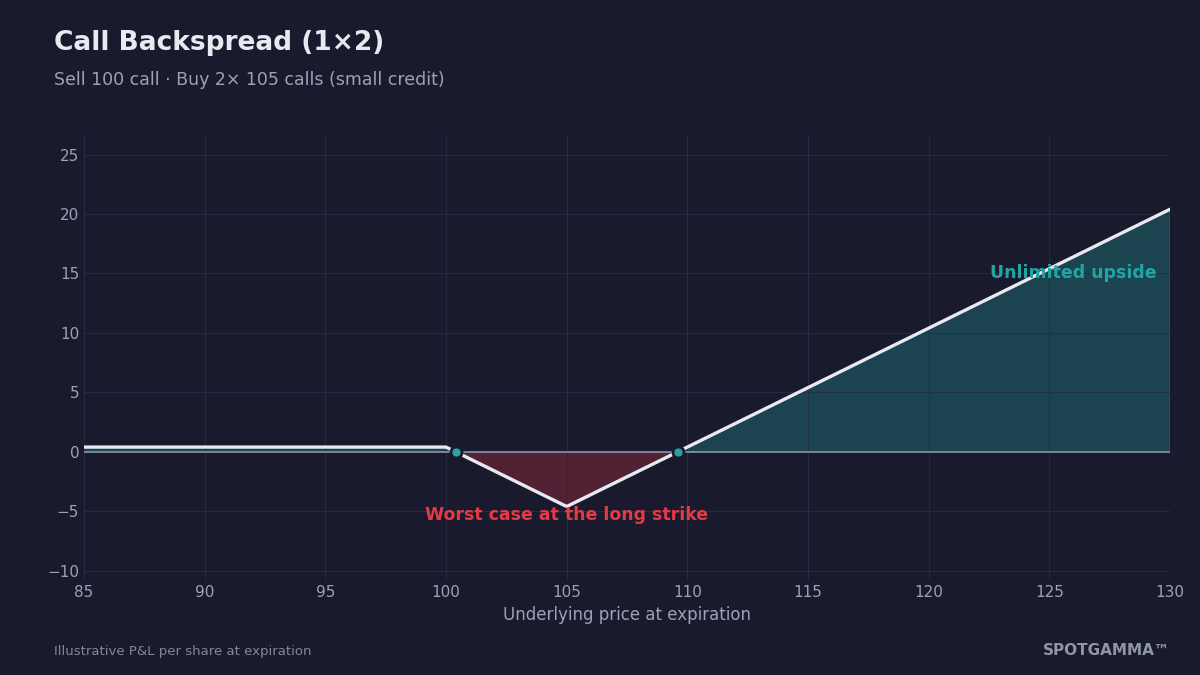
With the stock at $100:
- Sell 1× the 100 call.
- Buy 2× the 105 calls.
- Net credit: $0.40 ($40 per 1×2).
The outcomes at expiration:
- Below 100: all options expire worthless; you keep the $40 credit.
- At exactly 105: worst case. The short 100 call costs you $5.00, both long calls expire worthless, and the net loss is about $460.
- Above 105: the two long calls out-earn the one short call. Breakeven sits near $109.60, and beyond it profits are unlimited.
Note the shape: the trade loses only in the middle. It is a bet against the measured move — you profit on the fizzle and you profit on the melt-up. Build the 1×2 and stress it across price and time in SpotGamma’s free Options Calculator to see how the valley shifts as expiration approaches.
Call Backspread vs. Ratio Spreads and Strangles
- Vs. the front ratio spread: exact opposites. The front ratio collects theta and is hurt by runaway moves; the backspread pays theta (via the expiration valley) to own the runaway move. Choose by which tape you expect — contained or trending.
- Vs. the long strangle: both are long-volatility, but the strangle pays a debit and profits in either direction. The backspread is directional, often costs nothing upfront, and keeps a credit if you are wrong quietly — but loses more than a strangle if price pins the long strikes.
Using Positioning Data to Trade It Better
The backspread needs the tape that keeps going — and dealer positioning data describes exactly when that tape shows up. As part of our options strategy library, this is the structure most aligned with negative-gamma conditions:
- Deploy as gamma flips negative. When gamma exposure (GEX) flips negative, dealer hedging amplifies moves instead of dampening them — selling into declines, buying into rallies. That is the mechanical backdrop for the extended, trending moves a backspread is built to capture. In positive-gamma, range-bound regimes, the same position bleeds toward its valley.
- Trade the break of the Call Wall, with flow confirmation. A rally clearing the Call Wall has left the strike where dealer hedging historically caps price — and sustained call buying on HIRO confirms hedging flows are feeding the move rather than fading it. That combination is the structure-aware entry signal.
- Mind implied volatility at entry. You own two options against one; the position is long vega. Entering after IV has already spiked means paying up for convexity that may deflate even if direction cooperates.
Risks
- The valley is real. A rally that stalls exactly at the long strikes into expiration produces the maximum loss — the market moving your direction, but not enough, is the worst outcome.
- Theta works against you near the strikes. As expiration approaches with price between the strikes, decay accelerates the slide toward the valley.
- IV crush hurts. Net long options means a volatility collapse marks the position down even with price unchanged.
- Early assignment on the short leg. The short in-the-money call can be assigned ahead of dividends in American-style options, unbalancing the structure.
FAQ
When does a call backspread profit most?
On a large, fast rally that carries well beyond the long strikes — beyond the upside breakeven the position is net long one call and gains without limit. It also keeps its small credit if the stock falls and everything expires worthless.
What is the worst case for a backspread?
The stock finishing exactly at the long strikes at expiration. There the short call is worth its full spread width against you while both long calls expire worthless — in our 100/105 example, a loss of about $460 per 1×2.
Why open a backspread for a credit?
The credit means the trade cannot lose if the stock falls: all legs expire worthless and you keep the premium. You are effectively being paid to hold unlimited upside exposure, with the risk concentrated in the pin zone around the long strikes.
This article is for educational purposes only and is not financial advice. Options involve substantial risk and are not suitable for all investors.