A long strangle is an options strategy that buys an out-of-the-money put and an out-of-the-money call with the same expiration, profiting if the underlying makes a large move in either direction. It is the budget version of the straddle: because both strikes sit away from the current price, the position costs a fraction as much — but the stock has to travel through one of the strikes and then some before the trade pays. Maximum loss is the debit, lost anywhere between the two strikes at expiration.
Key Takeaways
- A long strangle buys an OTM put below the market and an OTM call above it, same expiration — a directional-agnostic bet on a big move.
- It typically costs half or less of the equivalent straddle, because you are buying cheaper out-of-the-money premium on both sides.
- The trade-off is a wider dead zone: the entire region between the strikes is a total loss at expiration.
- Strike placement is the whole game — put the strikes where price can actually run, not just where premium looks cheap.
How the Long Strangle Works
Out-of-the-money options are pure extrinsic value: no intrinsic worth, only the probability that the stock reaches the strike. A strangle buys two of these lottery-adjacent premiums, one on each side of the market. The lower price tag is not a free lunch — it is the market telling you that neither strike is likely to be reached.
At expiration the geometry is simple. Finish anywhere between the put and call strikes and both legs expire worthless: the full debit is gone. Push through either strike and the surviving option starts earning intrinsic value, with breakeven reached once that intrinsic covers the whole debit. Before expiration, the position behaves more forgivingly — a sharp move or an implied volatility spike lifts both marks, and many strangle buyers trade the swing rather than the expiration payoff.
The strangle sits alongside its more expensive sibling in our options strategy library, and choosing between the two comes down to how far you think the move can carry.
Example
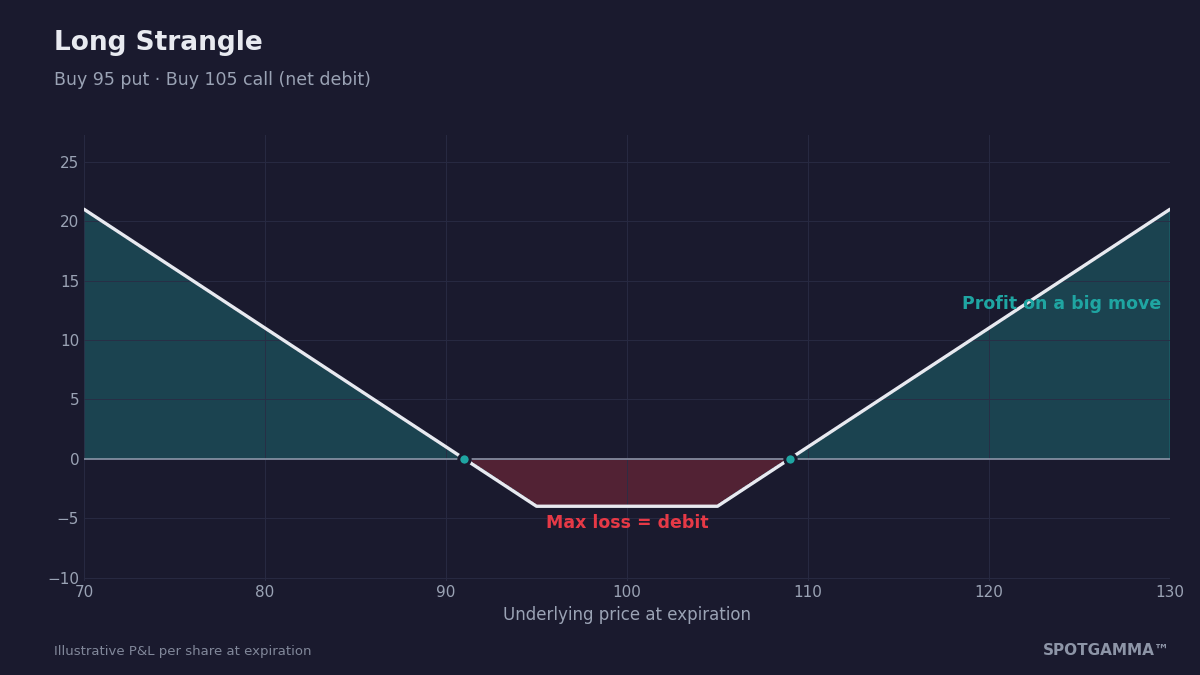
With the stock at $100:
- Buy 1× the $95 put and 1× the $105 call, same expiration, for a net debit of $4.00 ($400).
- Max loss: $400, taken anywhere between $95 and $105 at expiration — a 10-point-wide dead zone.
- Breakevens: $91 and $109. The call must carry the stock past $109, or the put below $91, for an expiration profit.
Compare that with the $8.00 straddle on the same stock: the strangle risks half as much, but its breakevens sit a point further out on each side, and it has a zone where everything expires worthless rather than a single worst-case point. You can model both side by side in SpotGamma’s free Options Calculator and watch how the trade-off shifts with strike selection.
Long Strangle vs. Straddle and Backspread
- vs. the long straddle: the straddle pays more for tighter breakevens and no dead zone; the strangle pays less and demands a bigger move. In practice, strangles suit traders expecting an outsized move, straddles suit traders expecting any decent move.
- vs. the call backspread: a backspread finances its long options by selling a closer strike, often entering for a credit — but it concentrates its bet in one direction. The strangle keeps both directions open and pays cash for the privilege.
Using Positioning Data to Trade It Better
Because strangle strikes are out-of-the-money, you are not just betting on movement — you are betting price clears specific levels. That makes the dealer positioning map directly relevant:
- Know what stands between you and your strikes. The Call Wall and Put Wall mark the strikes with the heaviest dealer gamma, where hedging flows have historically stalled rallies and declines. A strangle whose strikes sit just beyond those walls is a bet on the exact moves dealer hedging resists most — buy it only when you have a reason to expect the walls to break.
- A negative gamma flip is that reason. When GEX flips negative, dealer hedging amplifies moves instead of containing them, and strikes stop acting like barriers. That is the regime where OTM strikes get run over — and where a strangle’s cheap convexity earns its keep.
- In a positive-gamma, range-bound regime, the dead zone wins. Pinning between the strikes is the strangle’s worst outcome, and it is exactly what dealer hedging produces when gamma is positive and concentrated near the money.
Risks
- Total loss is the common case. The full debit vanishes anywhere inside a wide price range. Cheap does not mean high-probability — it usually means the opposite.
- Theta on two options. Both legs decay daily, and OTM options lose value quickly in the final weeks as the market gives up on them.
- IV crush. A post-event volatility collapse deflates both legs; a modest move with falling IV can still leave the position deep underwater.
- Whipsaw. A move toward one strike that reverses can round-trip your gains — the strangle needs follow-through, not just a twitch.
FAQ
Straddle vs strangle — which is better?
Neither is better outright; they price the same bet differently. The straddle costs more but profits on a smaller move, while the strangle costs less and needs a larger one. If you expect an extreme move, the strangle’s convexity per dollar is attractive; if you expect a solid but not extreme move, the straddle’s tighter breakevens usually serve better.
Why are strangles cheaper than straddles?
Because both options are out-of-the-money, carrying no intrinsic value and a lower probability of finishing in-the-money. You are paying only for the tails of the distribution, and the market charges less for outcomes it considers less likely.
What kills a long strangle position?
Time passing with the stock stuck between the strikes, and implied volatility falling after you buy. Either one bleeds the position; together — the classic quiet tape after a hyped event — they can wipe out most of the debit well before expiration.
This article is for educational purposes only and is not financial advice. Options involve substantial risk and are not suitable for all investors.