A double diagonal is an options strategy that sells a near-dated strangle and buys further-out-of-the-money options in a later expiration — a diagonal put spread below the market plus a diagonal call spread above it. Like an iron condor, it collects income if the underlying stays in a range; unlike a condor, its protective wings sit in a later month and retain volatility value, so the position is far less exposed to the volatility spikes that punish same-month premium sellers. The cost of that protection is a small net debit instead of a credit.
Key Takeaways
- The double diagonal = short front-month OTM put and call + long back-month, further-OTM put and call — two diagonals bracketing the price.
- Profit concentrates in two humps near the short strikes at the front expiration, with loss limited to roughly the net debit paid.
- The back-month longs are net positive vega: a volatility spike that wounds an iron condor actually supports this structure.
- It is a natural structure around known catalysts — sell the event-inflated front month, own the calmer back month.
How the Double Diagonal Works
Each side of the trade is a diagonal: short a nearer expiration, long a farther one at a different strike. The front-month short strangle is the income engine — those options carry the fastest time decay and, ahead of events, the richest implied volatility. The back-month longs serve two jobs at once: they define the risk (no naked short options anywhere) and they keep vega on your side.
That second job is the structure’s signature. An iron condor’s wings expire with its shorts, so a volatility shock inflates the whole package against you. A double diagonal’s wings live in a later month, where a vol spike raises their value. Net, the position is long vega — the rare range-income trade that gets a cushion, not a beating, when the market lurches.
The trade-off is that you pay for the privilege: back-month options cost more than same-month wings, so the package is typically a debit. Your worst case is bounded near that debit (plus any adverse vol move in the longs), realized when price blows far through either side and all four options converge toward intrinsic value.
Example
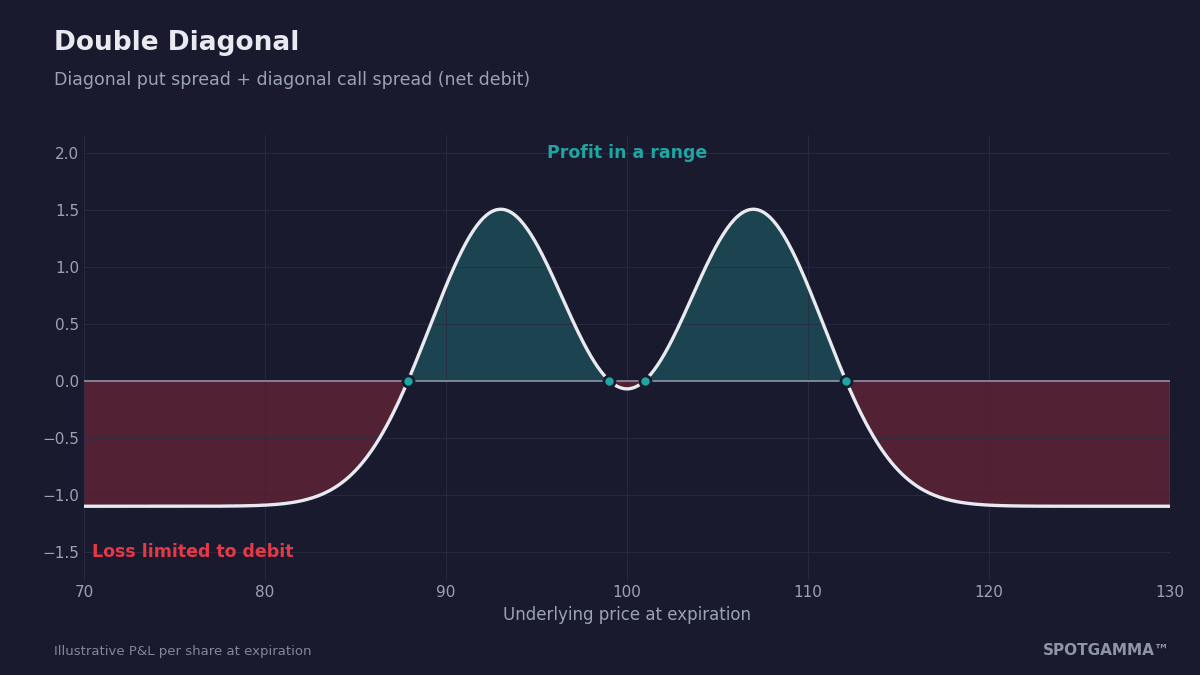
With the stock at $100:
- Put side: sell the front-month 95 put, buy the back-month 90 put.
- Call side: sell the front-month 105 call, buy the back-month 110 call.
- Net debit: $1.10 ($110).
At the front expiration, the P&L curve shows two profit humps near 95 and 105 — where a short option expires worthless at maximum decay while the nearby long retains its time value — with a modest dip between them and losses limited to roughly the $110 debit if price escapes the range entirely. Because the back-month legs still have life, the exact curve depends on where implied volatility stands at that point; model the two-expiration structure in SpotGamma’s free Options Calculator rather than eyeballing it.
Double Diagonal vs. Iron Condor and Calendar
- Vs. the iron condor: same range thesis, different month for the wings. The condor collects a credit and is short vega; the double diagonal pays a debit and is long vega. Expecting quiet prices but nervous about a vol shock — say, into a catalyst — is exactly the condition that favors the diagonal version.
- Vs. the calendar spread: a calendar is one strike, one profit peak — a pin trade. The double diagonal is two calendars-with-a-twist spread apart, trading peak height for a wider landing zone.
- Vs. a single diagonal: one diagonal has a directional lean; pairing opposing diagonals neutralizes direction and leaves the range-plus-vega profile.
Using Positioning Data to Trade It Better
A double diagonal is a bet on where the range sits and on term-structure pricing — both places where data beats guessing. This post is part of our options strategy library:
- Bracket the walls with the short strikes. The Call Wall and Put Wall mark the strikes where concentrated dealer gamma has historically capped rallies and slowed declines — the market’s own estimate of the range. Short strikes set at or just beyond the walls put your income zone inside the levels hedging flows defend.
- Favor positive-gamma regimes. When GEX is positive, dealer hedging dampens moves and ranges tend to hold — the environment every range-income structure wants. A negative-gamma tape extends moves through strikes, and even vega protection only softens that outcome.
- Sell rich front, own cheaper back. Ahead of known events, front-month IV typically trades at a premium to the back month. That inversion is the double diagonal’s entry edge: you are selling the expensive expiration and owning the cheaper one. If the term structure is steeply upward-sloping instead, the trade is paying up for its wings.
Risks
- A breakout still loses. Price escaping the range toward either long strike approaches max loss; the structure softens vol shocks, not directional ones.
- Vol crush in the back month. The position is long vega — if implied volatility collapses after entry, the back-month wings lose value and the debit is hard to recover.
- Four legs, two expirations. Execution slippage and management complexity are roughly double a condor’s; use limit orders on the package.
- Front-expiration transition risk. At the front expiry the position changes character entirely — unmanaged, the remaining back-month strangle is a different trade than the one you opened.
FAQ
Double diagonal vs iron condor — which should you trade?
Both profit from a range. Choose the condor when implied volatility is rich and you want to be short it; choose the double diagonal when you want range income but expect — or fear — rising volatility, since its back-month wings turn vol spikes from a threat into a cushion.
Why does a double diagonal handle vol spikes better?
Its protective long options sit in a later expiration and keep substantial vega. When implied volatility jumps, those wings gain value, offsetting losses on the short front-month strangle. An iron condor’s same-month wings offer no such offset, so the whole package marks against you.
How do you manage it at front expiration?
Before the front-month shorts expire or go in-the-money, either close the whole position, or roll the short strangle to the next expiration against the same wings — converting the trade into a fresh double diagonal or ending it. Letting the shorts ride into expiration week unmanaged invites assignment and pin risk.
This article is for educational purposes only and is not financial advice. Options involve substantial risk and are not suitable for all investors.