An iron butterfly is an options strategy that sells an at-the-money straddle and buys an out-of-the-money put and call as protective wings, collecting a large net credit. Maximum profit — the full credit — is earned if the stock closes exactly at the short straddle’s strike at expiration, and losses beyond the wings are strictly capped. It is the defined-risk way to sell the most expensive premium on the board: the at-the-money straddle.
Key Takeaways
- The iron butterfly is short an ATM call and put at one strike, long a cheaper put below and call above — four legs, net credit.
- Max profit is the credit, at the center strike; max loss is the wing width minus the credit, reached beyond either wing.
- Because the short strikes sit at-the-money, the credit is large and the breakevens are wider than a butterfly’s tent — but the position starts losing the moment price leaves the center.
- It is a short-volatility, pin-thesis trade: you profit when realized movement comes in below what the straddle priced.
How the Iron Butterfly Works
The engine is the short straddle: selling both at-the-money options collects the market’s full implied move for the period. Sold naked, that position carries unlimited risk; the iron butterfly spends a portion of the credit on wings that cap the damage. What remains is a trade that wins if the stock moves less than the options implied, with a worst case known to the dollar before entry.
The payoff is a tent, like the long butterfly’s, but constructed from credit: you keep the full premium at the exact center, keep some of it anywhere inside the breakevens (the center strike plus or minus the credit), and lose a fixed, capped amount beyond the wings. The seller’s compensation is explicit — you are being paid implied volatility, and you keep whatever realized volatility fails to use up.
That framing is worth internalizing before trading any structure in our options strategy library: a $6.00 credit on a $100 stock is the market offering 6% of movement insurance. The iron butterfly is the bet that the market overpriced it.
Example
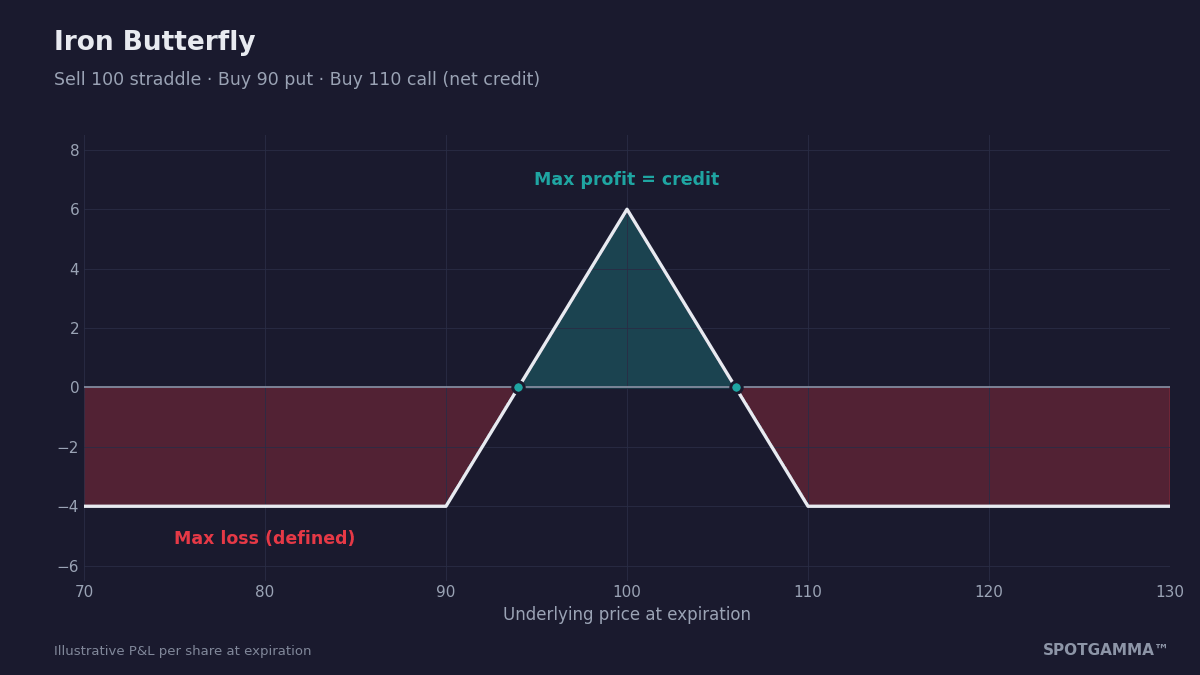
With the stock at $100:
- Sell the $100 straddle (one call, one put) and buy the $90 put and $110 call as wings, for a net credit of $6.00 ($600).
- Max profit: $600 with the stock at exactly $100 at expiration — every short option expires worthless.
- Max loss: $400 beyond either wing: the $10 wing width minus the $6 credit.
- Breakevens: $94 and $106 — a 12-point-wide profit zone, far more forgiving than a debit butterfly’s tent.
Note the risk/reward inversion versus the long butterfly: here you win more often (any finish between 94 and 106 profits) but risk more than you can make past the wings. Stress both structures in SpotGamma’s free Options Calculator to see which trade matches your read.
Iron Butterfly vs. Butterfly, Iron Condor, and Straddle
- vs. the butterfly spread: same pin thesis, opposite construction — the debit fly risks little for a precise pin; the iron fly collects a credit, wins across a wider zone, and risks more when wrong.
- vs. the iron condor: the condor moves its short strikes out-of-the-money, collecting less credit for a wider full-profit range. The iron fly maximizes premium at the cost of needing price to stay near one strike.
- vs. the long straddle: literally the other side of the core trade. If the implied move looks cheap, buy the straddle; if it looks rich, the iron butterfly sells it with the tail risk removed.
Using Positioning Data to Trade It Better
An iron butterfly needs price to stay near its center — so choose the center, and the regime, with data:
- Center it on the dominant gamma strike. The strike carrying the largest dealer gamma and open interest has historically attracted price into expiration as hedging flows push toward it — the same pinning logic that guides the debit butterfly. Placing the short straddle there, often near the Call Wall or the heaviest open-interest zone, aligns the trade with the market’s attractor.
- Favor positive-gamma regimes. When GEX is positive, dealer hedging actively dampens movement — selling into exactly the suppressed-volatility conditions the short straddle wants. A negative-gamma tape, where hedging amplifies moves, is the stand-aside signal.
- Check that the credit beats realized movement. The credit is your compensation for realized volatility. Compare the implied move you are selling against what the stock has actually been realizing — collecting 6% against a stock realizing 8% is a structurally losing proposition, whatever the chart looks like.
Risks
- Losses start immediately. Unlike a condor, there is no flat max-profit plateau — every point away from the center strike eats into the credit from the first tick.
- Gap risk. An overnight gap through a wing takes the position straight to max loss with no chance to manage; earnings nights are the classic trap.
- Short ATM options carry assignment risk — one side will generally be in-the-money near expiry, and early assignment (especially around dividends) can unwind the structure unexpectedly.
- A volatility spike marks the position against you even if price has not moved far yet; rising IV inflates the straddle you are short.
FAQ
Iron butterfly vs iron condor — which collects more?
The iron butterfly, always: its short strikes sit at-the-money where premium is richest, while the condor sells cheaper out-of-the-money strikes. The condor compensates with a wide zone of full profit, whereas the iron fly’s full credit is earned only at the exact center strike.
Where should an iron butterfly be centered?
On the strike price is most likely to gravitate toward at expiration. Positioning data points to the strike with the heaviest dealer gamma and open interest — historically sticky into expiry — rather than simply the current price or a round number.
When should you close an iron butterfly?
Most traders close well before expiration — commonly at a target like 25–50% of the maximum credit — rather than holding for the perfect pin. The final days add assignment and gap risk fast while the remaining profit accrues slowly, so the risk-adjusted math favors taking the win early.
This article is for educational purposes only and is not financial advice. Options involve substantial risk and are not suitable for all investors.