A calendar spread (or time spread) sells a near-dated option and buys a longer-dated option at the same strike, profiting from the faster time decay of the short-dated leg. The position makes its maximum profit when the stock sits at the shared strike as the front option expires — the short leg decays to nothing while the long leg retains most of its value. Risk is strictly limited to the small debit paid, which makes the calendar one of the cheapest ways to trade the passage of time itself.
Key Takeaways
- A calendar spread is short fast-decaying near-dated premium and long slower-decaying longer-dated premium at the same strike.
- Maximum profit arrives with the stock at the strike at front-month expiration; the payoff curve is a tent peaked there.
- Max loss is the debit paid — a large move in either direction collapses the spread’s value toward zero, but never below it.
- The trade is long the back month’s volatility: rising IV helps, falling IV hurts, the reverse of most premium-selling structures.
How the Calendar Spread Works
Options decay at very different speeds depending on time to expiration. An at-the-money option with two weeks left sheds extrinsic value far faster than the same strike with two months left — theta accelerates as expiry approaches. A calendar spread is built to harvest that difference: you sell the leg that is decaying quickly and own the leg that is decaying slowly.
Both legs are all extrinsic value when the strike is at the money, so the position’s profit engine is the decay differential, not direction. If the stock stays near the strike, the front option bleeds out while your back-month option holds value — and when the front leg expires worthless you can sell the survivor, or keep it and sell the next month against it. Drift far from the strike, though, and both legs converge toward the same small value: the spread between them, and your P&L, compresses toward zero.
There is a second engine: term structure. The spread is net long vega because longer-dated options carry more volatility sensitivity. Entering when front-month IV is rich relative to back-month IV means selling the expensive end of the curve and owning the cheap end — the configuration this trade, part of our options strategy library, is designed to exploit.
Example
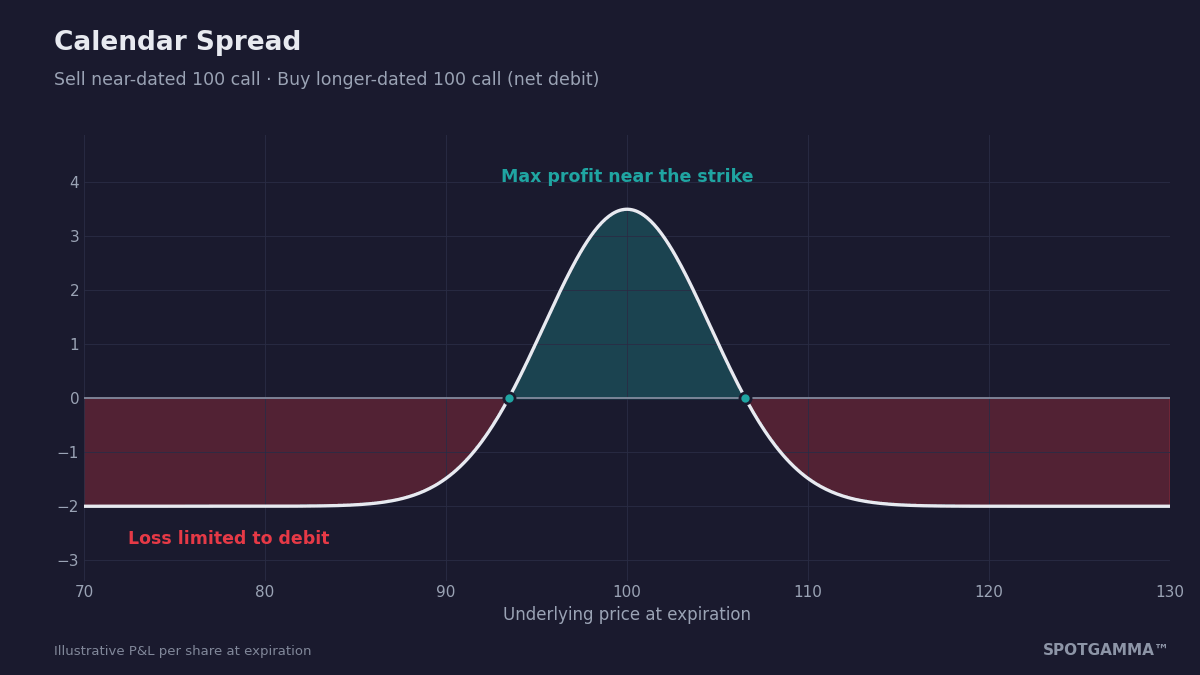
With the stock at $100:
- Sell 1× near-dated $100 call and buy 1× longer-dated $100 call for a net debit of $2.00 ($200).
- Max profit near $100 at the front expiration — roughly $350 in this illustration, where the short call dies worthless and the long call retains its remaining time value.
- Max loss: the $200 debit, approached when the stock runs far above or below the strike and both legs trade near parity with each other.
Exact profits depend on where implied volatility stands at the front expiry, which is why calendars reward modeling before entry — stress the position across price and IV in SpotGamma’s free Options Calculator rather than eyeballing it.
Calendar Spread vs. Diagonals and Butterflies
- vs. the diagonal spread: a diagonal shifts the two legs to different strikes, adding a directional lean to the time-decay engine. The pure calendar is direction-neutral; the diagonal is a calendar with a view.
- vs. the double diagonal: runs time spreads on both sides of the market at once, trading a range rather than a single pin point.
- vs. the butterfly spread: the butterfly builds a similar tent-shaped payoff within a single expiration. The butterfly is short vega; the calendar is long vega — the choice often comes down to whether you want volatility rising or falling while you wait.
Using Positioning Data to Trade It Better
A calendar is a bet on price gravitating to a strike — and strike gravity is a measurable phenomenon in options positioning:
- Center the spread on the biggest gamma strike. Strikes carrying massive open interest and dealer gamma act like magnets into expiration, as hedging flows push price back toward them — the pinning effect covered in our guide to options expiration (OpEx). A calendar centered on that strike, often at or near the Call Wall or the high-open-interest zone, aligns the tent’s peak with the market’s own attractor.
- Check the term structure before entry. You want to sell rich front-month IV against cheaper back-month IV — common ahead of near-term events. The inverted case, paying up for the back month while the front is cheap, starts the trade with the vega engine running backward.
- Respect the gamma regime. Pinning is a positive-gamma phenomenon. When GEX flips negative and dealer hedging starts amplifying moves, strikes lose their gravity and the calendar’s dead-center thesis weakens.
Risks
- A big move beats the tent. The stock running away from the strike in either direction grinds the spread toward worthless; your debit is capped but entirely at risk.
- Vega cuts both ways. A collapse in back-month implied volatility devalues the leg you own — calendars put on when IV is elevated can lose even with price sitting at the strike.
- Early assignment on the short leg. An ITM short call near a dividend, or a deep ITM short put, can be assigned before the front expiry and unwind the structure.
- Execution friction. Two expirations means two bid/ask spreads; enter and exit as a spread with limit orders, not leg by leg.
FAQ
How does a calendar spread make money?
From the decay differential between its legs: the short near-dated option loses value faster than the long back-dated one. If the stock stays near the strike, that gap accrues to you, with a secondary boost if implied volatility rises while you hold the long leg.
Where should you center a calendar spread?
At the strike you expect price to gravitate toward at the front expiration. Positioning data helps here: strikes with the heaviest gamma and open interest have historically acted as magnets into expiry, so centering the calendar on the dominant gamma strike puts the payoff peak where the pinning pressure is strongest.
What is the risk of a calendar spread?
The debit paid, and no more. You approach that max loss when the stock moves far from the strike in either direction, or when back-month implied volatility drops sharply and devalues the long leg.
This article is for educational purposes only and is not financial advice. Options involve substantial risk and are not suitable for all investors.