An iron condor is a defined-risk, market-neutral options strategy that combines a short out-of-the-money put spread with a short out-of-the-money call spread in the same expiration, collecting a net credit that is kept in full if the stock finishes between the two short strikes. The trade needs no directional view — it profits when price stays inside a range while time decay erodes the options sold. Because each short option is paired with a long option further out, the maximum loss is fixed and known before you ever place the order.
Key Takeaways
- Four legs, one expiration: sell an OTM put and buy a further-OTM put, sell an OTM call and buy a further-OTM call.
- Max profit is the credit received; max loss is the wing width minus the credit. Both are capped from day one.
- The position is short volatility and long time decay — it wants a quiet, rangebound tape, not a trend.
- Strike selection is the whole trade: a condor fails when a short strike sits inside the range the market actually travels.
How the Iron Condor Works
Both options you sell are out-of-the-money, which means their entire price is extrinsic value — time premium with no intrinsic worth. If the stock stays between the short strikes, that premium decays to zero by expiration and you keep the full credit. The two long options you buy further out cost a portion of the premium collected, but they convert what would otherwise be a naked strangle into a position with a hard floor on losses.
Structurally, an iron condor is just two credit spreads stacked on the same underlying: a bull put spread below the market and a bear call spread above it. Each spread’s width (short strike to long strike) sets the capital at risk; the distance between the two short strikes sets the profit zone. Tighter short strikes collect more credit but get breached more often. Wider short strikes win more frequently but pay less — and the occasional loss is larger relative to the credit. There is no free lunch in that trade-off, only a choice about which failure mode you prefer.
Because the condor is short options on both sides, it also benefits when implied volatility falls after entry and suffers (in marked P&L) when IV rises, even if price has not moved.
Example
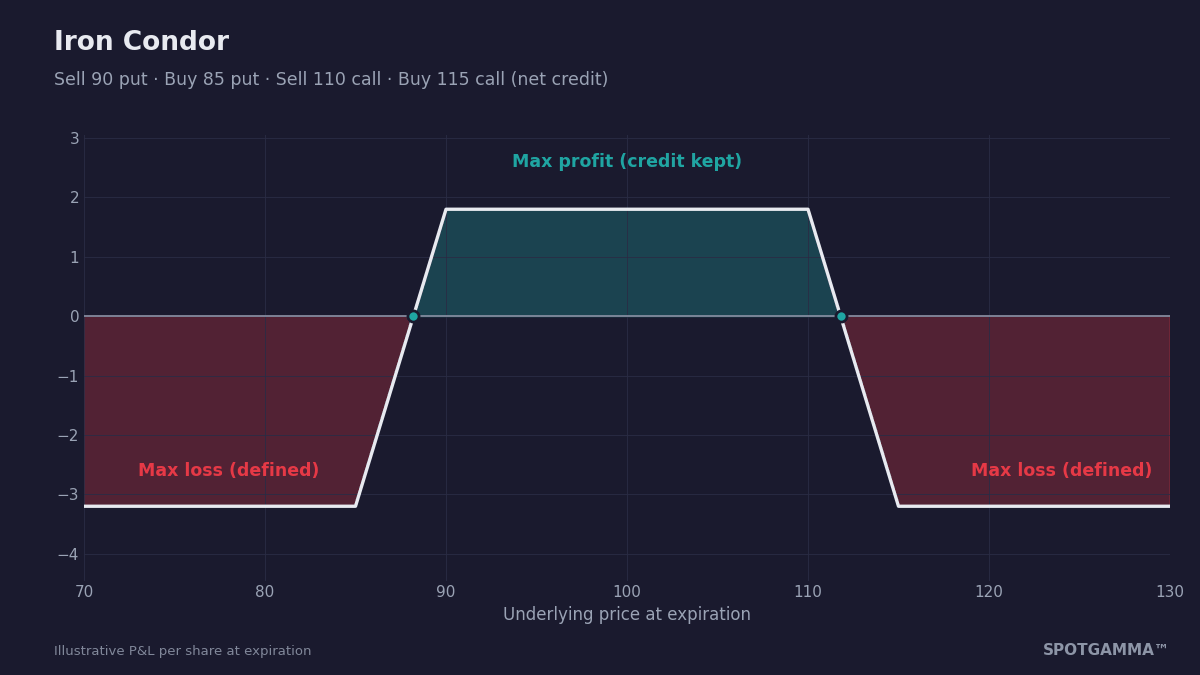
With the stock at $100:
- Sell the 90 put, buy the 85 put (the put credit spread).
- Sell the 110 call, buy the 115 call (the call credit spread).
- Net credit: $1.80, or $180 per contract.
At expiration, the position keeps the full $180 anywhere between 90 and 110. The maximum loss is $320 — the $5 wing width minus the $1.80 credit — and it is realized below 85 or above 115. Breakevens sit at 88.20 and 111.80. Notice the asymmetry: the trade risks $320 to make $180, which is typical for condors. The strategy’s edge, if there is one, comes from the range holding more often than the credit implies — not from a favorable payout ratio.
Iron Condor vs. Related Strategies
The condor is one member of a family of premium-selling structures covered in our options strategy library:
- Bull put spread — the bottom half of a condor on its own. Use it when you only want to bet that downside holds, without capping an upside view.
- Bear call spread — the top half on its own: a bet that a rally stalls, without taking risk below the market.
- Iron butterfly — move both short strikes to the same at-the-money strike. It collects far more credit but the profit zone narrows to a point; the condor trades premium for breathing room.
Using Positioning Data to Trade It Better
A condor is rent collected on a range — and dealer positioning data tells you where the market itself has drawn that range:
- Sell short strikes outside the walls. The Call Wall and Put Wall mark the strikes carrying the largest dealer gamma, where hedging flows have historically pinned or stalled price. Short strikes placed beyond those levels put the market’s own friction between the stock and your risk.
- Check the gamma regime before entry. In positive gamma exposure (GEX) regimes, dealer hedging dampens moves — the environment a condor needs. When GEX flips negative, hedging amplifies moves and range assumptions break; that is the signal to stand aside, not to collect more credit.
- Model it before you trade it. Build the four legs and stress the P&L across price and time in SpotGamma’s free Options Calculator.
Risks
- The payout is asymmetric: in the example, one full breach ($320 loss) erases nearly two winning condors ($180 each). A few bad months can undo many good ones.
- An IV spike inflates both short options and marks the position against you even while price remains inside the range — a problem if you are forced to close early.
- Short legs can be assigned early once they go in-the-money, particularly short calls just before an ex-dividend date.
- Gaps do not respect strikes: an overnight move through a short strike can skip past the price at which you planned to adjust.
FAQ
How does an iron condor make money?
It collects premium from two out-of-the-money credit spreads and keeps it as time decay erodes the options sold. If the stock finishes between the short strikes at expiration, both spreads expire worthless and the full credit is profit. Falling implied volatility after entry accelerates the gain.
What is the ideal market for an iron condor?
A rangebound tape where implied volatility is rich relative to how much the stock actually moves. Mechanically, positive-gamma regimes fit best: dealer hedging leans against price swings, helping the range hold. Trending or negative-gamma environments are where condors get hurt.
What happens if the stock moves past a short strike?
Losses accrue beyond the breakeven and max out at the wing width minus the credit — $320 in the example — once price passes the long strike. Traders typically manage earlier: closing the tested spread, rolling it out in time, or closing the whole condor before the loss approaches its cap.
This article is for educational purposes only and is not financial advice. Options involve substantial risk and are not suitable for all investors.