A jade lizard is an options strategy that sells an out-of-the-money put and an out-of-the-money call spread in the same expiration, collecting a total credit larger than the width of the call spread — which eliminates risk on the upside entirely. If the stock rallies through both call strikes, the call spread loses its full width, but the credit collected exceeds that width, so the position still finishes with a profit. The only direction that can hurt a jade lizard is down, below the short put.
Key Takeaways
- Three legs: short OTM put + short call spread, built so total credit > call-spread width.
- That one construction rule is the whole trick: it is what makes the upside mathematically risk-free at expiration.
- The position profits anywhere above the short put at expiry — up big, up small, flat, or even down modestly.
- All of the real risk lives below the short put, where it behaves like a naked short put less the credit collected.
How the Jade Lizard Works
Start with each piece. A short put, like the one in a put credit spread, collects premium for agreeing to buy stock at the strike — it profits if the stock stays above that level. A short call spread (a bear call spread) collects premium for betting the stock stays below the short call, with the long call capping how wrong you can be at the spread’s width.
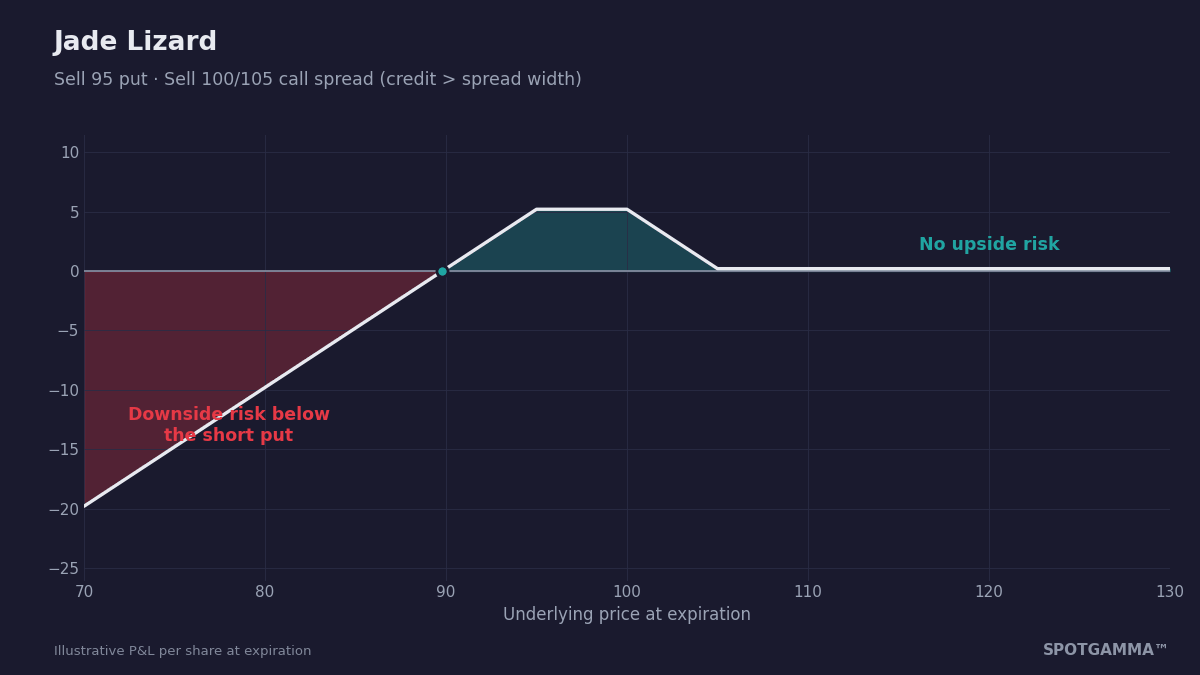
Sold together, the two credits stack. The construction rule does the rest: if the combined credit exceeds the call-spread width, then even the worst upside outcome — stock screaming through both call strikes, spread settling at full width — leaves you net positive. In the example below, $5.20 collected minus $5.00 of maximum call-spread loss is still +$0.20. The rally cannot hurt you.
The put side has no such cap. Below the short put strike, losses grow roughly dollar-for-dollar with the stock, cushioned only by the credit. The jade lizard is therefore best read as a short put with a bonus: the call spread fattens the credit (and widens the downside cushion) in exchange for giving up gains beyond it on a rally.
Example
With the stock at $100:
- Sell one $95 put.
- Sell the $100/$105 call spread (sell the 100 call, buy the 105 call).
- Total credit: $5.20 — more than the $5.00 width of the call spread, so upside risk is zero.
At expiration the position keeps some or all of the $520 anywhere above $95: the full credit if the stock finishes between $95 and $100, and at least $20 even if it finishes far above $105. The breakeven on the downside sits near $89.80 — the $95 put strike minus the $5.20 credit — and below that, losses build like a short stock position entered at $89.80. Lay the three legs out in SpotGamma’s free Options Calculator to see how the credit, the width, and the downside breakeven interact before you trade it.
Jade Lizard vs. Related Strategies
- Vs. a bull put spread: the bull put spread buys a lower put to cap the downside; the jade lizard leaves the downside open and instead sells a call spread to fatten the credit. Defined risk versus bigger premium.
- Vs. an iron condor: the condor is the same short strangle idea with wings bought on both sides — capped risk everywhere, smaller credit, and it can lose on a big rally. The jade lizard cannot.
- Vs. a covered strangle: the covered strangle adds stock ownership to a short strangle, doubling downside exposure; the jade lizard expresses a similar “sell premium, lean neutral-to-bullish” view without owning shares.
Using Positioning Data to Trade It Better
Since all the risk is on one side, the one decision that matters is where the short put goes — and that is a question positioning data answers directly. This post is part of our options strategy library, where that theme recurs:
- Place the short put below the Put Wall. The Put Wall marks the strike with the heaviest put gamma, where dealer hedging has historically slowed declines. A short put beneath that structural support puts the market’s own stabilizing flows between the stock and your risk zone.
- The classic setup is after a down move. Post-selloff, put IV is rich — you are selling expensive downside premium — while upside is feared but, for this structure, costless. That is exactly the environment where the jade lizard’s asymmetry is best paid.
- Respect the gamma regime. A positive-GEX tape, where hedging dampens moves, suits any premium seller; if gamma flips negative and declines start extending, the open downside of a jade lizard is the wrong exposure to be adding.
Risks
- The downside is effectively naked. Below the ~$89.80 breakeven, losses grow point-for-point with the stock; a gap through the Put Wall doesn’t negotiate.
- “No upside risk” holds at expiration, not necessarily mark-to-market — a violent rally with an IV spike can show interim losses before the math asserts itself.
- Assignment on the short put means taking delivery of 100 shares at $95; only sell the put on names at sizes you are genuinely willing to own.
- Three legs, three spreads: enter and exit as a package with limit orders, or slippage eats the edge that made the credit exceed the width.
FAQ
Why does a jade lizard have no upside risk?
Because the total credit collected is larger than the width of the short call spread. The worst a rally can do is force the call spread to its full width — and since the credit exceeds that width, the position still nets a profit on any finish above the strikes.
When is the best setup for a jade lizard?
After a down move, when put implied volatility is rich and you are being well paid to sell downside premium, with a neutral-to-moderately-bullish view. Placing the short put below the Put Wall aligns the trade’s one vulnerable side with structural support.
What is max loss on a jade lizard?
The short put strike minus the total credit, times 100 — realized if the stock goes to zero. In the example, $95 − $5.20 = $89.80, or $8,980 per contract: large and essentially the same as short-put risk, which is why strike placement and sizing carry the trade.
This article is for educational purposes only and is not financial advice. Options involve substantial risk and are not suitable for all investors.