A collar is an options strategy that protects a stock position by buying a put below the market and paying for it by selling a call above the market. The long put sets a hard floor under your losses, the short call caps your gains, and because the premium collected on the call offsets the premium paid for the put, the whole package can often be built for little or no net cost. The result is a stock position with both its downside and its upside bracketed — hence “collar.”
Key Takeaways
- A collar is three parts: long 100 shares, long one OTM put, short one OTM call — the call premium finances the put.
- Downside is floored at the put strike; upside is capped at the call strike. Between the two, you still own stock.
- A “zero-cost collar” is simply a collar where the call collected equals the put paid — common because equity put skew makes downside protection expensive and upside calls comparatively cheap to give up.
- Strike selection is the entire trade: where you set the floor and the cap determines how much protection you actually bought and how much upside you actually surrendered.
How the Collar Works
Start with the problem: you own stock, you want protection, and protective puts cost real money. Buying a put outright means paying extrinsic value — time premium that decays every day and that tends to be richest exactly when you want insurance most.
The collar’s answer is to sell a call against the same shares, exactly as you would in a covered call. That short call is nearly all extrinsic value, and in equities it usually isn’t even the expensive side of the chain: index and single-stock options typically carry put skew, meaning downside puts trade at higher implied volatility than equidistant upside calls. A collar sells the cheaper wing to buy the richer one, which is why getting to zero net cost often requires setting the call closer to the money than the put — the market charges for fear.
Mechanically, the three legs net out to a position that behaves like stock inside a band. Above the call strike, the short call’s losses offset the shares’ gains — profit stops. Below the put strike, the long put’s gains offset the shares’ losses — loss stops. The trade-off is explicit and visible on the payoff diagram before you ever place the order.
Example
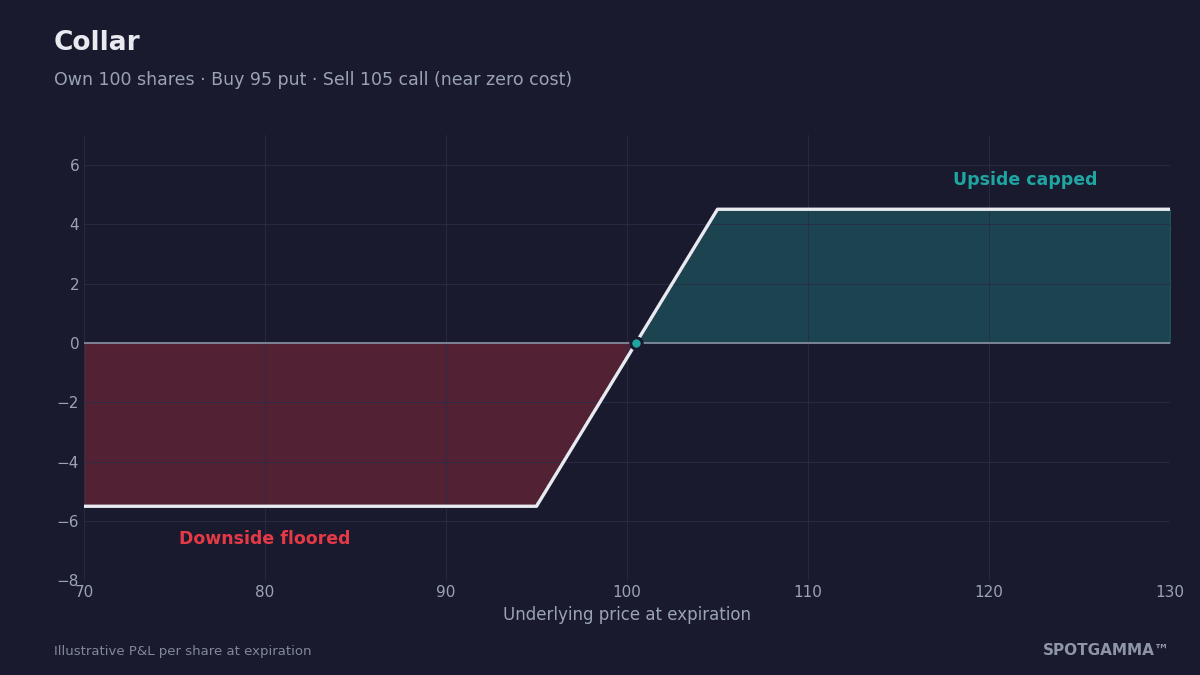
Suppose you own 100 shares of a stock trading at $100 and you want protection through the next few months:
- Buy one $95 put.
- Sell one $105 call.
- Net cost: roughly zero — in this example a small $0.50 debit, since the put cost slightly more than the call brought in.
Below $95, every further dollar of stock loss is matched by a dollar of put gain: your worst case is locked in at the $5 fall from $100 to $95, plus the $0.50 paid — about $550 on the position. Above $105, the shares keep appreciating but the short call loses dollar-for-dollar against them: your best case is the $5 rise to $105, less the $0.50 — about $450. Between $95 and $105, you simply hold stock, up or down with the market. You can build this exact structure and drag the strikes around in SpotGamma’s free Options Calculator to see how the floor, the cap, and the net cost trade off against one another.
Collar vs. Related Strategies
- Vs. a protective put: the protective put keeps unlimited upside but you pay full price for the insurance. The collar gives up upside above the call strike to make that insurance cheap or free.
- Vs. a covered call: the covered call collects income but leaves the downside open all the way down. The collar spends that income on a floor.
- Vs. selling the stock: a collar keeps the position (and any dividends, and potentially defers a taxable sale) while neutralizing most of the near-term risk — one reason it is a staple of concentrated-position management.
- The most famous collar in markets is JPMorgan’s quarterly hedged-equity collar, a multi-billion-dollar structure whose strikes are large enough to influence dealer positioning in the index itself — SpotGamma covers it in depth in our JPM collar explainer.
Using Positioning Data to Trade It Better
Both collar strikes are judgment calls, and positioning data turns them into informed ones. This strategy is part of our options strategy library, where the same principle repeats: let the market’s own structure pick your strikes.
- Anchor the put near the Put Wall. The Put Wall marks the strike with the heaviest put gamma, where dealer hedging has historically slowed declines. Setting your floor at or near that structural support means your insurance kicks in where the market already tends to stabilize — you’re not paying up for protection far above a level that is likely to hold anyway.
- Set the call at the Call Wall. The Call Wall is the strike where dealer long gamma has historically stalled rallies. Capping your upside at a level where upside tends to stall anyway makes the cap less costly in practice — you’re selling away the part of the distribution that gamma exposure suggests was hardest to reach.
- Check skew before you price it. The collar’s economics are a skew trade: you sell the (usually cheaper) call to fund the (usually richer) put. When put skew is unusually steep, zero-cost collars require giving up more upside; when skew flattens, the same protection comes cheaper. Compare the IV of your two strikes before assuming “zero cost” is a good deal.
Risks
- Opportunity cost is the real cost. “Zero cost” refers to premium, not economics — in a strong rally, the capped upside above the call strike is money genuinely foregone.
- The short call can be assigned early, particularly around ex-dividend dates when it trades near parity, which would call your shares away.
- The floor is not free of loss. You can still lose the full distance from your cost basis down to the put strike, plus any net debit paid.
- Collars are term-limited. Protection ends at expiration, and re-collaring quarter after quarter in a falling market means repeatedly selling calls at lower and lower strikes.
FAQ
What does a zero-cost collar mean?
A zero-cost collar is a collar where the premium collected from the short call equals the premium paid for the long put, so the hedge is established for no net outlay. The cost hasn’t disappeared — it has been converted into capped upside above the call strike.
What are the downsides of collaring a stock?
You surrender all gains above the call strike, you can still lose down to the put strike, and the short call carries early-assignment risk around dividends. A collar trades open-ended outcomes in both directions for a defined band, which disappoints in strong rallies.
How do you choose collar strikes?
Decide the maximum loss you can tolerate and set the put there, then find the call strike that funds it. Positioning data refines both: a put near the Put Wall aligns the floor with structural support, and a call at the Call Wall caps upside where rallies have historically stalled anyway.
This article is for educational purposes only and is not financial advice. Options involve substantial risk and are not suitable for all investors.