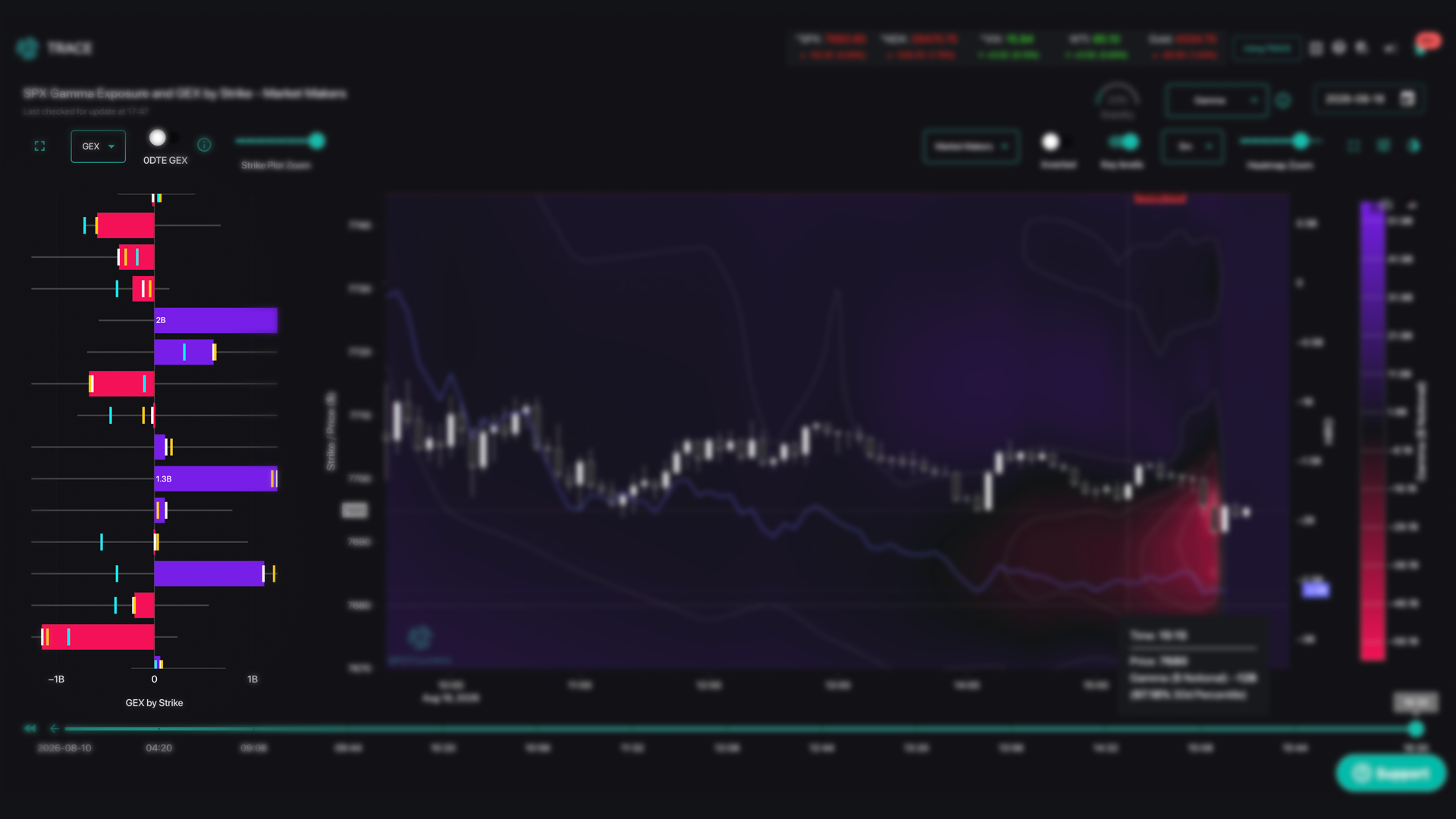
How do you trade GEX levels?
GEX levels are tradeable because they mark where options dealers’ hedging is concentrated — mechanical buying and selling that doesn’t care about news or narratives. The practical framework has three parts: know the regime (aggregate positive or negative gamma — it determines whether moves get dampened or amplified), know the levels (the strikes where hedging concentrates: call wall, put wall, zero gamma), and match the strategy to both. Traders don’t trade the GEX number itself; they trade price behavior around the levels it identifies, in the context the regime sets.
Step one: check the gamma regime
In positive gamma, dealers in aggregate sell strength and buy weakness as they hedge — moves get dampened, ranges compress, and mean-reversion around big strikes is the dominant behavior. In negative gamma, hedging flips pro-cyclical: dealers sell into declines and buy into rallies, so moves extend and accelerate. The same setup — say, a test of a big put strike — is a fade candidate in positive gamma and a breakdown candidate in negative gamma. This is why trading GEX levels without checking the regime fails: the levels are the same, the physics around them are opposite. (Full explainer: negative gamma.)
Step two: map the key levels
The call wall — the strike with the largest call gamma concentration — commonly acts as resistance and a magnet: rallies slow into it, and price often pins near it into expiration. The put wall is its downside counterpart, functioning as support while dealer hedging leans against declines. Zero gamma (SpotGamma’s Volatility Trigger) is the price where aggregate dealer gamma flips sign — above it the stabilizing regime, below it the amplifying one, which is why volatility often expands right as price crosses it. These three levels plus the regime give you the day’s structural map. (Deeper dives: call walls and put walls, GEX explained.)
Step three: match the strategy to the structure
- Positive gamma, price between walls: range trading — fade moves toward the walls, target the middle; premium selling benefits from the dampened realized volatility (see is selling options profitable?).
- Positive gamma, price at the call wall: rallies tend to stall — a common area to take profits on longs, sell covered calls, or fade extensions, especially near expiration when pinning strengthens.
- Negative gamma, price below zero gamma: trend-following beats fading — breakdowns extend, bounces are sharp but fragile, and long premium (not short) is the structurally favored options position.
- Wall migrations: when the call or put wall rolls to a new strike, the range is repricing — a structural signal that precedes the chart catching up.
- Around OpEx: pinning pressure peaks into expiration and releases after; the post-OpEx window is when ranges expand.
What are the common mistakes when trading GEX levels?
Four recur. Ignoring the regime — treating a put wall as support in deep negative gamma tape. Trading stale levels — most free GEX is computed once daily from open interest; large session flows (0DTE especially) move the real levels intraday, which is why SpotGamma updates its structure during the day and measures realized hedging flow live via HIRO. Treating every big strike as dealer gamma — open interest isn’t positioning; a strike where customers face customers produces no hedging flow, which is what SGOI’s actual-positioning estimates distinguish. Using levels as triggers instead of context — GEX levels are the map of where mechanical flows live, not an entry signal by themselves; the traders who use them well pair the map with their own execution process.
Does GEX-level trading work for SPY, QQQ, and futures?
Yes — the gamma structure is computed from index options (SPX, NDX), and it maps directly onto SPY, QQQ, ES, and NQ, which track the same complexes. Futures traders commonly convert SPX levels to ES points and trade the same walls. Single stocks have their own gamma structures, often more extreme than the index — that’s per-name positioning territory (SpotGamma covers 3,500+ names in EquityHub).
Last updated: August 2026 — Published by SpotGamma. See today’s structure on the free SPX GEX chart, and what free GEX data can and can’t tell you.