Erasca is a biotechnology company developing cancer drugs that target mutations in the RAS family. These mutations are common in difficult-to-treat cancers, including pancreatic and lung cancer.
The company’s lead drug, ERAS-0015, has shown encouraging early results. On November 20, Erasca will provide updated clinical data that could produce a large move in the stock.
Why the November update matters
Early testing showed that ERAS-0015 helped shrink tumors in some patients with advanced pancreatic and lung cancer.
In one small group of seven pancreatic-cancer patients receiving the selected 32-milligram dose, four experienced tumor shrinkage. That produced a reported response rate of 57%.
The problem is that seven patients are not enough to prove how well a drug works. Some responses were also unconfirmed, meaning additional scans were needed to show that the improvement lasted.
The November presentation will include more patients and longer follow-up. Investors want to learn whether the strong early results continue as the trial grows.
Three questions will likely determine the stock’s reaction:
- Are more patients responding to the drug?
- Are the earlier responses lasting?
- Is the drug still reasonably safe as patients remain on treatment longer?
Strong results would give investors more confidence that ERAS-0015 can move into larger trials and eventually become an approved treatment. Weaker results would suggest the early success may have been influenced by the small number of patients.
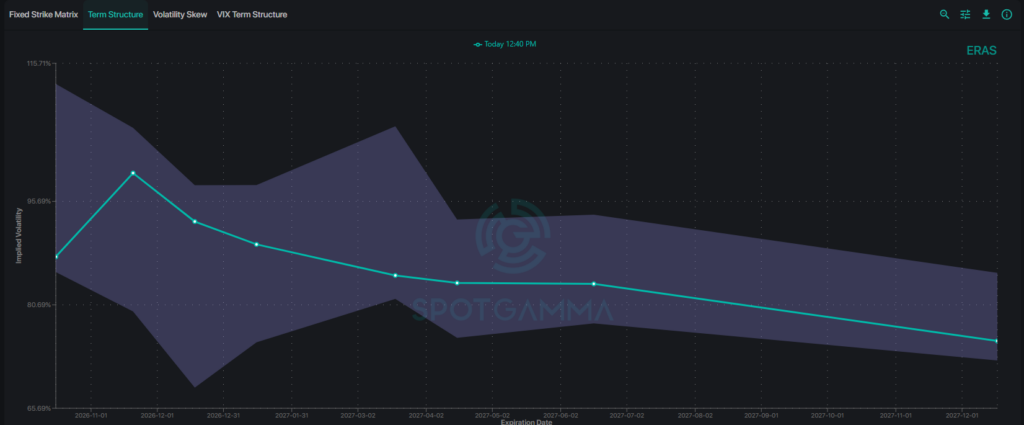
The term structure of ERAS options shows the clear bid to implied volatility around the November expiration which should capture the drug data release expected that same week. The term structure then tails off lower in further out months in 2027.
The main safety risk
Most side effects reported so far have been manageable. The most common were skin rash, diarrhea and mouth irritation.
However, one patient developed serious lung inflammation known as pneumonitis and later died after choosing to stop supportive care. Investors will watch for any additional cases of pneumonitis or other severe side effects.
A drug can shrink tumors and still fail if patients cannot safely remain on treatment. That is why the November safety update may be nearly as important as the response rate.
Erasca has plenty of cash—but the stock is not cheap
Erasca had approximately $384 million in cash and investments at the end of June. It then raised another $594 million in net proceeds through a July stock offering. The headline number from the offering is higher: gross proceeds before underwriting discounts and other expenses were approximately $632.5 million, from 36,142,857 shares sold at $17.50.
That gives the company close to $1 billion before accounting for more recent spending. This is important because clinical trials are expensive. Erasca should not need to immediately raise more money to continue developing its drugs.
The downside is that investors already value the company at roughly $5 billion. That is a high valuation for a company without an approved product or revenue.
The market is therefore expecting ERAS-0015 to become an important cancer drug. Good results may not be enough—the data may need to be strong enough to justify those expectations.
The other intriguing factor is the stock’s short interest is declining the past several months and near 9% currently, down from 11% earlier this summer. That is relatively low for a biotech to begin with and seeing short interest decrease in a biotech awaiting key data is potentially a positive signal.
Could Erasca be acquired?
Erasca has several characteristics that could interest a larger pharmaceutical company:
- A promising cancer drug targeting a major area of medical need
- A second RAS drug called ERAS-4001
- A strong cash position
- Management with previous acquisition experience
Merck is already working with Erasca on a trial combining ERAS-0015 with Keytruda. This gives Merck a close look at the drug, but the partnership is not evidence that Merck plans to acquire the company. (Source: ERAS Investor Relations)
Erasca CEO Jonathan Lim also founded Ignyta, which Roche acquired for $1.7 billion in 2018. That history adds to the takeover speculation, although it does not guarantee another sale.
There is also an intellectual-property dispute with competitor Revolution Medicines. Erasca believes the allegations are without merit, but the uncertainty could make a potential buyer more cautious.
M&A should therefore be viewed as possible additional upside—not the primary reason to own the stock.
What the options market expects
Options are contracts traders use to speculate on or protect against a future stock move. When an important event is approaching such as a binary one in the biotech world, options usually become more expensive because traders expect greater volatility.
The relevant ERAS options expire on November 20—the same day the clinical results will be presented.
Based on recent options pricing, the market is roughly accounting for the stock to finish between approximately $9 and $21 after the event. That represents a possible move approaching 40% in either direction from the $15 area.
This does not mean the stock will definitely remain inside that range. It simply shows that options traders expect an unusually large reaction.
The SpotGamma volatility skew graph below shows November expiration with a bit more put skew than call skew which is common in biotechs that have binary risk. The Nov $17.50 calls that were recently bought do show lower overall skew than other strikes however.
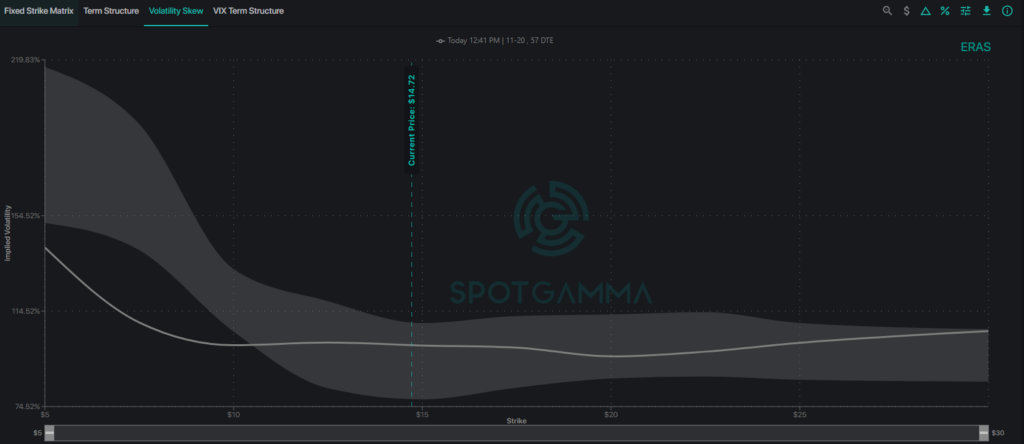
There was also heavy buy side trading in the November $17.50 calls this month with 10,000 bought at $2.05 on 9/18. This follows bullish spreads in January expiration that opened earlier this summer and still hold in open interest. Over 15,000 of the January $15/$35 call spreads traded and may have been a call ratio spread taking advantage of skew.
Because ERAS options have wide bid-ask spreads and limited liquidity, their signals should be treated cautiously. (Source: CBOE)
The bottom line
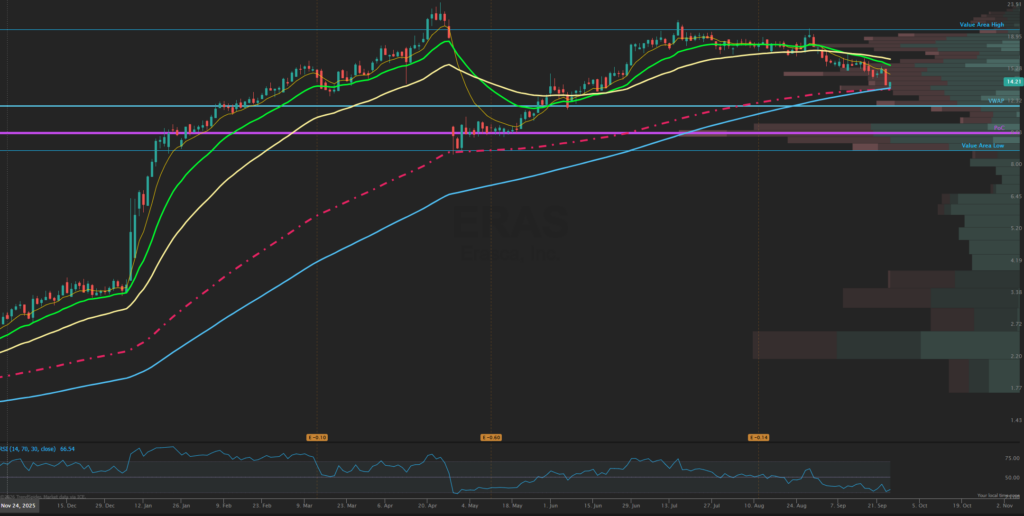
ERAS stock price the past year has had quite the rally from late 2025 being under $5.00 and making an April 2026 high of nearly $25. The stock has now retraced to the rising 200 day moving average making the risk to reward compelling ahead of November data.
The November catalyst comes down to a simple question: Do Erasca’s promising early results continue when more patients and longer follow-up are included?
If tumor responses remain strong, last longer and do not create new safety concerns, ERAS-0015 could move closer to larger registration trials. That could support a higher stock price and increase potential acquisition interest.
If response rates weaken, serious side effects increase or the drug fails to separate itself from competing treatments, the stock could fall sharply.
Erasca has promising science, a strong balance sheet and potential M&A appeal. But expectations are already high, and the options market is preparing for a large move in either direction.