A ratio spread is an options strategy in which you buy one option and sell two (or more) further out-of-the-money options of the same type and expiration. The most common version — the 1×2 call ratio spread — buys one call and sells two higher-strike calls, often for a net credit, profiting most if the stock drifts up to the short strike and sits there. The tradeoff: one of the two short options is uncovered, so a runaway move through the short strike carries open-ended risk.
Key Takeaways
- A 1×2 call ratio spread buys one call and sells two higher-strike calls; a put ratio spread does the same on the downside.
- Put on for a credit, the trade profits or scratches anywhere below the short strike — the stock can fall, sit still, or rally modestly and you keep money.
- Max profit lands exactly at the short strike at expiration, where the long call is worth full spread value and both short calls expire worthless.
- The second short call is naked. Beyond the upside breakeven, losses grow point-for-point with the stock — this is the defining risk of the structure.
How the Ratio Spread Works
Think of a ratio spread as a bull call spread that pays for itself — and then some — by selling one extra call. The embedded 100/105 call spread gives you participation in a move up to the short strike. The extra short 105 call brings in additional premium, often enough to turn the whole package into a net credit.
That extra short call changes the character of the trade. A plain debit spread is a directional bet with capped risk. The 1×2 is a bet on a measured move: you want the stock to grind toward the short strike and stop. The position is short extrinsic value overall, so time decay generally works for you, and falling implied volatility helps rather than hurts — the opposite of a long options position.
Above the short strike, the math flips. The long call and one short call cancel each other out, leaving you functionally short one naked call. Every point beyond the upside breakeven is a point of loss, with no cap.
Example
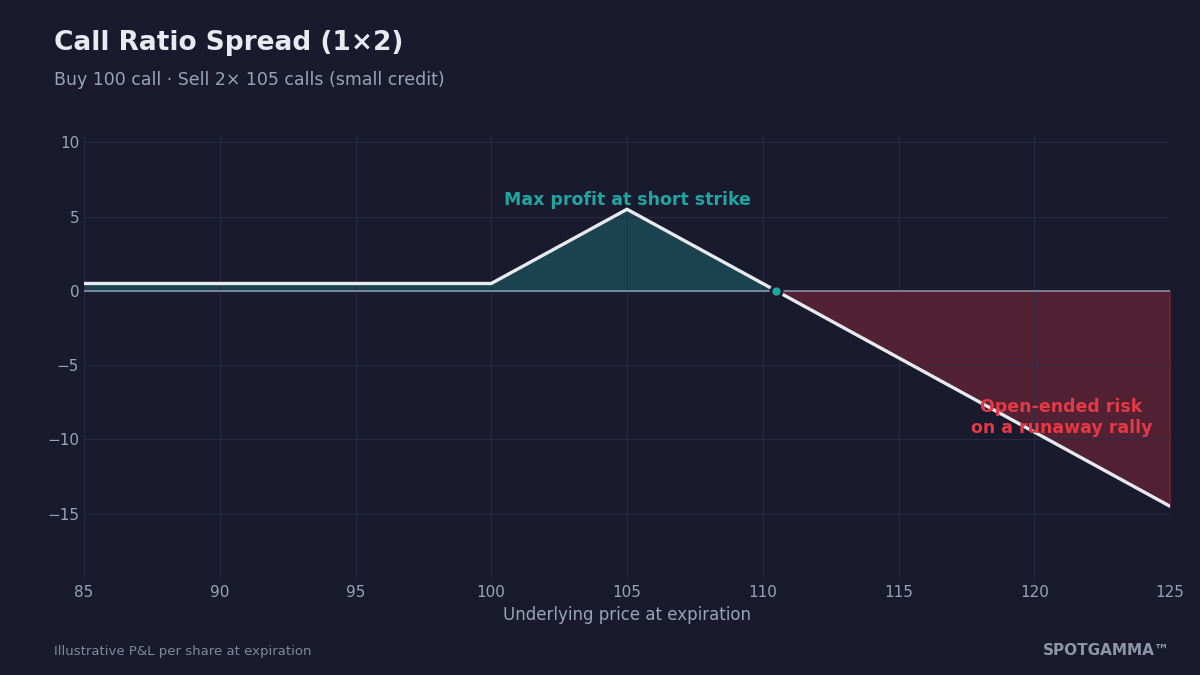
With the stock at $100:
- Buy 1× the 100 call.
- Sell 2× the 105 calls.
- Net credit: $0.50 ($50 per 1×2).
The outcomes at expiration:
- Below 100: every option expires worthless; you keep the $50 credit.
- At exactly 105: max profit. The 100 call is worth $5.00, both 105 calls expire worthless, and you keep the credit — $550 total.
- Above 105: profit erodes point-for-point. Breakeven sits near $110.50; beyond it, losses are open-ended.
Because the structure is entered for a credit, there is no price at which you lose on the downside — the risk lives entirely above the market. You can build this 1×2 and stress it across price and time in SpotGamma’s free Options Calculator before committing capital.
Ratio Spreads vs. Backspreads and Broken Wing Butterflies
- Vs. the call backspread: the mirror image. The backspread sells one and buys two, paying theta to own the explosive move. The front ratio collects theta and is hurt by the explosive move. Same legs, opposite convexity.
- Vs. the broken wing butterfly: a BWB is a ratio spread with the naked call bought back further out — capping the runaway risk in exchange for some credit. If the open-ended tail bothers you, the BWB is the defined-risk cousin.
- Vs. the bull call spread: the 1×2 is a bull call spread plus one naked short call. The debit spread costs money and caps risk; the ratio pays you and uncaps it.
Using Positioning Data to Trade It Better
The whole trade hinges on one question: will the rally stall at the short strike? That is precisely what options positioning data speaks to. This post is part of our options strategy library, and the ratio spread may be the single most positioning-sensitive structure in it:
- Sell the 2x strike at the Call Wall. The Call Wall marks the strike with the largest concentration of dealer gamma, where rallies have historically stalled as hedging flows lean against further upside. Placing the short strike there aligns your max-profit point with the market’s own resistance map.
- Respect the gamma regime. In positive gamma (GEX) regimes, dealer hedging dampens moves — the contained tape a front ratio wants. When GEX flips negative, hedging amplifies moves and strikes stop holding; that is a stand-aside signal for naked upside risk.
- Check the tape before fading it. Heavy real-time call buying on HIRO means hedging flows are actively fueling the rally you are about to sell into. A ratio spread opened into that flow is how the naked leg gets run over.
Risks
- Open-ended upside risk. One short call is uncovered. A takeover headline, short squeeze, or gamma-driven melt-up can push losses far beyond anything the credit compensates for.
- Margin. Brokers margin the naked leg like any short call, so the capital requirement is far larger than the credit received.
- Early assignment. The short calls can be assigned early once they go in-the-money, particularly around ex-dividend dates in American-style options.
- Slow to profit. Max profit accrues near expiration. A fast rally to the short strike early in the trade can show a mark-to-market loss even though the terminal picture looks fine.
FAQ
What is a 1×2 ratio spread?
A position that buys one option and sells two further out-of-the-money options of the same type and expiration — for calls, buy one lower-strike call and sell two higher-strike calls. It is the most common ratio spread and is frequently entered for a net credit.
Where is the risk in a call ratio spread?
Above the short strike. The long call covers one short call, leaving the second one naked, so losses grow without limit beyond the upside breakeven. Entered for a credit, the trade has no downside risk — the stock can go to zero and you keep the credit.
Why do traders sell ratio spreads for a credit?
The credit removes one side of the risk graph entirely: there is no losing outcome below the long strike. Traders accept the naked upside leg in exchange for a position that wins if the stock falls, sits still, or rises moderately — three of the four possible outcomes.
This article is for educational purposes only and is not financial advice. Options involve substantial risk and are not suitable for all investors.