A bull call spread is a defined-risk options strategy that buys a call option and sells a second call at a higher strike in the same expiration, paying a net debit that is the most the trade can lose. The long call provides the upside exposure; the short call finances part of it and caps profit at the higher strike. The result is a cheaper, slower-decaying way to trade a rally to a specific target than buying a call outright.
Key Takeaways
- Buy a call, sell a higher-strike call, same expiration — max loss is the debit, max profit is the strike width minus the debit.
- The short strike is a profit target, not a formality: the trade pays in full when price reaches it and nothing extra beyond it.
- The short leg offsets theta decay and softens IV crush, which makes debit spreads more forgiving than long calls into events.
- Breakeven sits at the long strike plus the debit — the stock must actually move for the trade to win.
How the Bull Call Spread Works
A plain long call has two quiet costs: the extrinsic value that decays every day, and the implied-volatility premium that can collapse the moment an awaited event passes. The bull call spread attacks both by selling a higher-strike call against the long one. The premium collected shrinks the net cost, and because the short leg carries extrinsic value of its own, its decay and its IV exposure partially cancel the long leg’s. You are left holding mostly the thing you actually wanted: exposure to the stock traveling from here to there.
The payoff is simple at expiration. Below the long strike, both options expire worthless and the debit is lost. Between the strikes, the long call’s intrinsic value grows dollar-for-dollar with the stock. At and above the short strike, every extra dollar gained on the long call is surrendered on the short call — profit is frozen at the width minus the debit.
Spread pricing carries a useful signal: the cheaper the spread relative to its width, the less probability the market assigns to the move. Paying $4.00 for a $10-wide spread means the market prices roughly a coin flip’s worth of that journey; paying $8.00 means the market already believes, and your edge has largely been spent.
Example
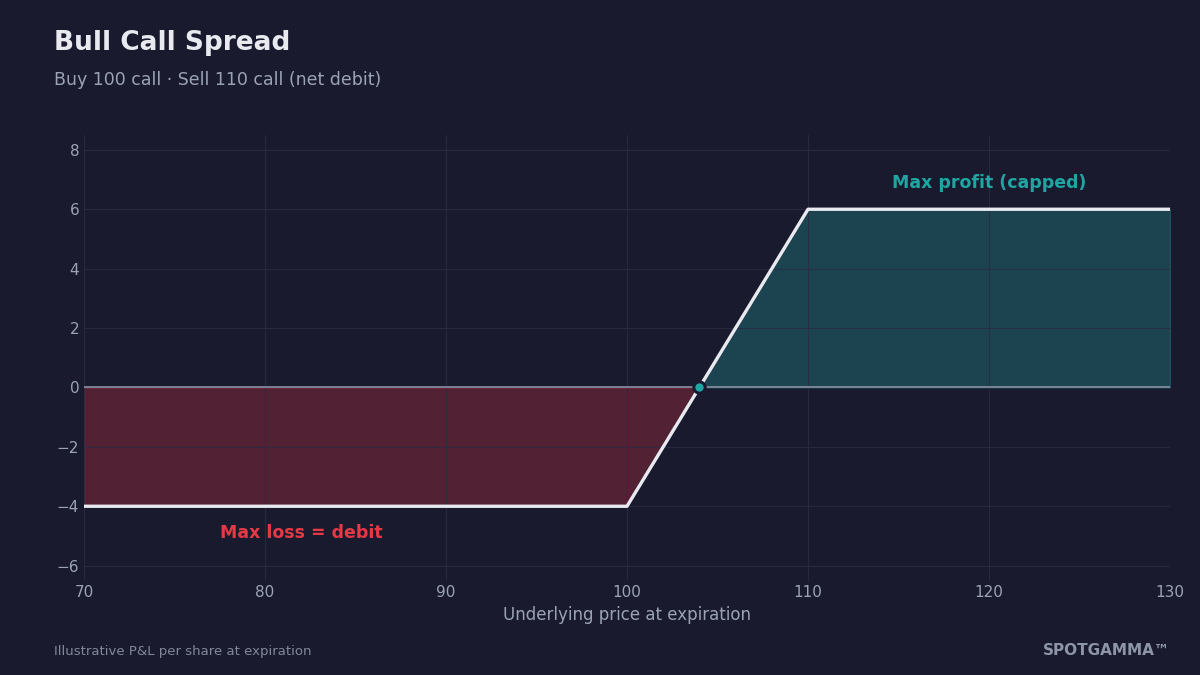
With the stock at $100:
- Buy the 100 call.
- Sell the 110 call.
- Net debit: $4.00 ($400 per spread).
At expiration, the maximum loss of $400 lands anywhere below 100 — the entire debit, but never more. Breakeven is 104. Above 110, profit is capped at the maximum of $600: the $10 width minus the $4 paid. The trade risks $400 to make $600, and that 1.5-to-1 payout is the compensation for needing the stock to rally through the breakeven rather than merely survive.
Bull Call Spread vs. Related Strategies
Where this structure sits in our options strategy library:
- Vertical spreads explained — the family overview: all four bull/bear, debit/credit combinations and how they relate.
- Bull put spread — the credit-side twin: a nearly identical risk graph built by selling puts below the market, paid for the move not happening instead of paying for the move.
- Bear call spread — the mirror image: the trader selling you this spread’s upside is effectively running one.
Using Positioning Data to Trade It Better
The short strike decides the trade, and dealer positioning data tells you where to put it:
- Place the target where price can actually arrive. Rallies through the Call Wall are historically hard-won, because the heavy dealer gamma at that strike leans against further upside. Setting the short strike at or below the wall means your maximum payout zone sits inside the range hedging flows permit — not beyond it.
- Use spreads when IV is the enemy. Into earnings and events, long calls pay top dollar for implied volatility that evaporates on the news. The short leg of a debit spread sells some of that same rich IV back, which is why spreads survive IV crush far better. Checking the gamma exposure (GEX) backdrop helps you judge whether the tape favors a grind toward the wall or a stall.
- Model it before you trade it. Compare the spread against the outright call across price and time in SpotGamma’s free Options Calculator.
Risks
- The full debit is lost if the stock finishes below the long strike — defined risk is not small risk.
- A rally that arrives after expiration pays nothing; spreads force you to be right about timing, not just direction.
- Profit is capped: in a runaway rally the spread earns $600 while the outright call keeps climbing.
- The short leg can be assigned early once it is in-the-money, particularly around ex-dividend dates, creating a short stock position until managed.
FAQ
When should you use a bull call spread instead of buying a call?
When you have a price target rather than a conviction that the move could be unlimited, and when implied volatility is elevated. The spread’s short leg cuts the cost, slows the decay, and offsets IV crush — advantages that matter most into events and in expensive options.
What is the max loss on a bull call spread?
The net debit paid, in this example $400 per spread. It occurs when the stock finishes at or below the long strike at expiration, and no scenario can lose more than that amount.
Should the short strike be above or below resistance?
At or below it. The short strike is where your profit maxes out, so placing it beyond a level that price struggles to clear — such as the Call Wall, where dealer hedging historically stalls rallies — pays you for distance the stock may never travel. A target the market can reach is worth more than a bigger one it cannot.
This article is for educational purposes only and is not financial advice. Options involve substantial risk and are not suitable for all investors.