A synthetic long stock position buys a call and sells a put at the same strike and expiration, producing a profit-and-loss profile that mirrors owning 100 shares almost exactly. The combination is put-call parity made tradable: long call plus short put equals long stock. Traders use it to hold stock-like exposure with far less capital outlay than buying shares — while accepting that the short put carries the full downside of share ownership.
Key Takeaways
- Long call + short put at the same strike and expiry = synthetic long stock; the payoff is a straight line through the strike, just like shares.
- The position’s delta is approximately 100 from entry — the call’s delta and the short put’s delta always sum to roughly one.
- Capital outlay is a fraction of the share price, but the margin on the short put is where the real exposure lives: downside risk equals stock all the way to zero.
- The structure is the foundation for understanding every “combo” — collars, risk reversals, and conversions are all variations on the same parity.
How the Synthetic Long Works
Put-call parity says that for European options, a call and a put at the same strike and expiry are linked by a fixed relationship: call minus put equals stock minus the discounted strike. Rearranged, buying the call and selling the put reconstructs the stock’s payoff exactly — above the strike, the call gains point-for-point; below it, the short put loses point-for-point. There is no price at expiration where the combination behaves differently from shares bought near the strike.
Why does the combination cost nearly nothing? The call you buy and the put you sell carry almost identical extrinsic value at the same strike, so the premiums roughly cancel. Whatever small net debit or credit remains reflects interest rates and dividends — the carry cost of the shares you are choosing not to buy. If the package ever priced meaningfully away from parity, arbitrageurs would trade stock against the combo until it snapped back.
Greeks are refreshingly boring: delta near 100, gamma, vega, and theta all near zero because the long and short legs offset. You are not making a volatility bet. You own the direction, full stop.
Example
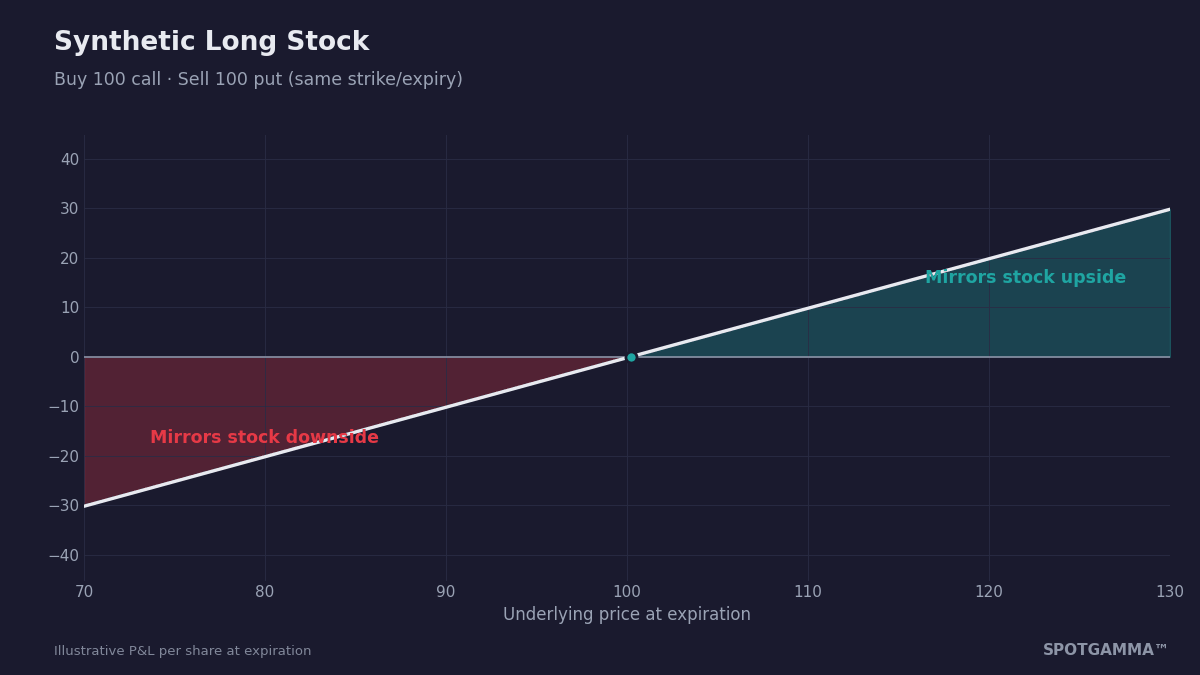
With the stock at $100:
- Buy 1× the 100 call.
- Sell 1× the 100 put (same expiration).
- Net cost: about $0.20.
At expiration the position is worth exactly what the stock did: at $110 the call is worth $10 (+$980 after cost); at $90 the short put costs $10 (−$1,020). Every dollar the stock moves, the combo moves — up or down — while committing a fraction of the $10,000 the shares would require upfront. Lay the synthetic side-by-side with 100 shares in SpotGamma’s free Options Calculator and the two P&L lines sit on top of each other.
Synthetic Long vs. ZEBRA, Risk Reversal, and LEAPS
- Vs. the ZEBRA: the honest comparison. Both replicate stock-like delta, but the ZEBRA caps the downside at its debit while the synthetic leaves it fully open. The synthetic is cheaper to carry; the ZEBRA lets you sleep through a gap down.
- Vs. the risk reversal: split the synthetic’s strikes apart — put below the market, call above — and you have a risk reversal: a flat zone in the middle, with skew usually improving the financing.
- Vs. LEAPS calls: a deep-ITM LEAPS call is the defined-risk route to long-term stock-like delta. The synthetic tracks shares more exactly, but the LEAPS buyer’s worst case is the premium, not the strike.
Using Positioning Data to Trade It Better
A synthetic is a pure delta position, so the work is all in entry level and timing — the same questions dealer positioning data is built to answer. This post is part of our options strategy library:
- Enter at levels where hedging supports price. Initiating a synthetic long as the market tests the Put Wall aligns your 100-delta entry with the strike where concentrated put gamma has historically slowed declines — the market’s own structural support, which matters doubly when your downside is uncapped.
- Let the gamma regime set expectations. Positive GEX regimes tend to contain moves — favoring entries at range extremes; negative-gamma regimes extend them — rewarding momentum entries confirmed by real-time hedging flows on HIRO, and punishing early dip-buying.
Risks
- Full stock downside. The short put means the position loses like shares all the way to zero. Capital efficiency is not risk reduction — size the trade as if you owned the stock.
- Margin expansion at the worst time. As the stock falls, the short put’s margin requirement grows, which can force liquidation during drawdowns.
- Early assignment. An in-the-money American-style short put can be assigned before expiry, converting the position to actual shares — same economics, but a sudden change in capital usage.
- No dividends. Synthetic holders do not collect dividends; expected dividends are already priced into the combo’s cost.
FAQ
How does a synthetic long differ from owning stock?
The expiration P&L is nearly identical; the differences are practical. The synthetic requires less capital upfront, pays no dividends, has an expiration date, and carries assignment and margin mechanics. Economically, you hold the same exposure with different plumbing.
What is put-call parity?
The no-arbitrage relationship linking calls, puts, stock, and cash: a call minus a put at the same strike and expiry equals the stock minus the discounted strike. It is why the long-call/short-put combo reconstructs shares, and why mispricings between options and stock cannot persist.
When would a trader use a synthetic instead of shares?
When capital efficiency matters — freeing cash while keeping full exposure — or when options markets offer better execution than the shares. It also appears inside broader structures: conversions, reversals, and collar adjustments all lean on the synthetic relationship.
This article is for educational purposes only and is not financial advice. Options involve substantial risk and are not suitable for all investors.