LEAPS (Long-term Equity AnticiPation Securities) are options with roughly a year or more until expiration, and a LEAPS options strategy uses them to hold long-term directional exposure with far less capital than owning the shares. A LEAPS call controls 100 shares for a fraction of their cost, with risk strictly limited to the premium paid. Because the time horizon is long, LEAPS behave less like short-dated options — slow decay, high sensitivity to implied volatility — and more like a leveraged, defined-risk stand-in for the stock itself.
Key Takeaways
- LEAPS are ordinary calls and puts with 1–2+ years to expiration — the long horizon, not the contract type, is what changes their behavior.
- Max loss is the premium paid; upside on a LEAPS call is open-ended above the breakeven.
- Entry timing dominates returns, because you buy years of time premium in a single print — the IV level on entry day is baked in for the life of the trade.
- Deep-ITM LEAPS (roughly 70–80 delta) track the stock closely and serve as the long leg of the poor man’s covered call.
How the LEAPS Strategy Works
Every option’s price splits into intrinsic value and extrinsic (time) value, and the LEAPS trade is fundamentally a bet that the long runway is worth the time premium. Two properties follow from the long expiry.
First, theta is slow. Time decay is not linear — it accelerates as expiration approaches. A two-year option loses relatively little value per day in its first year; most of the decay is concentrated in the final months. A LEAPS buyer who exits with a year remaining never pays the steep part of the decay curve, which is why LEAPS are usually closed or rolled early rather than held to expiry.
Second, vega is large. With so much time value on the books, the position’s mark moves meaningfully with implied volatility. Buy LEAPS when IV is elevated and a subsequent vol normalization can offset months of being right on direction. This is the mechanical reason entry timing matters more for LEAPS than for almost any other long-premium trade.
Moneyness sets the character. An OTM LEAPS is a long-odds convexity bet that is mostly extrinsic value. A deep-ITM LEAPS at 70–80 delta is mostly intrinsic — it gains and loses nearly point-for-point with the shares, which is what makes it a genuine stock substitute.
Example
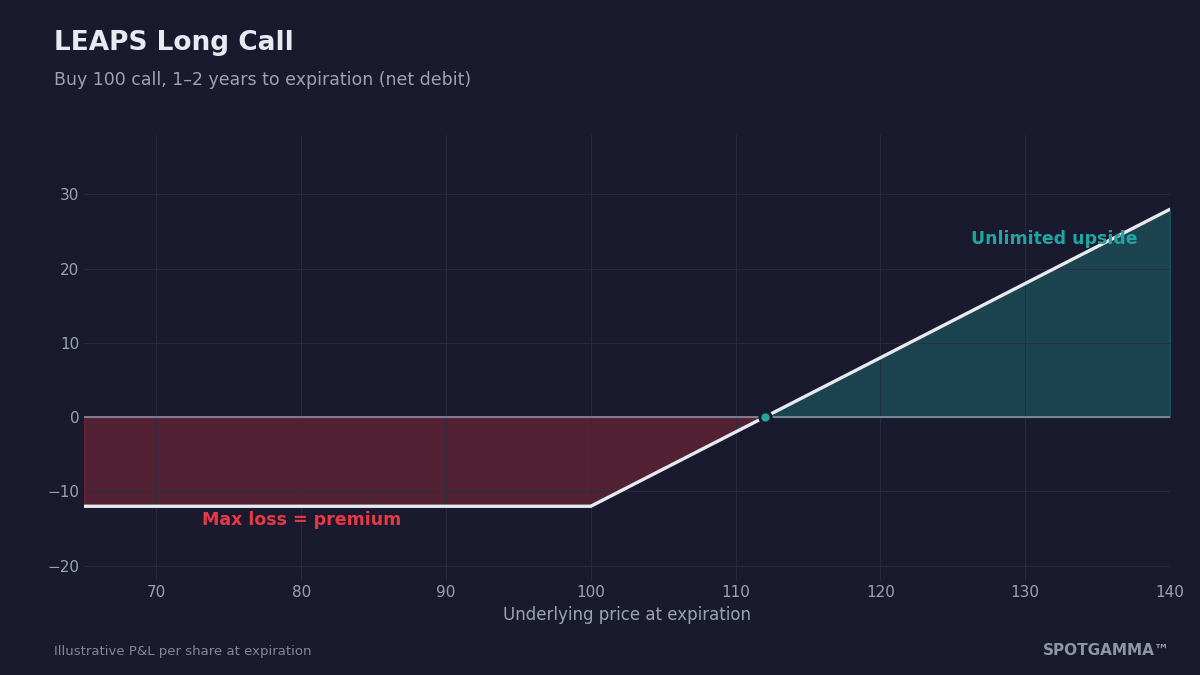
With the stock at $100:
- Buy one $100 call with 1–2 years to expiration for $12.00.
- Max loss: $1,200, no matter how far the stock falls.
- Breakeven at expiration: $112 — though in practice LEAPS are usually closed or rolled well before expiry, when the position still carries time value and the breakeven is effectively lower.
Compare the alternative: $10,000 of stock with $10,000 of downside. The LEAPS buyer risks $1,200 for the same open-ended upside, paying $12 of premium for the privilege. How that trade-off evolves across price, time, and volatility is worth seeing before committing a year of premium — model it in SpotGamma’s free Options Calculator.
LEAPS vs. Related Strategies
- Vs. owning stock: less capital, defined risk, no dividends, and a clock. The stock owner can be wrong indefinitely; the LEAPS owner pays for every month of being early.
- Vs. synthetic long stock: the synthetic (long call, short put) replicates shares almost exactly with near-zero premium outlay, but the short put leaves the full downside open. The LEAPS call costs more and caps the loss at the debit.
- Vs. the poor man’s covered call: the PMCC is a LEAPS plus a recurring short call — the natural next step once you own a deep-ITM LEAPS and want to grind down its cost basis.
Using Positioning Data to Trade It Better
Because the IV you pay on day one is locked in for years, positioning data earns its keep on the entry. As with everything in our options strategy library, the point is mechanics, not prediction:
- Enter after the washout, not during it. Negative-gamma flush days — the tape accelerating down toward the Put Wall — have historically been the high-IV, low-price moments. The price looks attractive, but you are paying peak volatility for years of time premium. Waiting for IV to normalize after the flush materially lowers the cost basis of the same exposure.
- Use the Put Wall as the entry map. Declines have historically decelerated at the strike carrying heavy put gamma; a stabilization at that level with IV coming off is the structurally cleaner entry than catching the knife above it.
- Prefer 70–80 delta if the goal is stock replacement. Deep-ITM LEAPS minimize the extrinsic value you own, which minimizes the vega bet you’re implicitly making — and they slot directly into a PMCC later.
Risks
- The full premium is at risk. $1,200 is less than $10,000, but it goes to zero if the stock sits below the strike at expiration — a 100% loss on the position.
- IV crush hurts for a long time. Buying LEAPS at elevated volatility can leave the position underwater even as the stock drifts higher.
- No dividends, and a hard deadline. The thesis has to play out within the contract’s life; “eventually” is not a strike-friendly timeframe.
- Liquidity is thinner in long-dated chains — wide bid/ask spreads can cost a meaningful fraction of the edge on entry and exit.
FAQ
What counts as a LEAPS option?
Any listed equity or index option with roughly a year or more until expiration — exchanges list them out to about three years. They are structurally identical to ordinary options; only the long time horizon distinguishes them.
Should LEAPS be bought ITM or OTM?
For stock replacement, deep in the money at roughly 70–80 delta: mostly intrinsic value, minimal decay, close tracking of the shares. Out-of-the-money LEAPS are cheaper but are mostly time premium, making them a volatility bet that needs a large move to pay.
How does theta affect LEAPS?
Slowly at first — time decay accelerates near expiration, so a LEAPS loses relatively little per day in its early life. Most holders close or roll with six to twelve months remaining, avoiding the steep final stretch of the decay curve entirely.
This article is for educational purposes only and is not financial advice. Options involve substantial risk and are not suitable for all investors.