Applied Materials (AMAT) heads into fiscal fourth-quarter earnings on Thursday Nov 12th after the close of market as a key barometer for semiconductor capital spending. AI infrastructure, high-bandwidth memory and advanced chip packaging remain powerful growth drivers, but investors will want evidence that equipment orders and margins can sustain momentum into fiscal 2027.
With elevated options premiums, guidance may matter more than the earnings beat.
1. What Is the Options Market Pricing?
Wall Street expects approximately $10.30 billion in revenue and $4.06 in adjusted EPS, versus management’s prior outlook of $10.25 billion and $4.02. Last quarter, AMAT generated revenue of $9.12 billion and non-GAAP EPS of $3.50.
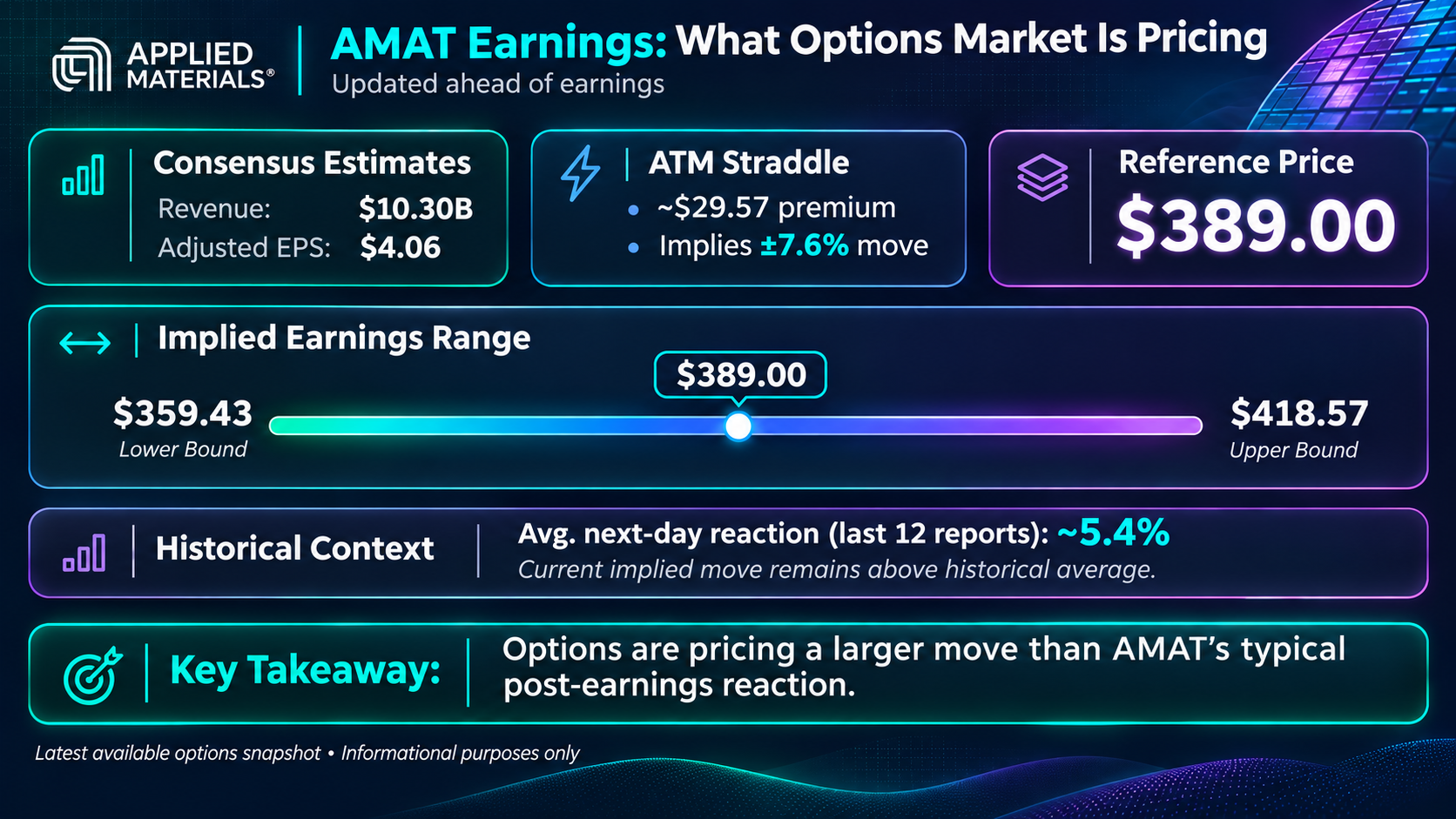
With AMAT trading near $392.12 on the morning of November 12, the November 13 at-the-money straddle is priced around $27.78, implying an earnings move of approximately 7.1%. That translates to an indicative post-earnings trading range of roughly $364-$420.
That is down from 9.2% implied earlier this week and 7.6% Wednesday.
For perspective, AMAT’s average next-session reaction across its last 12 earnings reports was approximately 5.4%. The current options premium therefore still implies a larger-than-typical reaction, creating a meaningful hurdle for traders purchasing directional options.
Takeaway: Direction alone may not be enough for option buyers if the realized move disappoints and implied volatility contracts.
2. Volatility Skew: Downside Protection Commands a Premium
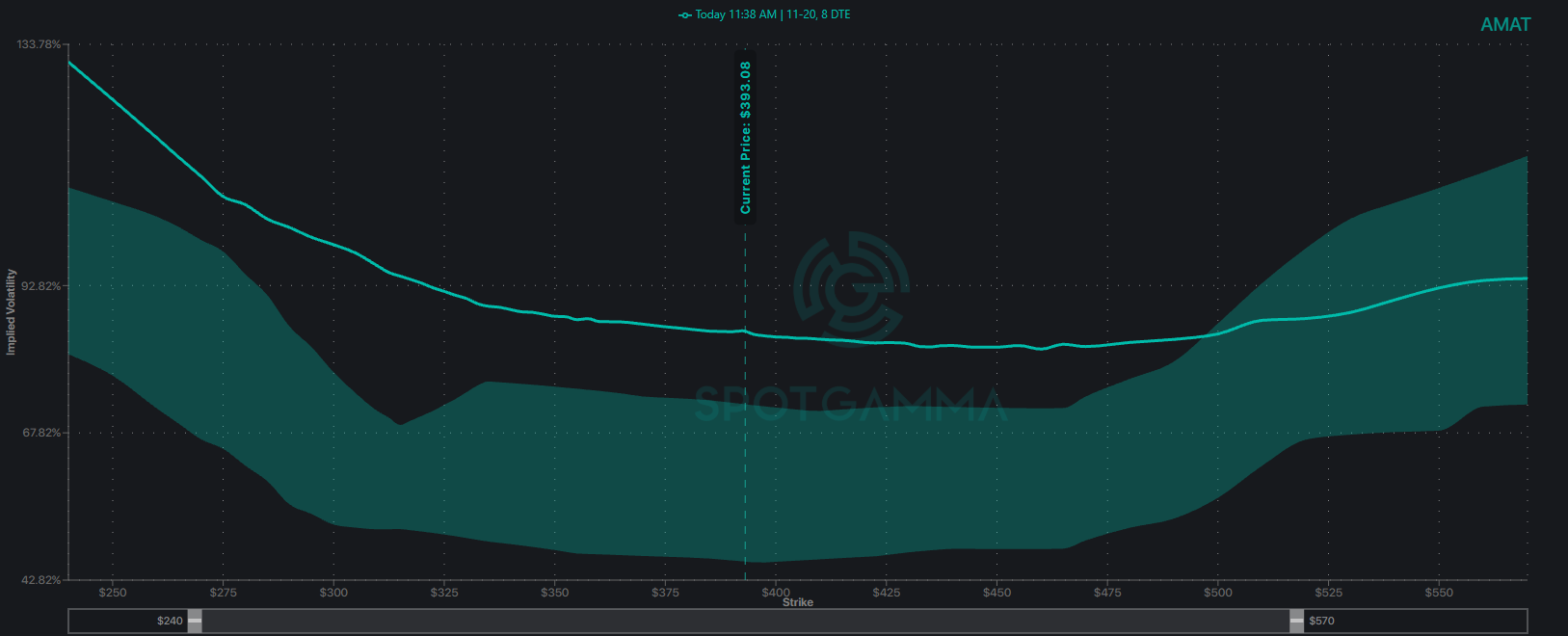
SpotGamma’s updated November 20 volatility skew shows at-the-money implied volatility near 84%, reflecting elevated options premiums ahead of Thursday’s earnings. With AMAT trading around $393 at the time of the snapshot, the curve continues to exhibit a pronounced downside skew.
Implied volatility rises sharply below $350, with particularly expensive protection at strikes below $300. Meanwhile, the curve flattens across approximately $400-$475 before gradually rising again above $500.
Unlike November 13 options, the November 20 curve spans additional trading days. Rich downside puts do not, by themselves, predict a decline.
Takeaway: Defined-risk spreads may provide cheaper directional exposure while limiting vulnerability to post-earnings volatility compression.
3. Dealer Gamma: $400 Remains the Key Pivot Ahead of Earnings
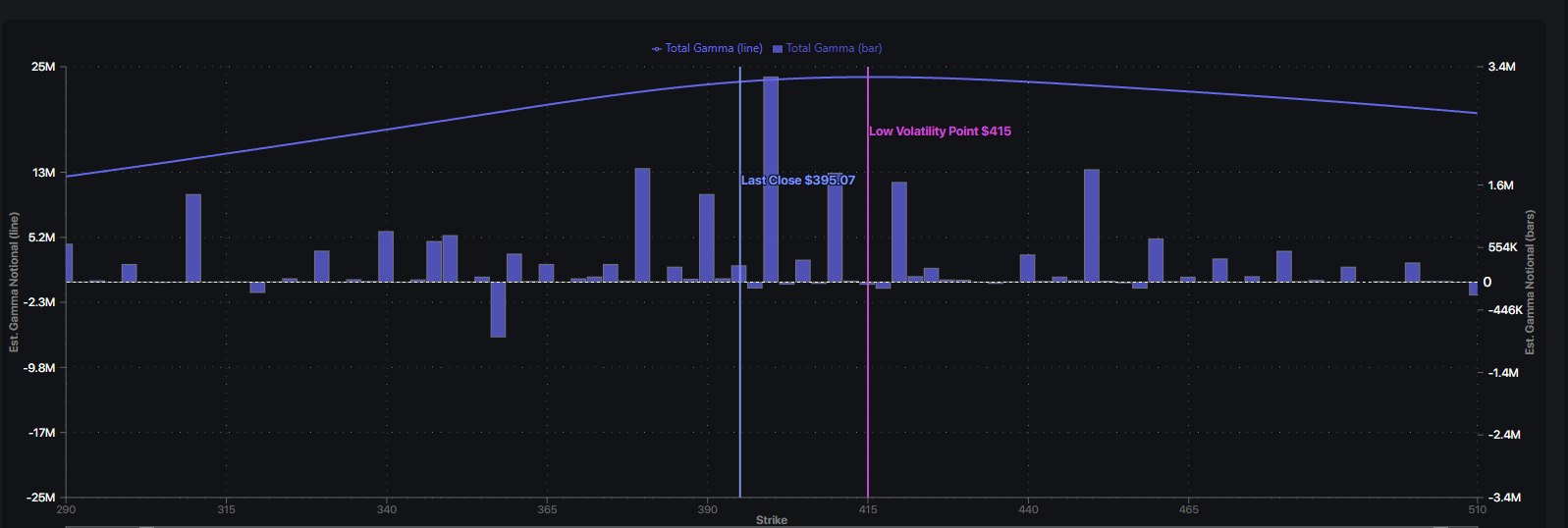
SpotGamma’s updated Synthetic OI dealer gamma map shows positive aggregate gamma across the displayed strike range, suggesting dealer hedging could provide a stabilizing influence ahead of Thursday’s earnings.
With AMAT’s reference closing price at $395.07, the largest positive gamma concentration sits near $400, making it the most important nearby positioning level. Additional positive concentrations appear around $380-$390, $410-$420, and $450.
SpotGamma’s Low Volatility Point has shifted from $447.50 to $415, where elevated positive gamma could dampen an earnings rally.
On the downside, a notable negative strike-level gamma concentration remains near $355-$360, although the broader modeled gamma profile stays positive.
Positive gamma positioning can encourage dealers to sell rallies and buy declines, potentially moderating price swings. However, an earnings surprise could overwhelm these stabilizing flows, particularly as existing positions unwind or shift after the announcement.
Takeaway: Watch $400 as the pivot and $415 as an upside volatility reference. A sustained break could signal earnings momentum overpowering dealer hedging.
4. Fundamental Catalysts: The 2027 Outlook Is the Real Test
AMAT’s August quarter delivered 25% year-over-year revenue growth and a 50.4% non-GAAP gross margin. The company has highlighted stronger demand from DRAM, leading-edge foundry/logic and advanced packaging as AI computing requires more complex manufacturing steps.
In October, management said it expects wafer-fabrication-equipment spending to accelerate through 2030, targeting more than two percentage points of market-share gains over that period.
Those long-term ambitions raise the stakes for near-term execution.
Three details deserve attention: fiscal 2027 demand visibility, especially memory and advanced packaging; margin durability as investment ramps; and China exposure, which represented 26% of Semiconductor Systems plus Global Services revenue last quarter.
Management’s first-quarter outlook could ultimately determine whether a Q4 beat is rewarded or sold.
5. Three Post-Earnings Scenarios
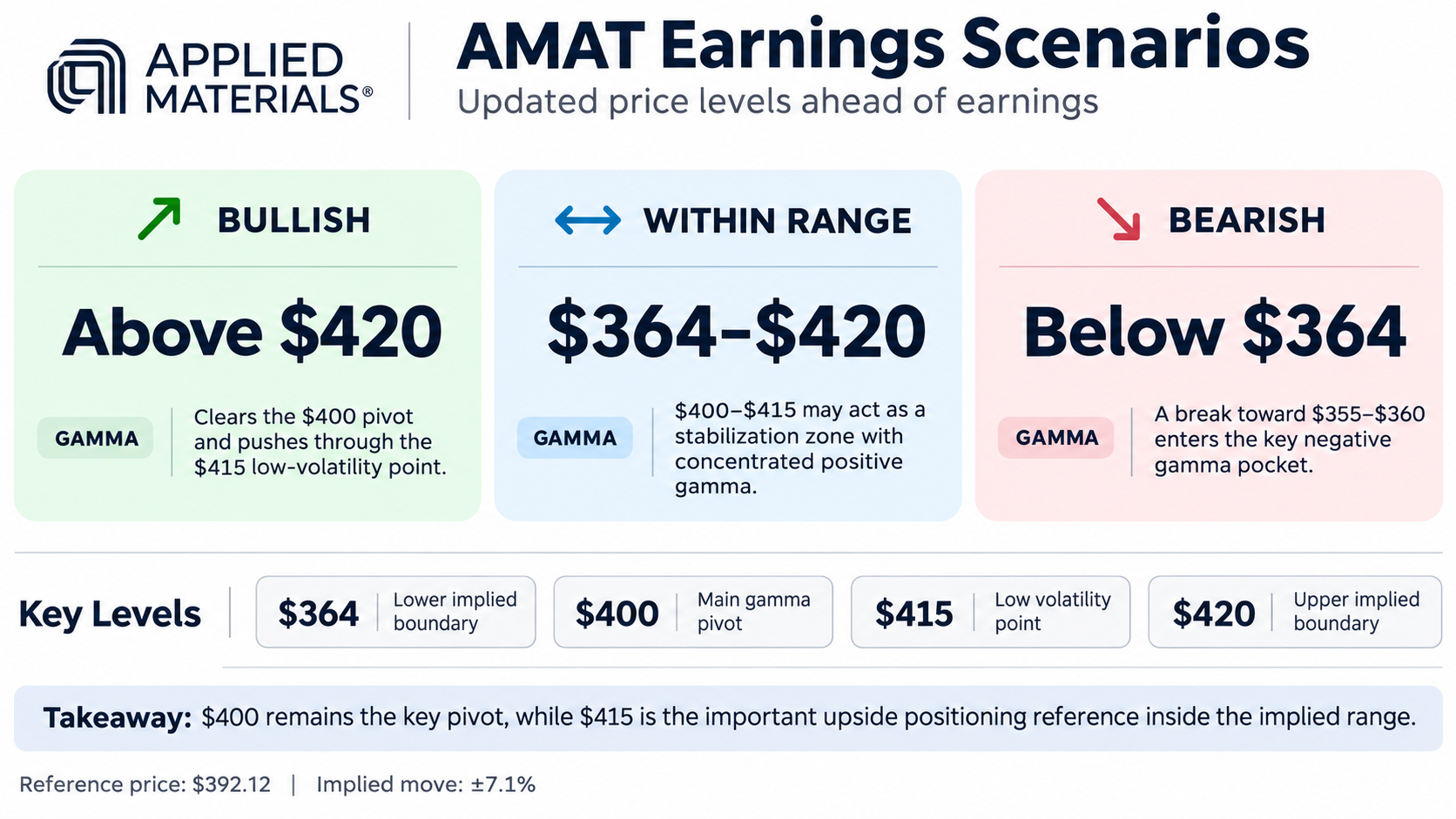
Bullish — Above $420
Strong results and constructive fiscal 2027 guidance drive AMAT beyond $420. A sustained move through $400 and the $415 Low Volatility Point would suggest earnings momentum is overcoming dealer hedging resistance.
A confirmed breakout could open the door toward $430-$450, where additional positive gamma concentrations may influence price action.
Within Implied Range — $364-$420
Results meet expectations, but guidance fails to materially reset the outlook. AMAT remains within the options-priced range, with $400-$415 potentially acting as a stabilization zone due to concentrated positive gamma positioning.
Post-earnings volatility compression becomes a key consideration, particularly for traders holding expensive outright calls or puts.
Bearish — Below $364
Disappointing orders, margins, or forward guidance push AMAT beneath the lower implied boundary near $364, signaling a larger-than-expected downside reaction.
A sustained decline would bring the notable $355-$360 negative strike-level gamma concentration into focus, potentially increasing sensitivity to additional selling. A further breakdown could expose the $340-$345 region.
Key Takeaway: A sustained break below $364 or above $420 would exceed the options market’s implied earnings range.
6. Options Trade Idea: A Bull Call Spread Targeting $420
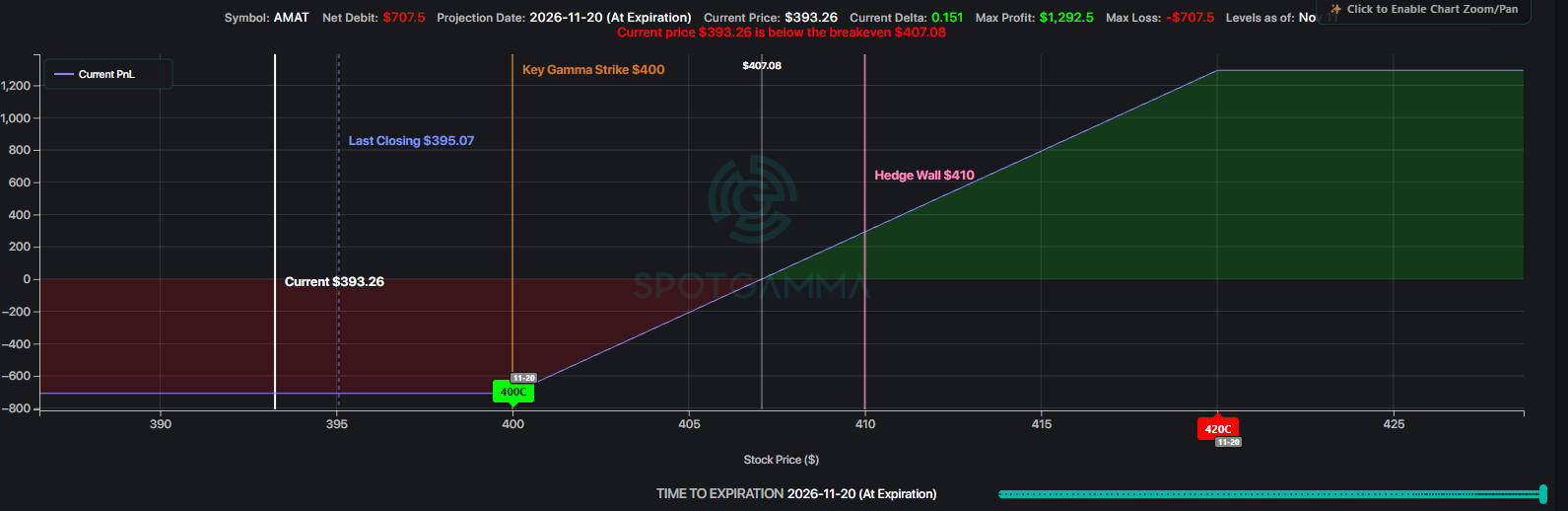
For traders expecting constructive earnings guidance and a moderately bullish reaction, the November 20 $400/$420 bull call spread offers a defined-risk way to participate in upside while limiting exposure to elevated options premiums.
Using recent indicative pricing, buying the $400 call for approximately $18.05 and selling the $420 call for $10.25 produces a net debit of $7.80 ($780 per spread).
At November 20 expiration, the position carries:
- Maximum risk: $780 per spread
- Maximum profit: $1,220 per spread
- Breakeven: $407.80
- Maximum profit reached: At $420 or higher
The structure aligns with SpotGamma’s positioning framework. The $400 strike represents the largest nearby positive gamma concentration, while the $415 Low Volatility Point sits just beneath the upper options-implied boundary near $420.
A rally through $400-$415 would favor the spread, which reaches maximum expiration value at $420. The short call offsets some upfront premium.
However, a muted reaction or disappointing guidance could leave the spread vulnerable to time decay and post-earnings volatility compression. The trade’s maximum profit and breakeven apply at expiration; earlier outcomes depend on remaining option values.
Takeaway: Defined-risk bullish exposure without requiring a breakout beyond $420.
Final Thoughts
AMAT enters earnings with strong semiconductor demand, elevated options premiums, and important dealer positioning around $400-$415.
The central question is whether management’s fiscal 2027 guidance can justify a move beyond the $364-$420 implied range.
With positive gamma potentially moderating price swings, traders should watch whether earnings-driven momentum can overcome these positioning levels. The bigger opportunity may come from allowing volatility to reset before establishing new directional exposure.