Palantir (PLTR) heads into Monday’s third-quarter earnings report with expectations elevated following another remarkable quarter of AI-driven growth. The company’s last report featured 93% revenue growth and sent shares sharply higher.
But with PLTR falling 6.3% on Friday and options pricing another double-digit earnings reaction, the market is signaling substantial uncertainty.
For options traders, the question is whether Palantir can deliver a surprise large enough to overcome expensive volatility and shifting dealer positioning.
1. What Is the Options Market Pricing?
PLTR options are pricing an unusually large move following Monday’s announcement.
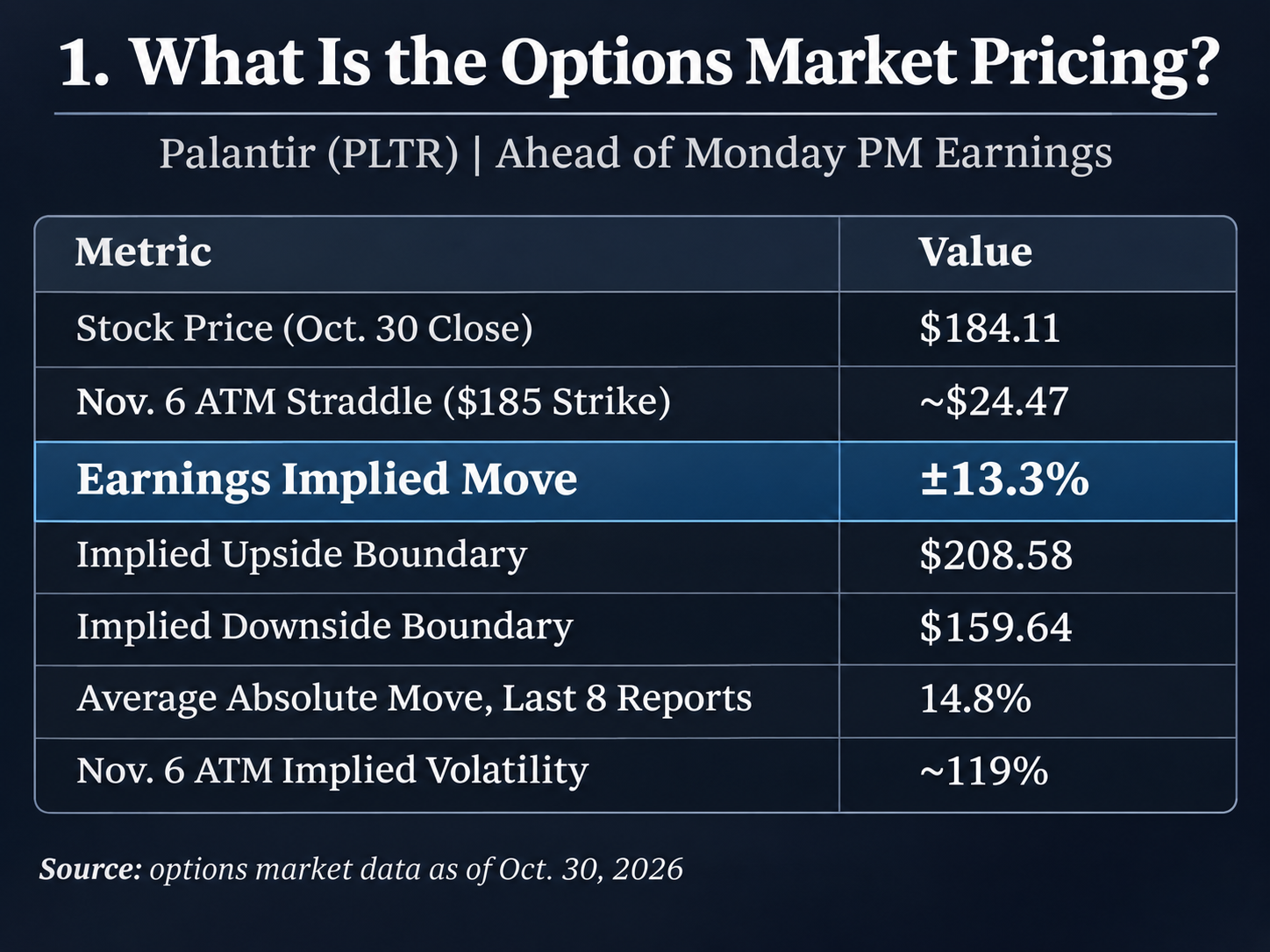
The $185 straddle costs approximately $24.47, meaning buyers need a significant move to overcome the premium paid, particularly if holding through expiration.
Interestingly, Palantir’s average absolute post-earnings reaction over its last eight reports is approximately 14.8%, slightly exceeding the current 13.3% implied move. The prior quarter produced a particularly large positive reaction of roughly 29%.
Options takeaway: Unlike some large-cap technology earnings where implied volatility historically overprices realized movement, PLTR has demonstrated an ability to deliver outsized reactions. That makes aggressively selling premium into this report potentially dangerous despite elevated IV.
2. Volatility Skew: Downside Protection Commands a Premium
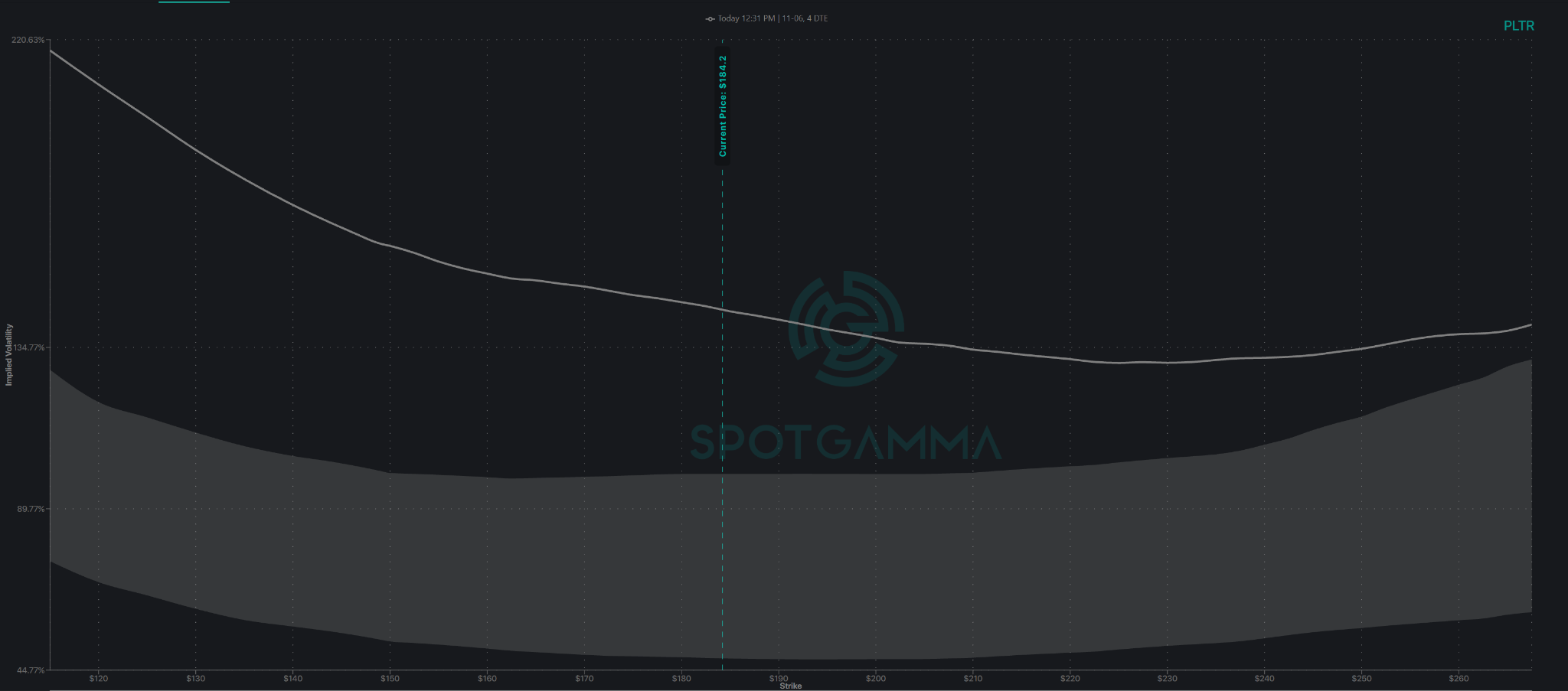
SpotGamma’s updated November 6 volatility skew shows a pronounced downside put skew, with implied volatility increasing sharply at strikes below PLTR’s current price of $184.20.
Near-the-money IV sits around 140–145%, while far out-of-the-money puts carry substantially higher implied volatility, exceeding 200% IV near the $120 strike. Conversely, upside call volatility is considerably flatter, declining toward 130–135% around the $220-$240 strikes.
This asymmetry suggests traders are paying aggressively for downside tail protection, while upside calls remain relatively less expensive on a volatility basis.
Options takeaway: The elevated put skew creates opportunities for defined-risk put credit spreads, but also reflects meaningful downside gap risk. For bullish traders expecting an outsized upside surprise, call debit spreads may offer a more attractive alternative to selling downside premium, particularly given PLTR’s history of large post-earnings moves.
3. Dealer Gamma Positioning: $175 Support, $190-$210 Upside
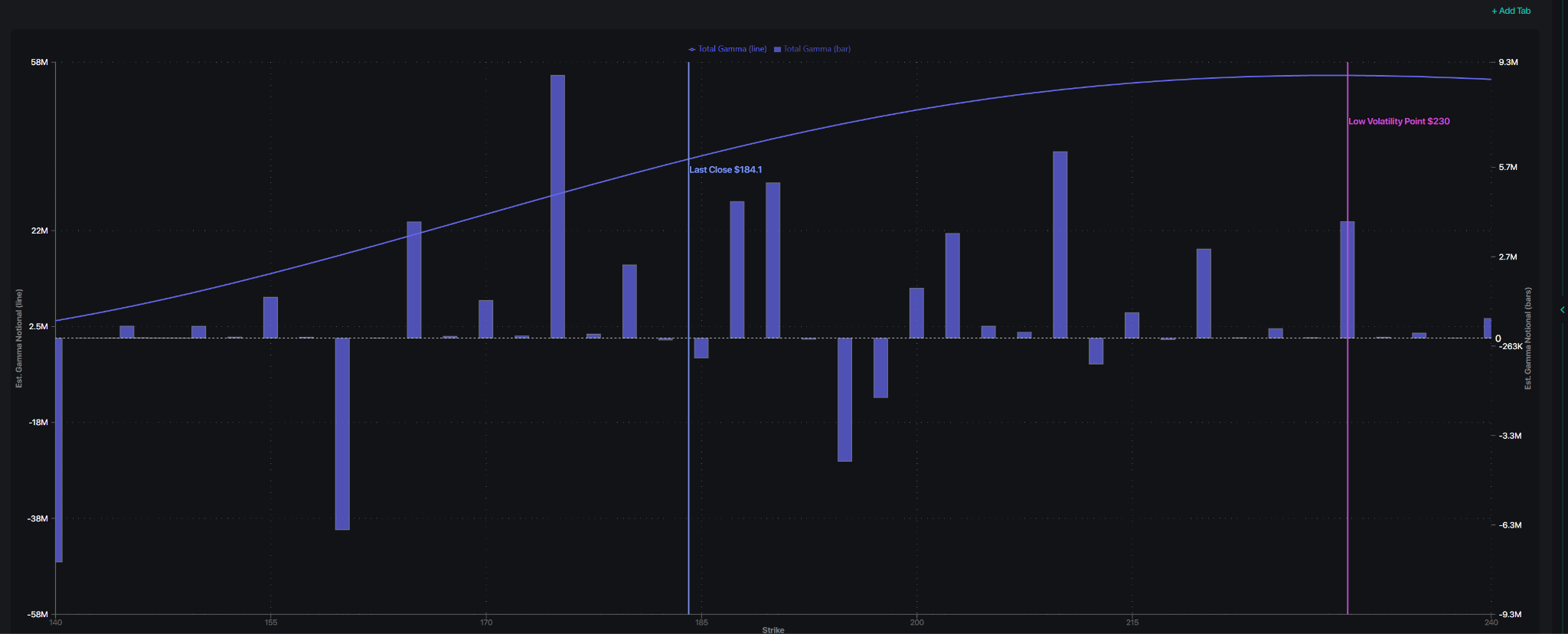
SpotGamma’s updated gamma map shows positive aggregate gamma near PLTR’s $184 price, suggesting dealer hedging could help dampen intraday volatility, although an earnings gap could overwhelm this positioning.
The largest positive gamma concentration sits at $175, establishing a potential downside support zone. Above spot, positive gamma clusters around $187.50-$190 and $210, while a negative gamma pocket near $195-$197.50 could amplify volatility if shares push through that region.
Options takeaway: A sustained recovery through $190-$195 would put $200 and eventually $210 in focus, while losing $175 would weaken the downside structure. These levels are conditional positioning estimates that could change significantly following earnings.
4. Fundamental Catalysts: Growth Expectations Remain Extraordinary
Palantir’s previous quarter established an exceptionally high bar.
| Metric | Q2 2026 Actual |
|---|---|
| Total Revenue | $1.94B (+93% YoY) |
| U.S. Commercial Revenue | $764M (+149% YoY) |
| U.S. Government Revenue | $809M (+90% YoY) |
| Adjusted Operating Margin | 62% |
| Adjusted Free Cash Flow | $1.22B |
For Monday’s report, Wall Street expects approximately $2.18 billion in revenue and $0.41 in earnings per share.
Management previously guided toward $2.16-$2.164 billion in Q3 revenue and $8.15-$8.158 billion for the full year.
Three factors should dominate the reaction:
- U.S. commercial growth: Can AIP adoption continue translating into exceptional contract and revenue growth?
- Government demand: Can defense and government contracts maintain their strong momentum?
- Forward guidance: Does management deliver another meaningful upward revision to 2026 expectations?
The third factor may matter most. With substantial growth already expected, simply beating consensus may not be enough if forward guidance disappoints.
5. Post-Earnings Reaction Scenarios
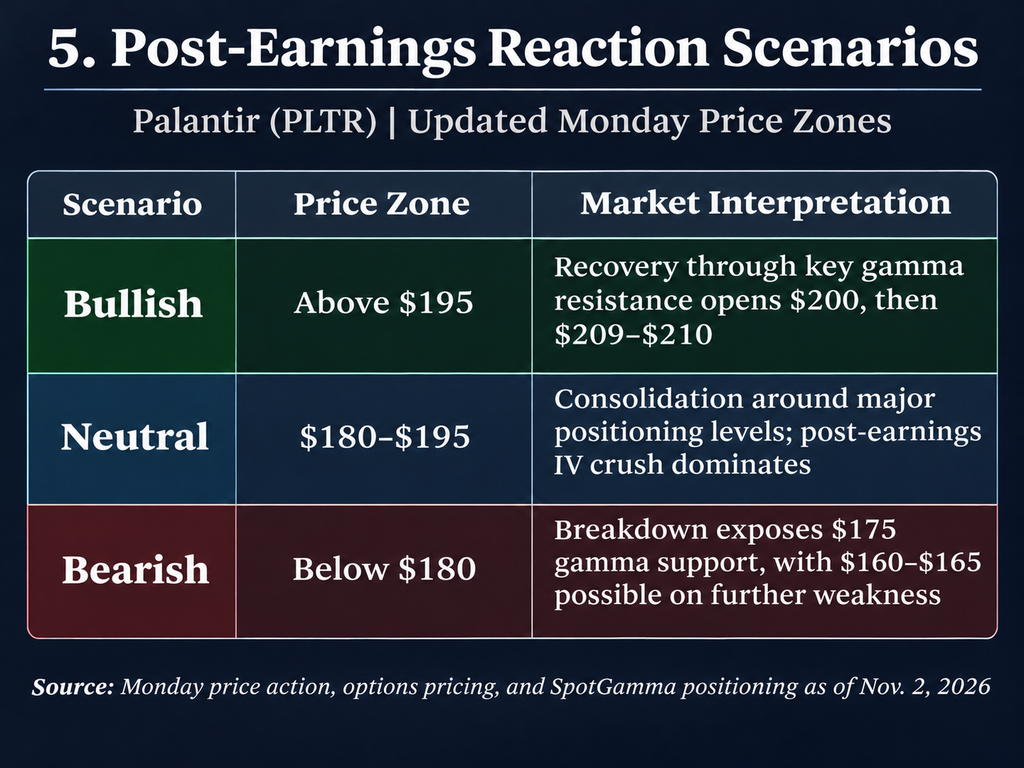
The $190–$195 area becomes the critical upside pivot, while $180 is the first downside threshold following Monday’s trading range.
A sustained break below $175 would weaken the positive gamma support structure and increase the potential for a move toward the lower options-implied boundary.
These are conditional reaction zones, not probability-weighted forecasts. Post-earnings dealer positioning could change significantly.
6. Options Strategy to Consider: Defined-Risk Call Debit Spread
With downside puts carrying elevated volatility premiums and SpotGamma positioning highlighting upside levels near $190-$210, a November 6 $185/$205 call debit spread offers an alternative for moderately bullish traders.
- Buy the $185 call.
- Sell the $205 call.
- Illustrative net debit: $7.45 ($745 per spread).
- Maximum profit: $1,255 per spread.
- Maximum loss: $745 per spread.
- Breakeven at expiration: $192.45.
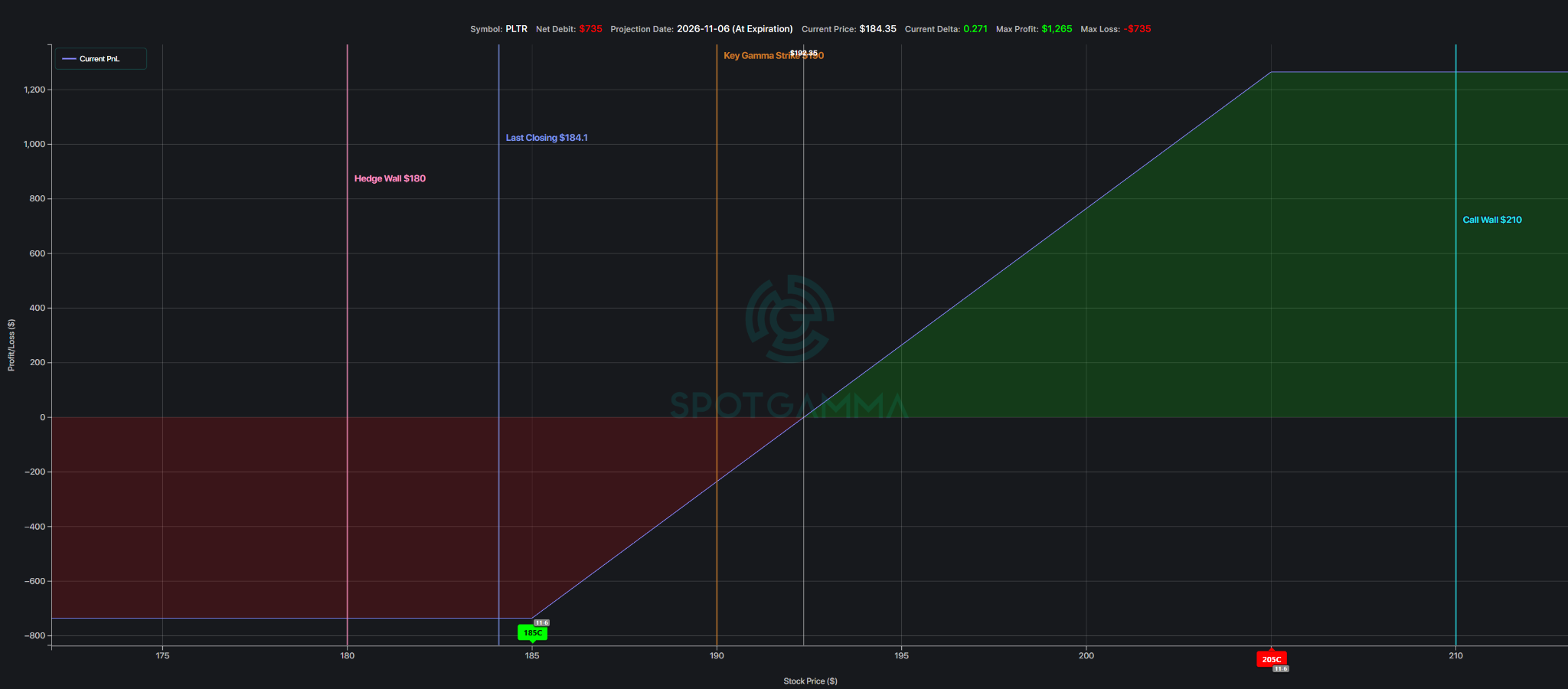
This structure benefits from a bullish earnings reaction while limiting downside exposure to the initial debit. The $205 short strike sits near the upper implied-move boundary, offering approximately 1.7:1 maximum reward-to-risk.
Although post-earnings volatility compression remains a consideration, the short $205 call partially offsets the long call’s volatility exposure. The primary risk is a bullish reaction insufficient to clear the $192.45 expiration breakeven.
Options takeaway: The updated skew favors considering defined-risk upside participation over aggressive downside premium selling. Traders without strong directional conviction may find better opportunities after Tuesday’s volatility reset.
Final Takeaway
Palantir enters earnings with extraordinary fundamental momentum, expensive short-term volatility, and significant downside skew.
The options market is pricing approximately a 13.3% reaction, while historical performance suggests that even larger moves remain plausible.
The central question is whether accelerating AI adoption and another upward guidance revision can justify the elevated expectations already embedded in shares.
The opportunity may be less about predicting Monday’s earnings surprise and more about trading Tuesday’s volatility reset and the price structure that emerges afterward.