Gamma Exposure (GEX) reveals how Wall Street dealers must trade to hedge their books — and those flows move the market.
SpotGamma pioneered institutional-grade GEX models, highlighting when stock volatility is set to trigger.
Here’s how it works:
| $80B+ Gross gamma in S&P 500 options | 68% Of sessions close inside SpotGamma’s GEX range |
| 60%+ Of SPX volume from 0DTE options daily | Since 2020 SpotGamma pioneered GEX analysis |
| See Live GEX Levels | Free SPX GEX Chart |
Static Options Data Won’t Tell You What Dealers Will Do Next
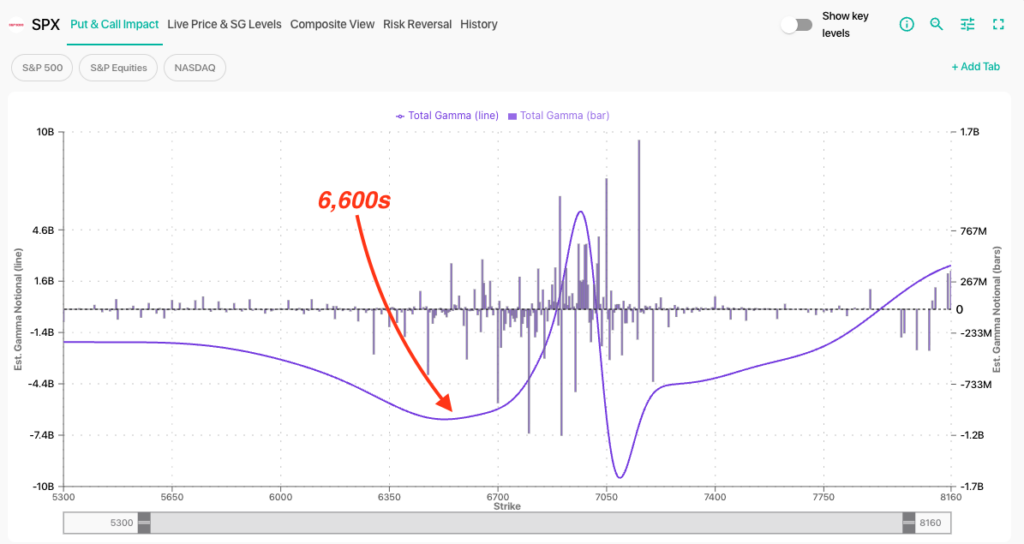
Most retail traders look at open interest, scan options chains, or glance at put/call ratios. These are rearview-mirror metrics. They don’t show you the force that’s actively pushing price right now. That force is dealer gamma hedging — and it’s invisible until you know how to model it.
Static OI Chains Miss Intraday Changes
Open interest is a snapshot. Dealers adjust their hedges in real time as price moves — those adjustments don’t show up in yesterday’s data.
Naive GEX Models Ignore Dealer vs. Customer
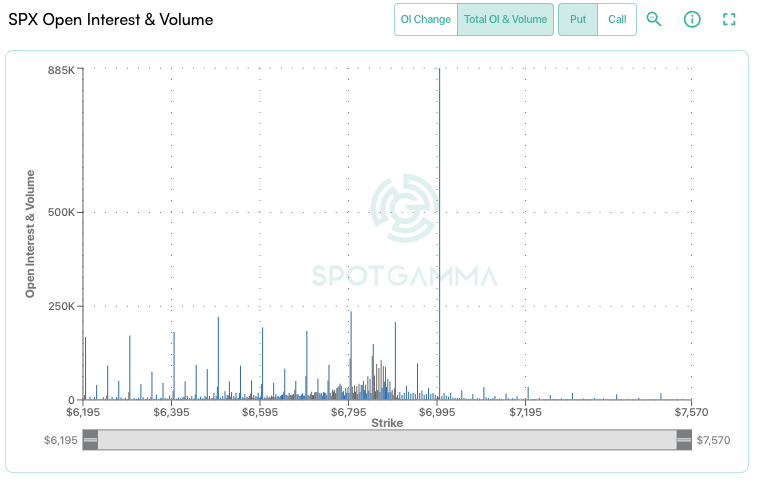
Basic GEX calculations assume all market participants are the same. They aren’t. Dealers take the opposite side of customer trades — direction matters.
Single-Expiry Models Are Dangerously Incomplete
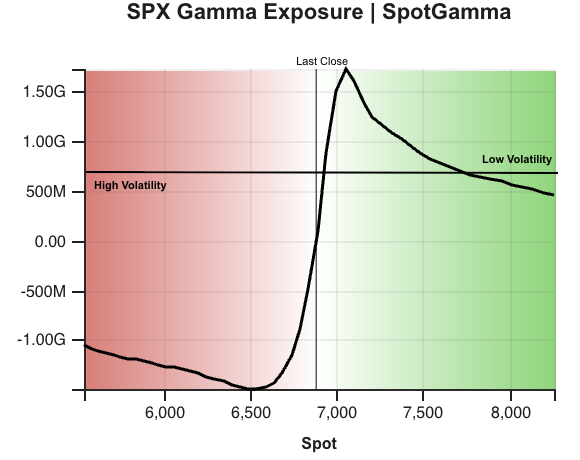
Focusing only on monthly expiry misses the growing dominance of 0DTE options, which now account for over 50% of SPX volume and have enormous intraday impact.
No Signal for When Volatility Will Spike
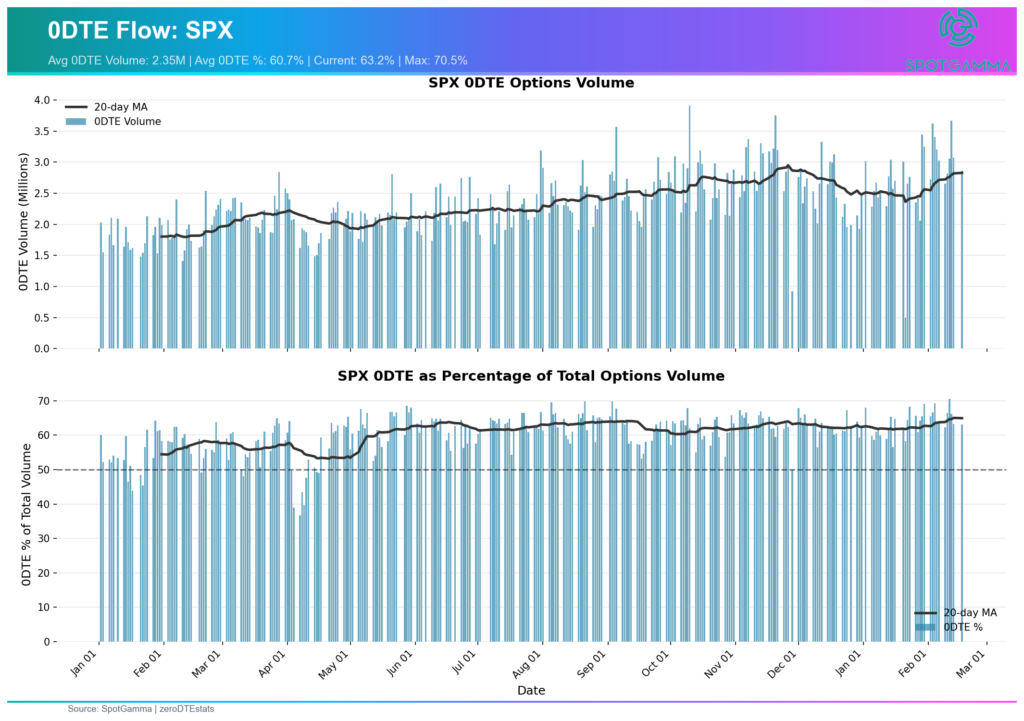
Standard tools give you a number — not a roadmap. You need to know where the regime changes: the exact price level where calm markets turn chaotic.
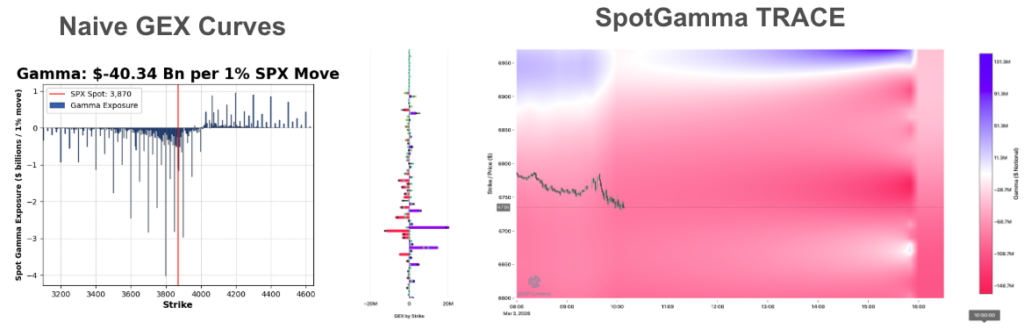
Here is a basic, Naive GEX model vs. SpotGamma’s TRACE application. Naive GEX models have no understanding of options were bought or sold, and they cannot account for 0DTE options flows – which are now +60% of options volume. SpotGamma’s live GEX heatmap gives you both: a proprietary open interest bought vs sold model, plus real time 0DTE coverage.
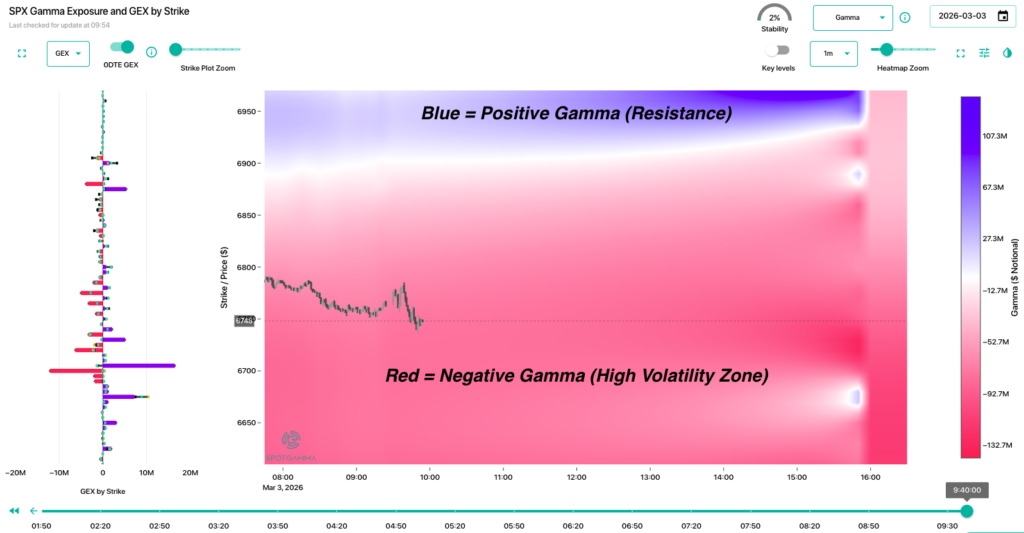
What Is Gamma Exposure (GEX)?
Gamma Exposure (GEX) is the estimated net gamma position held by options market makers across all strikes and expirations. It measures how much a dealer’s total delta changes for every 1% move in the underlying — and therefore, how aggressively they must buy or sell to stay hedged as price moves.
To understand GEX, start with gamma itself. Gamma is the rate of change of an option’s delta — how much the option’s hedge ratio shifts as the stock price moves. When a dealer sells you a call option, they buy shares to hedge their delta exposure. But as price moves, that delta changes (gamma at work) — forcing the dealer to continuously adjust their hedge.
GEX aggregates this dynamic across every open option contract at every strike. The result is a real-time map of how much buying or selling dealers are obligated to do at each price level. When gamma exposure is large at a strike, dealers must make large hedging trades there — and those trades move the market.
GEX (per strike) = Option Gamma × Open Interest × Contract Size × Spot Price² × 0.01
Net GEX (market total) = Σ (Call GEX) − Σ (Put GEX) across all strikes & expirations
SpotGamma calculates this across the four nearest expirations — including 0DTE options — incorporating its proprietary Open Interest & Volume Adjustment model to account for intraday position changes that don’t yet appear in official OI data.
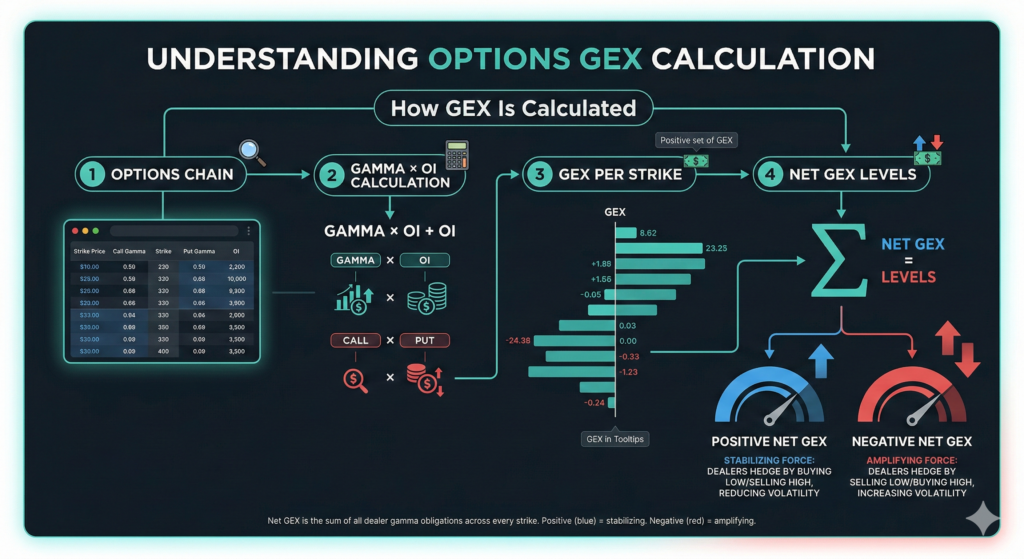
How GEX Is Calculated:
Flow: Options Chain → Gamma × OI → GEX Per Strike → Net GEX Levels.
Positive Gamma vs. Negative Gamma: Opposite Market Dynamics
The sign of net GEX tells you everything about how the market will behave around a level. Positive and negative gamma create two fundamentally different market environments.
Positive Gamma: Dealers Are Stabilizers
When net GEX is positive, market makers hold long gamma positions. As price moves up, their delta rises — so they sell the underlying to rebalance. As price falls, their delta drops — so they buy.
This “buy the dip, sell the rip” behavior counteracts price movement. The result: tighter ranges, lower realized volatility, and mean-reverting behavior — the market tends to stay pinned near key strikes.
- Intraday ranges compress
- VIX tends to drift lower
- Breakouts fade quickly
- Common during options expiration weeks
- Market closes near key gamma-heavy strikes
Negative Gamma: Dealers Are Amplifiers
When net GEX is negative, market makers hold short gamma positions. As price drops, they must sell more to re-hedge. As price rises, they must buy more.
This pro-cyclical hedging amplifies price moves in whatever direction the market is already moving. Volatility expands rapidly. Moves become reflexive and harder to fade.
- Intraday ranges expand sharply
- VIX spikes are common
- Breakouts and breakdowns accelerate
- Common after large selloffs
- Difficult to time entries/exits using technical analysis alone
Historical GEX Example
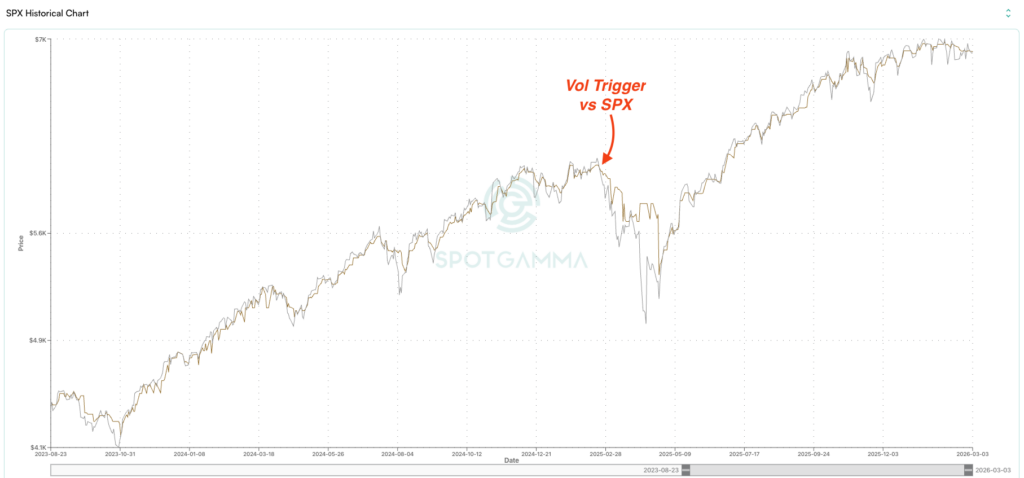
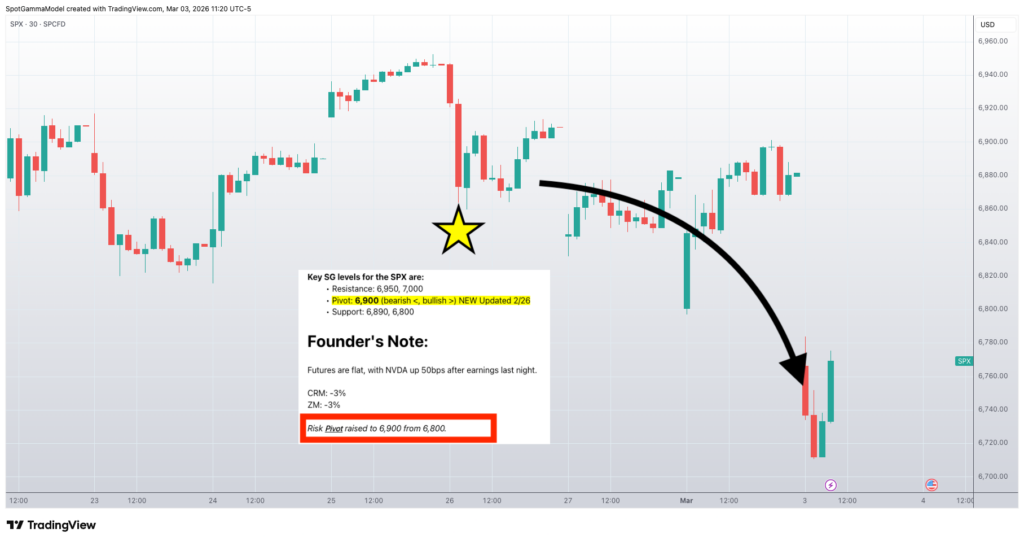
On February 26th, 2026 SpotGamma Founder, Brent Kochuba, raised the SPX Risk Pivot to 6,900 from 6,800 due to the dynamics of negative gamma building below SPX price.
That negative gamma was a warning that if the SPX shifted lower, options market makers may have to sell ES futures, which could lead to a sharp market decline. SpotGamma Members also saw the SPX shift below the Volatility Trigger – a clear sign that SPX was shifting from supporting positive gamma, to volatility-driving negative gamma.
The S&P500 subsequently declined 2%, and the VIX hit a high of 28!
The Gamma Levels That Matter: Your GEX Roadmap
SpotGamma’s models distill the entire options market into a handful of critical price levels. Each tells a different part of the dealer positioning story. Understanding all five is the difference between navigating the market and being surprised by it.
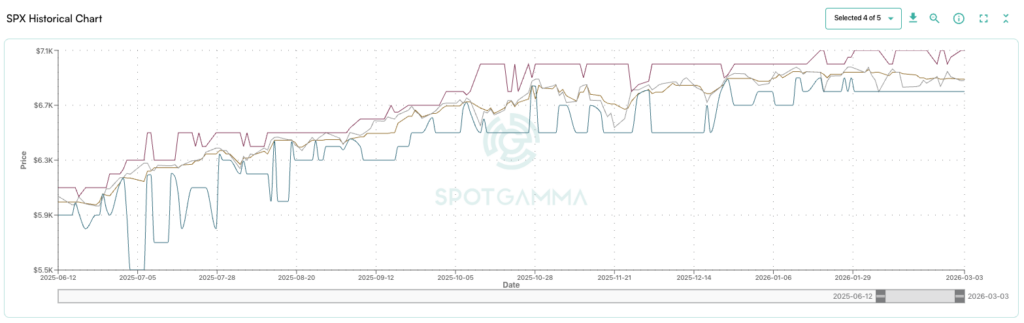
Zero Gamma: The Gamma Flip Line
Zero Gamma is the price level where dealers’ net gamma position crosses from positive to negative (or vice versa). Above this level, dealers are generally long gamma — stabilizing the market. Below it, they shift toward short gamma — amplifying volatility.
Think of Zero Gamma as the gamma regime inflection point. By itself, it doesn’t trigger volatility — but it marks where the character of dealer hedging fundamentally changes. SpotGamma models this level daily across all major index products and individual equities.
Volatility Trigger™: SpotGamma’s Proprietary Last Line of Gamma Support
The Volatility Trigger™ is SpotGamma’s most actionable level — and it’s not the same as Zero Gamma. While Zero Gamma marks the inflection point, the Volatility Trigger identifies where dealers have their last major concentration of positive gamma support.
When price breaks below the Volatility Trigger, dealers flip to short gamma and begin selling futures into declines — a self-reinforcing loop that amplifies the selloff. This is the level where calm volatility environments turn chaotic. SpotGamma calculates it from the actual distribution of dealer gamma across strikes, not a simple OI crossover.
Key Distinction
Zero Gamma is the inflection point. The Volatility Trigger is the last defensive line. SpotGamma’s Volatility Trigger often sits several points above Zero Gamma, giving traders earlier warning of a regime shift than basic models provide.
Risk Pivot: The Structural S&P500 Safety Level
The Risk Pivot marks the outer boundary of SpotGamma’s structural gamma support zone — the price range where positive dealer gamma creates a natural buffer against sharp moves. Within this zone, dealers act as market stabilizers.
A sustained break above or below the Risk Pivot removes that structural support. Once price exits the zone, dealers must hedge alongside the move (short gamma behavior), increasing the probability of an accelerated directional trend. The Risk Pivot is particularly valuable for options traders sizing positions: within the zone, selling volatility is more favorable; outside it, buying protection becomes more compelling.
The Call Wall Ceiling: Maximum Upside Resistance
The Call Wall is the strike price with the highest concentration of net call gamma. As the underlying approaches this strike, dealers become aggressively long delta (from the calls they’ve sold) and must sell the underlying to reduce their delta exposure — creating a powerful resistance effect that pins price or causes sharp reversals.
The Call Wall typically marks the upper boundary of the market’s near-term range and is one of SpotGamma’s most reliable resistance indicators. It shifts as options expire and new positions are opened, so SpotGamma recalculates it daily with intraday updates.
The Put Wall Floor: Maximum Downside Support
The Put Wall is the strike with the highest concentration of net put gamma — the market’s most important structural support level. As price approaches the Put Wall, dealers have sold massive amounts of put options and are aggressively short delta. To hedge, they must buy the underlying, creating upward pressure that cushions the decline.
A Put Wall hold is one of the most powerful “buy the dip” setups in the options market. A Put Wall break, by contrast, removes that mechanical buying support and often leads to rapid acceleration lower as dealers must sell to re-hedge.
Why SpotGamma’s GEX Is Different: The Model That Others Can’t Replicate
SpotGamma pioneered options-market-structure analysis for retail traders in 2018. In the years since, the models have been refined through millions of data points and validated across every major market event. Here’s what makes SpotGamma’s GEX different from anything else available.

Intraday OI Updates
Official open interest only updates overnight. SpotGamma’s proprietary OI & Volume Adjustment model estimates intraday position changes from live trade volume — giving you near real-time GEX that reflects today’s positioning, not yesterday’s.

4-Expiration Model
SpotGamma calculates GEX across the four nearest expirations, including 0DTE options. This is critical in a world where 0DTE now drives over 50% of SPX daily volume and creates gamma spikes that single-expiry models completely miss.

Dealer vs. Customer Positioning
SpotGamma’s models distinguish between dealer-side and customer-side positioning. This directionality is what makes the GEX sign (positive vs. negative) meaningful — basic models that treat all participants equally produce misleading signals.

TRACE: Real-Time Intraday GEX
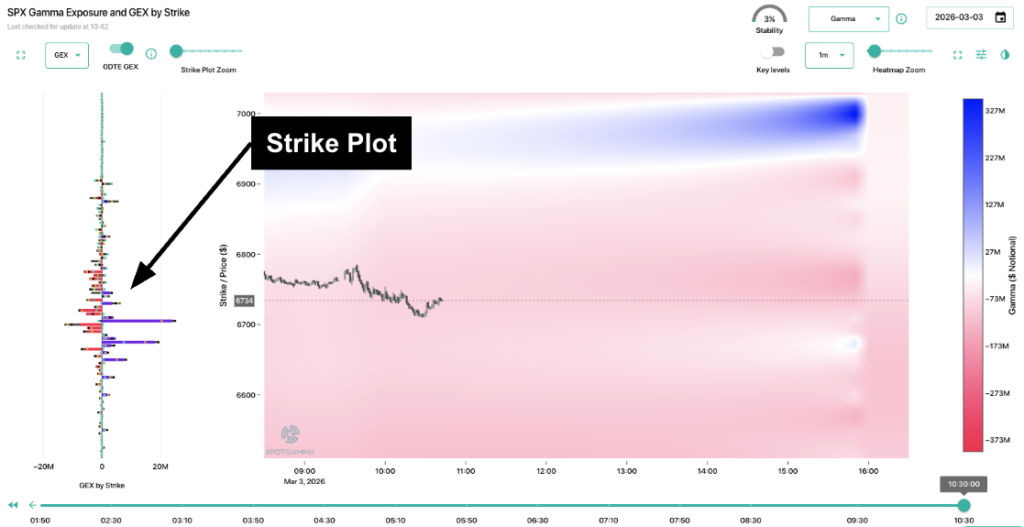
TRACE ingests every options trade across all US exchanges in real time, calculating Gamma, Delta Pressure, and Charm Pressure as it happens. The Strike Plot visualizes dealer positioning by strike — updated continuously throughout the session.

3,500+ Equity Coverage
GEX analysis isn’t just for SPX. SpotGamma’s Equity Hub applies the same dealer-positioning models to over 3,500 individual stocks and ETFs — identifying gamma-driven support, resistance, and volatility signals at the single-name level.

Built by the Pioneers
SpotGamma’s founder Brent Kochuba coined the term “gamma exposure” as a trading concept for retail markets. The methodology has since been validated in academic research, cited by institutional desks, and integrated by major platforms including Bloomberg.
78% Days SPX closes inside SpotGamma’s predicted range
20+ bps Reduction in absolute returns per 1σ increase in gamma imbalance
Since 2018 Years of real-world GEX model validation
Bloomberg SpotGamma levels integrated into Bloomberg Terminal
3 Ways Traders Use GEX Every Day
GEX isn’t a backroom quant metric — it’s a daily trading tool. Here’s how SpotGamma members use it across different strategies and timeframes.
1) Intraday Range Trading & 0DTE
Before every session, check the Call Wall and Put Wall. Those are your ceiling and floor. In positive gamma environments (above the Volatility Trigger), fading moves toward those levels has historically been one of the highest-win-rate intraday setups available.
For 0DTE options traders, TRACE shows real-time dealer gamma by strike — revealing which levels will attract price and which will cause rapid acceleration if broken. Knowing whether you’re in positive or negative gamma changes your entire 0DTE approach.
2) Swing Trading Regime Identification
The most important decision a swing trader makes is whether to be long volatility or short volatility. GEX tells you which regime you’re in. Above the Volatility Trigger, range-bound and short-vol strategies have an edge. Below it, trend-following and long-vol plays are favored.
Monitor the Volatility Trigger and Risk Pivot levels daily. When price approaches these thresholds, begin sizing out of range-bound positions and consider adding directional exposure in the direction of the break.
3) Portfolio & Options Risk Management
Institutional and retail portfolio managers use GEX to size protection more intelligently. Inside the Risk Pivot zone (positive gamma), buying expensive puts often means overpaying for protection you don’t need. Outside that zone, protection becomes underpriced relative to actual dealer-driven risk.
When net GEX turns deeply negative across major indices, that’s a high-conviction signal to increase hedges, reduce position size, and prepare for the vol expansion that follows — before the news cycle gives you a reason.
GEX Across the Market: Key Instruments
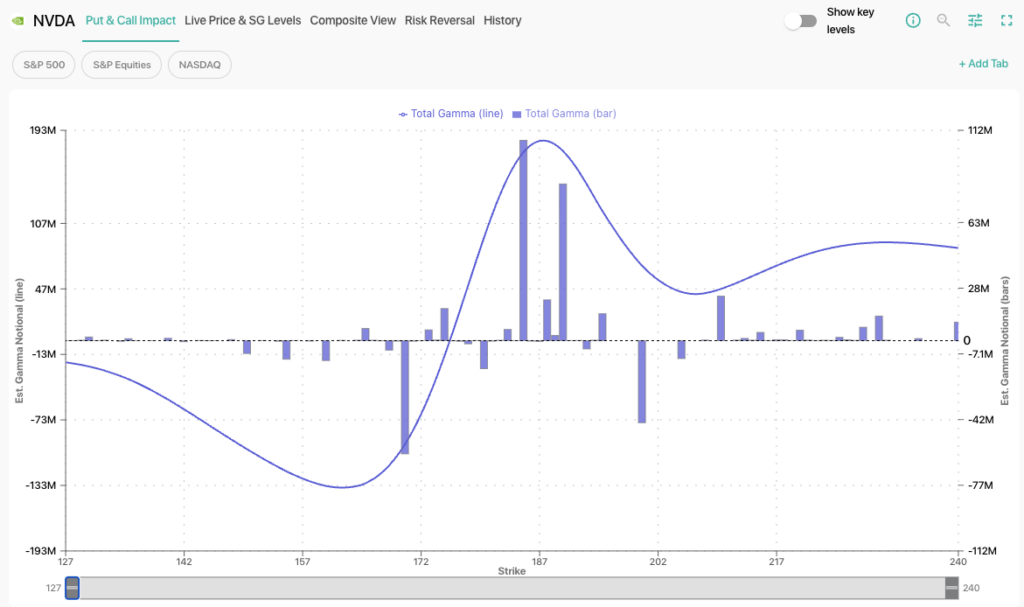
SpotGamma provides daily GEX levels for all major index products and 3,500+ individual equities. Here are the core instruments where GEX has the highest structural impact.
SPX: S&P 500 Index
The market. ~$80B+ gross gamma. 0DTE dominance. SpotGamma’s flagship GEX product.
SPY: SPDR S&P 500 ETF
High retail participation. Put-buying activity creates powerful GEX support levels. Free SPY GEX chart available.
QQQ: Invesco Nasdaq-100 ETF
Tech-heavy options activity. GEX often diverges from SPX, signaling sector rotation dynamics.
IWM: Russell 2000 ETF
Small-cap volatility amplified by GEX. High-gamma strikes frequently cause sharp intraday reversals.
/ES: E-mini S&P Futures
Futures traders use SpotGamma levels as pre-market roadmaps. Volatility Trigger is the key overnight level.
3,500+ Individual Equities
NVDA, AAPL, TSLA, MSTR, and 3,500+ more. Equity Hub maps GEX-driven support and resistance for every major stock.
Real-Time GEX Gamma Exposure
TRACE: See Dealer Gamma As It Happens
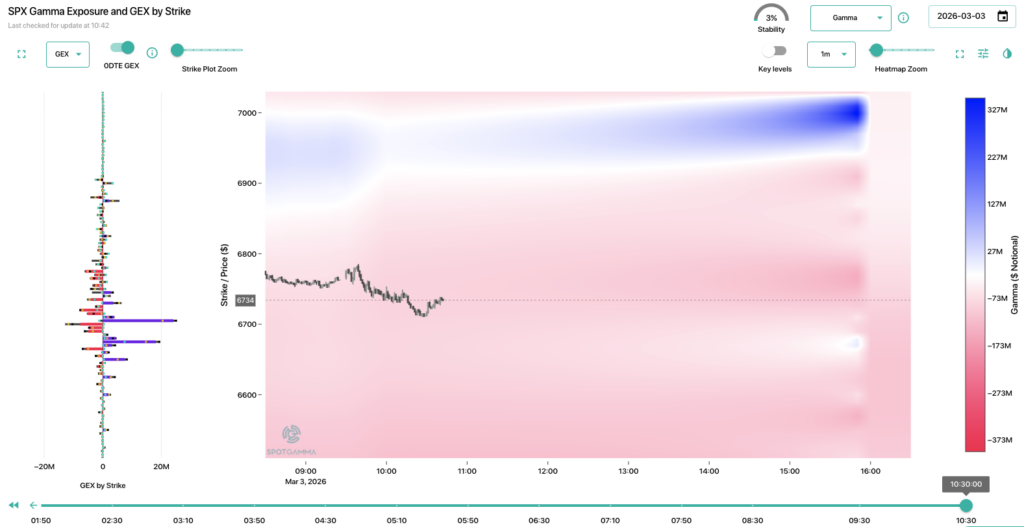
TRACE is SpotGamma’s real-time options flow and gamma visualization tool — built on SpotGamma’s proprietary Options Inventory Model. It ingests every trade across all US exchanges and instantly calculates how dealer gamma exposure is shifting.
Strike Plot
Real-time GEX, Open Interest, and Net OI displayed as color-coded bars at every strike. Blue = positive (support). Red = negative (resistance).
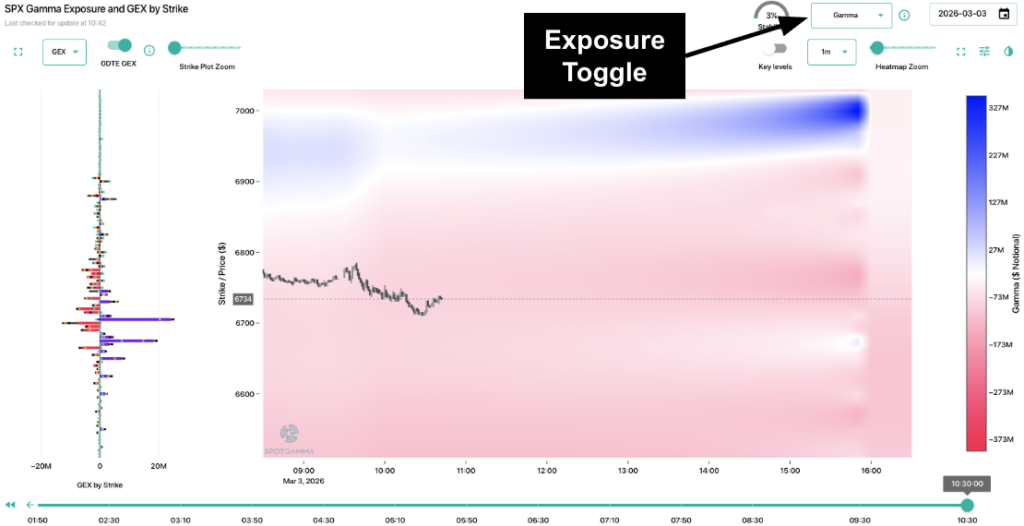
Gamma, Delta & Charm Pressure
Three models show different dimensions of dealer hedging flows — gamma (positional), delta (directional), and charm (time-decay-driven).
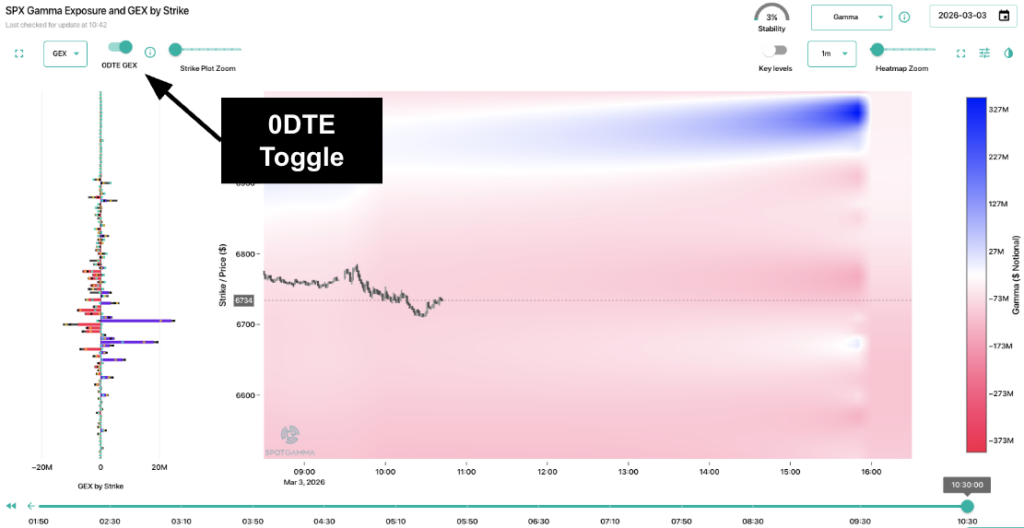
0DTE Toggle
Isolate same-day expiry positions on the Strike Plot to see exactly which strikes are driving intraday gamma pressure right now.
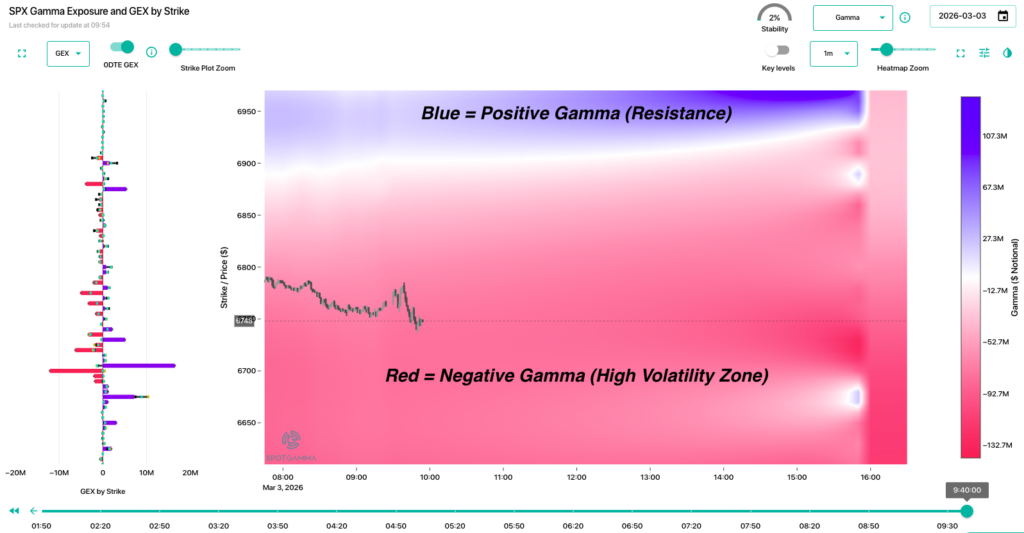
Heat Map Visualization
Color-coded heat maps show buying (blue) and selling (red) pressure zones as they build intraday — mapping support and resistance as it forms.
Get Access: Start Trading With the Full GEX Picture
Every SpotGamma plan includes live GEX levels, Key Levels (Call Wall, Put Wall, Volatility Trigger, Zero Gamma, Risk Pivot), TRACE, HIRO, and the daily Founder’s Note — the market’s most trusted options-structure briefing.
Essentials Membership
For active traders who want the key GEX levels and daily market structure briefing.
- Daily Founder’s Note (AM + PM)
- Key Levels: Call Wall, Put Wall, Zero Gamma, Volatility Trigger, Risk Pivot
- SPX/SPY/QQQ/IWM GEX charts
- Equity Hub — Proprietary daily GEX Gamma Exposure for +3,500 stocks
- Options Calculator
- FlowPatrol©
- Education Library
Alpha Membership (Most Popular)
For intraday traders, options, and futures traders who need the deepest, real time GEX & 0DTE data.
- Everything in Essentials +
- Full intraday, real time GEX updates via TRACE
- 0DTE Strike Plot with real-time updates
- Charm & Delta Pressure models
- Advanced Volatility Dashboard
- HIRO: real time hedging impact in +3,000 stocks
- Tape: real time options prints in +3,000 stocks
- Live daily training sessions
- Premium Discord community
- Priority support
Trusted by thousands of traders and integrated into Bloomberg Terminal • No free trial required — see plans at spotgamma.com/subscribe
FAQ Gamma Exposure: Frequently Asked Questions
What is Gamma Exposure (GEX), and why does it matter for traders?
Gamma Exposure (GEX) measures the aggregate net gamma position held by options market makers across all strikes and expirations. More practically, it tells you how much dealers must buy or sell the underlying index for every 1% price move — so it’s a real-time map of mechanically-driven order flow that has nothing to do with fundamentals, news, or sentiment.
GEX matters because dealer hedging flows are enormous. With over $80 billion in gross gamma in S&P 500 options alone, a 1% index move can trigger billions in mechanically-required buying or selling. Understanding GEX tells you whether those flows will stabilize or amplify whatever direction the market is already moving — which is the single most important structural edge available to options-aware traders.
What is the difference between positive and negative gamma?
When net GEX is positive, market makers are long gamma — they hold positions that gain delta when the market rises, and lose delta when it falls. To stay hedged, they must sell into rallies and buy into dips. This counter-cyclical hedging dampens volatility and causes the market to mean-revert within a range.
When net GEX is negative, market makers are short gamma — they must buy when the market rises and sell when it falls. This pro-cyclical hedging amplifies moves, expanding intraday ranges and making trends more persistent. Negative gamma environments are typically associated with VIX spikes, breakdowns, and reflexive selloffs.
The transition between positive and negative gamma is not random — it happens at specific, calculable price levels: the Zero Gamma level and the Volatility Trigger™.
What is the Zero Gamma level?
Zero Gamma is the price level where net GEX transitions from positive to negative (or vice versa). It’s the inflection point on the gamma curve — above it, the market generally operates in a stabilizing, low-volatility regime; below it, the regime shifts toward instability.
SpotGamma models Zero Gamma daily across all major indices and individual equities. However, a price dip below Zero Gamma doesn’t immediately trigger volatility — that’s why SpotGamma developed the Volatility Trigger™, which is the more actionable and predictive level for when dealer behavior actually flips to amplifying market moves.
What is the Volatility Trigger™ and how is it different from Zero Gamma?
The Volatility Trigger™ is SpotGamma’s proprietary level identifying where dealers have their last major concentration of positive gamma support. It’s not the same as Zero Gamma, and this distinction is critical.
Zero Gamma is a mathematical crossover point. The Volatility Trigger reflects the actual distribution of dealer gamma — specifically, where the most meaningful cluster of positive gamma sits. It typically sits above Zero Gamma, giving traders earlier warning of a potential regime shift.
When price breaks below the Volatility Trigger, dealers begin selling futures into market declines (short gamma hedging), creating a feedback loop that amplifies the move. This is why the Trigger often marks the beginning — not the middle — of a volatility event.
What is the Risk Pivot, and how should traders use it?
The Risk Pivot marks the outer edge of SpotGamma’s structural gamma support zone — the price range where positive dealer gamma creates a natural cushion against large moves. When price is within this zone, dealers are net long gamma and act as market stabilizers.
A sustained break above or below the Risk Pivot level removes that cushion. Once outside the zone, dealer hedging becomes pro-cyclical (short gamma), increasing the probability of an accelerated directional move.
Options traders can use the Risk Pivot to calibrate strategy selection: when price is comfortably inside the zone, short-volatility strategies (spreads, iron condors) have a structural tailwind. When price tests or breaks outside the zone, buying protection or directional exposure becomes more favorable on a risk-adjusted basis.
How is SpotGamma’s GEX model different from a basic GEX calculation?
Basic GEX models calculate gamma × open interest at each strike using prior-day OI data — a single expiration, updated once per day, treating all market participants as equivalent. SpotGamma’s model goes significantly further:
1. Intraday OI updates: SpotGamma’s proprietary OI & Volume Adjustment model estimates real-time position changes from live trade flow — so GEX reflects today’s positioning, not yesterday’s snapshot.
2. Multi-expiry coverage: GEX is calculated across the four nearest expirations, including 0DTE options that drive over 50% of SPX daily volume and produce the most acute intraday gamma effects.
3. Dealer-specific modeling: SpotGamma distinguishes between dealer-side and customer-side positioning, which is what gives the positive/negative GEX sign its directional meaning. Models that don’t differentiate produce unreliable signals.
4. TRACE real-time layer: SpotGamma’s TRACE platform ingests every US options trade in real time, providing a continuous live view of gamma positioning that updates with every transaction — not just at market open.
Can retail traders realistically use GEX analysis, or is this only for institutions?
GEX analysis was originally an institutional concept — but SpotGamma was built specifically to make it accessible to active retail traders. Today, SpotGamma has over 10,000 members across individual traders, RIAs, hedge funds, and prop desks.
For retail traders, GEX is most actionable as a filter and framework — not a mechanical signal to blindly follow. Use it to answer three questions before entering a trade: (1) What is the current gamma regime? (positive/negative); (2) Where are the key structural levels? (Call Wall, Put Wall, Volatility Trigger); (3) Is the market expanding or contracting range? (short-gamma vs. long-gamma environment).
These three inputs don’t require a quant degree. SpotGamma’s daily Founder’s Note translates them into plain-English market context every morning — so you can apply GEX analysis to your trading regardless of your technical background.
The Market Has a Hidden Structural Map.
You Can See It.
Every day, billions of dollars in dealer gamma hedging shapes the S&P 500’s price action. SpotGamma gives you the levels, the context, and the real-time tools to navigate it — before the news explains what happened.
Trusted by thousands of traders • Bloomberg Terminal integration • Pioneering GEX analysis since 2020