A butterfly spread is a three-strike options strategy — buy one option at a lower strike, sell two at a middle strike, buy one at a higher strike — that pays its maximum profit when the stock finishes exactly at the middle strike at expiration. Because the two long wings fully cover the two short options, risk is capped at the small debit paid. The butterfly is the market’s purest expression of a pin: a low-cost, high-payout bet that price lands on a specific number at a specific time.
Key Takeaways
- The classic long butterfly is a 1 / −2 / 1 structure across three equidistant strikes, built with all calls or all puts.
- Max profit lands at the middle strike at expiration; the payoff tent slopes to zero at the wings.
- Max loss is the debit — typically a small fraction of the strike width — because you are selling two inflated middle-strike premiums against your wings.
- The payoff can be many multiples of the risk, but the profit zone is narrow: this is a precision trade, not a direction trade.
How the Butterfly Spread Works
Think of the butterfly as two vertical spreads sharing a middle strike: a bull call spread from the lower strike up to the body, and a bear call spread from the body up to the upper wing. Below the lower wing both spreads expire worthless; above the upper wing their values cancel. Only around the middle strike does the structure hold net value — maximized when the long lower call carries full intrinsic value and both short calls die exactly worthless.
The economics come from extrinsic value. The at-the-money middle strike carries the most time premium on the board, and the butterfly sells two of them while buying the cheaper wings. That financing is why a fly across 10 points of strikes can cost barely a point — the market is paying you richly to take the other side of “the stock finishes right here.”
The probability of a perfect pin is low, which is precisely why the payout is high. The interesting question — the one that separates butterfly traders in our options strategy library from dart throwers — is whether some strikes are more likely to attract price than chance suggests. Positioning data says yes.
Example
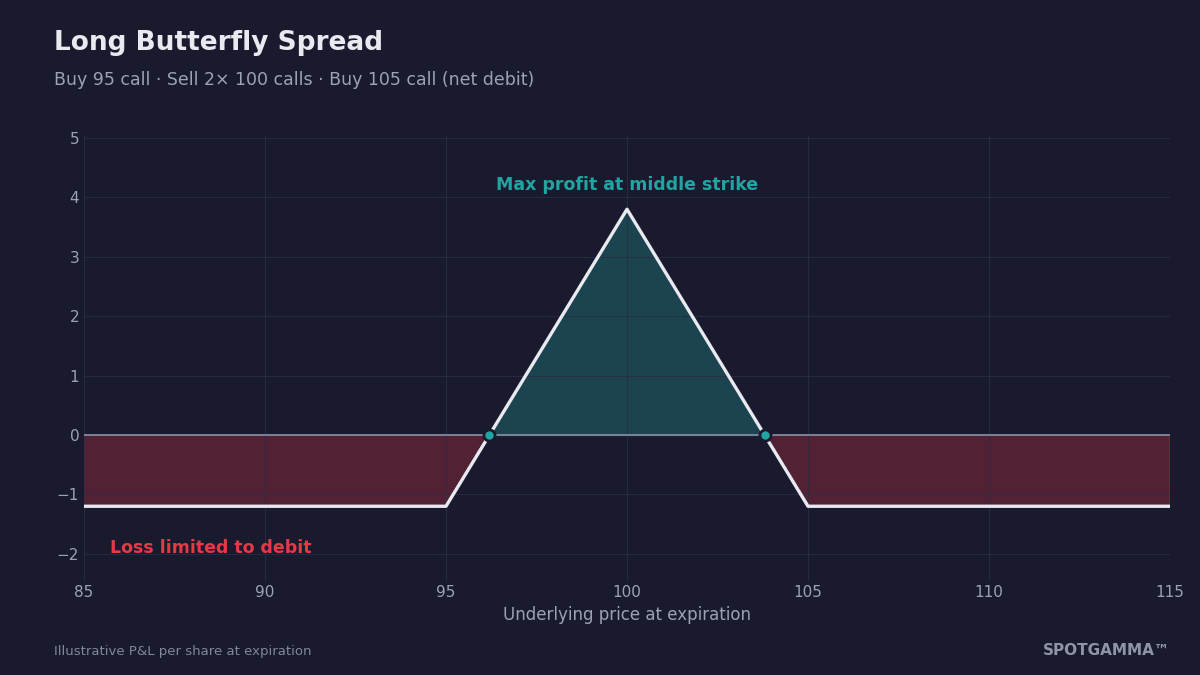
With the stock at $100:
- Buy 1× the $95 call, sell 2× the $100 calls, buy 1× the $105 call, for a net debit of $1.20 ($120).
- Max profit: $380 with the stock at exactly $100 at expiration — the $5 spread between the lower wing and the body, minus the debit.
- Max loss: $120, the debit, anywhere beyond the wings ($95 and below, or $105 and above).
- Breakevens: $96.20 and $103.80.
That is better than 3-to-1 payout on risk if the pin lands, with a profit zone about 7.6 points wide. Model how the tent sharpens as expiration approaches in SpotGamma’s free Options Calculator — the fly’s value barely moves for most of its life, then resolves quickly in the final days.
Butterfly Spread vs. Iron Butterfly, Broken Wing, and Calendar
- vs. the iron butterfly: same tent-shaped payoff, built as a credit — short straddle plus protective wings. Economically similar; the iron fly collects premium up front and typically uses a wider profit zone.
- vs. the broken wing butterfly: skips a strike on one wing to finance the trade to near zero cost, shifting all the risk to one side instead of splitting it.
- vs. the calendar spread: also a tent peaked at a strike, but built across expirations and long vega — the butterfly keeps everything in one expiry and is short vega.
Using Positioning Data to Trade It Better
A butterfly is only as good as its body strike. Rather than centering it on a round number or a hunch, use the positioning map:
- Put the body on the biggest gamma strike. Strikes carrying the heaviest dealer gamma exposure and open interest have historically been sticky into expiration — dealer hedging flows push price back toward them as expiry approaches. A butterfly centered on the dominant gamma strike into expiration week is the textbook SpotGamma application of this trade.
- Watch the walls. The Call Wall and Put Wall mark where hedging pressure concentrates; a fly whose body sits at a wall pairs the structure’s narrow payoff with the strike the market itself is defending.
- Favor positive-gamma tape. Pinning is strongest when dealers are long gamma and dampening movement. In a negative-gamma regime price tends to trend through strikes, and the fly’s tiny profit zone is unlikely to hold the landing.
Risks
- Low hit rate by design. Most expirations will not land in the tent; expect frequent full losses of the (small) debit between occasional large payoffs.
- All-or-nothing endgame. The position’s value resolves mostly in the final days, and a late one-point move can be the difference between max profit and nothing.
- Assignment risk on the short middle strikes once they trade in-the-money near expiry — manage before expiration rather than riding pin risk into settlement.
- Three legs, three spreads. Fills matter at this price scale; a sloppy entry can double the cost of a $1.20 structure. Use limit orders on the package.
FAQ
How do butterfly spreads profit?
By the stock finishing near the middle strike at expiration, where the two short options expire worthless while the lower long wing keeps its intrinsic value. Profit peaks exactly at the body strike and fades to a loss of the debit beyond either wing.
What is the best strike for the body of a butterfly?
The strike price is most likely to settle on — which positioning data can estimate. Strikes with the largest dealer gamma and open interest have historically acted as magnets into expiration, so centering the body on the dominant gamma strike stacks the pin probability in your favor.
Why are butterflies so cheap?
Because you sell two at-the-money options — the richest extrinsic value on the board — against two cheaper wings, and because a precise pin is a low-probability event. The small debit is the market’s fair charge for a narrow but high-payout outcome.
This article is for educational purposes only and is not financial advice. Options involve substantial risk and are not suitable for all investors.