A long straddle is an options strategy that buys a call and a put at the same strike and expiration — typically at-the-money — to profit from a large move in either direction. Because you own both sides, you do not need to predict whether the stock goes up or down, only that it moves further than the combined premium implies. Maximum loss is the total debit paid, suffered if the stock closes exactly at the strike at expiration; profit is unlimited to the upside and extends nearly to zero on the downside.
Key Takeaways
- A long straddle buys an at-the-money call and put with the same strike and expiration — it is direction-agnostic but movement-dependent.
- Max loss is the full debit paid, realized only if the stock pins the strike at expiration. Breakevens sit at the strike plus and minus the debit.
- The trade is really a bet that realized movement beats the implied move the options market has priced in.
- Its two enemies are time decay and IV crush — you are long two blocks of extrinsic value, and both legs bleed every day the stock sits still.
How the Long Straddle Works
An at-the-money option has essentially no intrinsic value — its price is almost entirely extrinsic, or time premium. A straddle buys two of those premiums at once, which is why it feels expensive: you are paying the market’s full estimate of how much the stock can move before expiration, twice over, once in each direction.
That framing is the key to the trade. The combined premium of the ATM call and put is, to a close approximation, the market’s implied move for the period. Buy the straddle and you win when the stock travels further than that estimate (or when implied volatility rises enough to mark both legs up). Sit through a quiet tape and the position decays from both ends — one leg will always expire worthless, and the other has to earn back the cost of both.
Straddles are part of our options strategy library for a reason: they are the cleanest expression of pure long volatility available to most traders, and the best way to learn what being long volatility actually costs.
Example
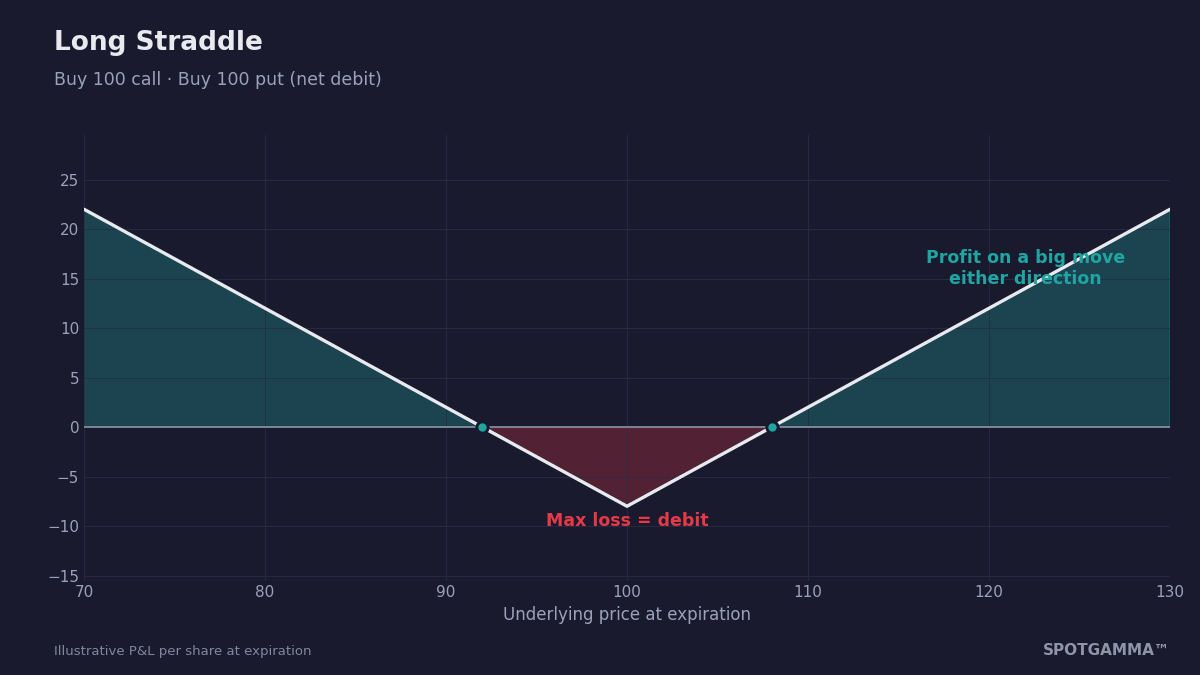
Suppose a stock trades at $100:
- Buy 1× the $100 call and buy 1× the $100 put, same expiration, for a net debit of $8.00 ($800 per straddle).
- Max loss: $800, taken only if the stock closes at exactly $100 at expiration — both legs expire worthless.
- Breakevens: $92 and $108. The stock must move 8% in either direction by expiration for the position to profit at expiry.
Beyond either breakeven, the straddle gains roughly dollar-for-dollar with the stock. Note that these numbers describe expiration — before expiry, a fast move or a rise in implied volatility can push the straddle to a profit well inside the breakevens, which is why many straddle buyers exit on the move rather than holding to the end.
Long Straddle vs. Strangle and Iron Butterfly
- vs. the long strangle: a strangle moves both strikes out-of-the-money, cutting the debit roughly in half — but widening the breakevens. Cheaper ticket, bigger move required.
- vs. the iron butterfly: the iron fly is the other side of your trade — it sells the ATM straddle and buys wings for protection. If you think the implied move is too cheap, buy the straddle; too rich, the iron fly collects it.
- Timing the entry on IV: we cover why straddles work best when implied volatility is depressed in our guide to low-IV options strategies.
Using Positioning Data to Trade It Better
A straddle is a bet that realized movement beats what options are pricing. Two checks improve the odds of that bet:
- Check IV percentile before anything else. Buying a straddle when implied volatility is already elevated means paying top dollar for a move the market has largely priced — the stock can move and you can still lose. The best straddle entries tend to come when IV sits low in its own historical range.
- Check the gamma regime. When gamma exposure (GEX) is negative, dealer hedging amplifies moves rather than dampening them — producing the extended, trending tapes a straddle needs. In positive-gamma regimes, that same hedging pins price to heavily-trafficked strikes, and pinning quietly bleeds a straddle to death.
- Model it before you trade it. Build the two legs and stress the P&L across price, time, and volatility — model it in SpotGamma’s free Options Calculator before committing the debit.
Risks
- Double theta. You own two decaying premiums. Every flat day transfers money from you to the seller, and decay accelerates into expiration.
- IV crush. After an earnings report or known event, implied volatility can collapse and deflate both legs at once — the stock can move and the straddle can still lose.
- The move has to be large. An 8% breakeven requirement is a high bar; most expiration cycles do not deliver it, which is why straddles lose more often than they win and rely on occasional outsized payoffs.
- Pinning at the strike. The max-loss point is not an edge case — high-open-interest ATM strikes are exactly where expiration pinning tends to occur.
FAQ
How much does the stock need to move for a straddle to profit?
At expiration, the stock must move past the strike by more than the total debit — in the example above, $8 on a $100 stock, or 8% in either direction. Before expiration the bar is lower: a fast move or a rise in implied volatility can produce a profit well inside the breakevens.
When is the best time to buy a straddle?
When implied volatility is low relative to its own history and you expect realized movement to pick up — a catalyst the market has not fully priced. Buying immediately before well-telegraphed events usually means paying peak IV for a move that is already in the price.
What is straddle IV crush?
The sharp drop in implied volatility that follows a known event such as earnings. Both legs of the straddle lose extrinsic value at once, so unless the stock’s actual move exceeds what was implied, the position loses even though the stock moved.
This article is for educational purposes only and is not financial advice. Options involve substantial risk and are not suitable for all investors.