A bull put spread — also called a put credit spread — is a defined-risk options strategy that sells a put option and buys a second put at a lower strike in the same expiration, collecting a net credit that is kept in full if the stock finishes above the short strike. It is a bet that a level holds: the stock does not need to rally, it only needs to stay above the put you sold. The long put below defines the worst case, capping the loss at the strike width minus the credit.
Key Takeaways
- Sell a put, buy a lower-strike put, same expiration — max profit is the credit, max loss is the width minus the credit.
- The trade wins in three of four scenarios: stock up, stock flat, or stock down but above the short strike.
- Time decay works for you — each day the floor holds, the short put’s extrinsic value erodes in your favor.
- Strike placement beneath genuine support is the entire edge; the credit is compensation for the floor breaking.
How the Bull Put Spread Works
The put you sell is out-of-the-money, so its price is pure extrinsic value — a payment the market offers you for insuring against a decline through that strike. If the stock stays above it, the insurance expires unused and the premium is yours. The lower-strike put you buy costs part of the credit back, but it converts an obligation with substantial downside into one with a hard floor: below the long strike, both options move together and losses stop growing.
Because the position profits from the simple passage of time, its natural enemies are the things that interrupt quiet markets: gaps, trend days, and volatility spikes. Rising IV inflates the short put faster than the long one and marks the spread against you even when price has not breached anything. That is why the structure is at its best when premium is rich but the tape is contained — you are paid well for a floor the market is actively defending.
Stack this spread beneath the market and a bear call spread above it, and you have built an iron condor — the bull put spread is the lower half of that trade.
Example
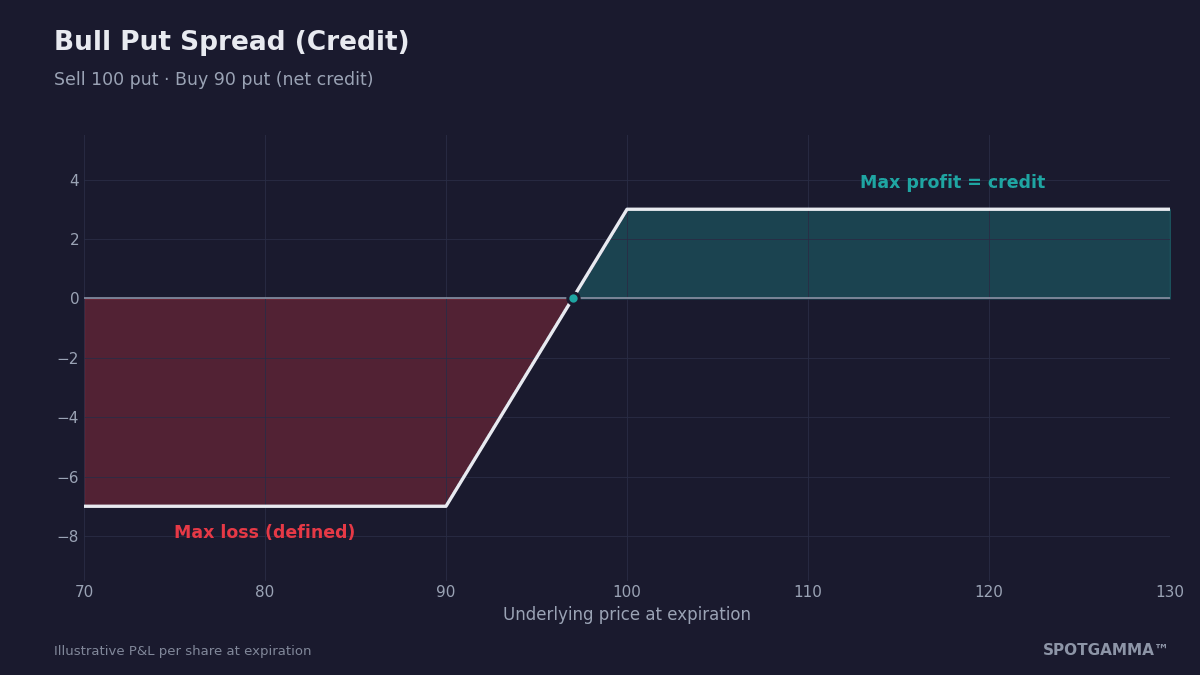
With the stock at $100:
- Sell the 100 put.
- Buy the 90 put.
- Net credit: $3.00 ($300 per spread).
Finish anywhere above 100 at expiration and the full $300 is kept. Breakeven is 97. Below 90, the loss is capped at $700 — the $10 width minus the $3 credit. The payout is asymmetric by construction: the trade risks $700 to make $300, so the floor must hold considerably more often than two times in three just to break even over many trades. That is the honest arithmetic every credit seller lives with.
Bull Put Spread vs. Related Strategies
Context from our options strategy library:
- Bear call spread — the same credit logic aimed at a ceiling instead of a floor; together they form the iron condor.
- Vertical spreads explained — how the credit build relates to its debit twin, the bull call spread, and when each is better priced.
- Cash-secured puts — the undefended version: selling the put without the protective leg, with stock acquisition as a welcome outcome rather than a risk.
Using Positioning Data to Trade It Better
You are betting a level holds — so pick a level with structure behind it:
- Sell beneath the Put Wall. The Put Wall marks the strike with the heaviest put gamma, where dealer hedging has historically slowed declines. Short puts placed below the wall align your trade with that mechanical support, so the market’s own flows defend your strike before your capital does.
- Respect the gamma regime. Positive gamma exposure (GEX) regimes — where dealer hedging dampens moves and ranges hold — are the credit seller’s friend. A GEX flip to negative means hedging starts amplifying moves; that is the signal to cut risk or stand aside, not to add spreads because the premium looks richer.
- Model it before you trade it. Test strikes and widths against your level map in SpotGamma’s free Options Calculator.
Risks
- Asymmetric payout: one full loss ($700) outweighs two full wins ($300 each), so a single broken floor can erase months of income.
- Gap risk is unmanageable by design — an overnight move through both strikes skips every adjustment you planned to make.
- A volatility spike marks the spread against you even while price holds, forcing uncomfortable decisions before the thesis has actually failed.
- The short put can be assigned early once in-the-money, converting the spread into long stock plus a long put until resolved.
FAQ
How does a bull put spread differ from a cash-secured put?
The spread buys a lower put that caps the loss and slashes the capital requirement; the cash-secured put stands fully exposed down to zero and reserves cash to buy shares if assigned. Sellers who want the stock treat assignment as the plan; spread traders treat it as the failure mode they have pre-paid to limit.
What is the ideal strike for a bull put spread?
Below a level the market has shown it defends. Positioning data makes this concrete: short strikes beneath the Put Wall sit behind the dealer hedging that has historically slowed declines, letting you collect premium with structural support between price and your risk.
When should you close a put credit spread?
Most traders take profits well before expiration once the bulk of the credit has decayed — commonly around 50 to 75 percent of the maximum — because the remaining pennies carry the same tail risk as day one. On the loss side, a breach of the short strike or a gamma regime flip is a better exit trigger than hoping a broken floor repairs itself.
This article is for educational purposes only and is not financial advice. Options involve substantial risk and are not suitable for all investors.