A bear call spread — also called a call credit spread — is a defined-risk options strategy that sells a call option and buys a second call at a higher strike in the same expiration, collecting a net credit that is kept in full if the stock finishes below the short strike. It is the standard structure for fading a rally: the stock can fall, go nowhere, or even drift modestly higher, and the trade still wins as long as price stays under the call you sold. The long call above caps the damage if the rally refuses to stop.
Key Takeaways
- Sell a call, buy a higher-strike call, same expiration — max profit is the credit, max loss is the width minus the credit.
- The position profits from time decay and from the ceiling holding; it does not require the stock to decline.
- Rising implied volatility and accelerating upside momentum are its enemies — both inflate the call you are short.
- Where you sell the short strike matters more than how much credit it brings in.
How the Bear Call Spread Works
The out-of-the-money call you sell is entirely extrinsic value — a price the market pays you for the stock’s potential to rally through that strike. Each day the rally fails to materialize, a slice of that premium decays into your pocket. The higher-strike call you buy returns part of the credit, but it transforms a naked short call’s unlimited upside risk into a fixed, known worst case.
At expiration the outcomes are three. Below the short strike, both calls expire worthless and the full credit is kept. Between the strikes, the short call’s intrinsic value eats into the credit, with breakeven at the short strike plus the credit. Above the long strike, the loss is frozen at the width minus the credit, no matter how far the stock runs.
This spread is the top half of an iron condor; pair it with a put credit spread below the market and you are collecting rent on a full range rather than a single ceiling.
Example
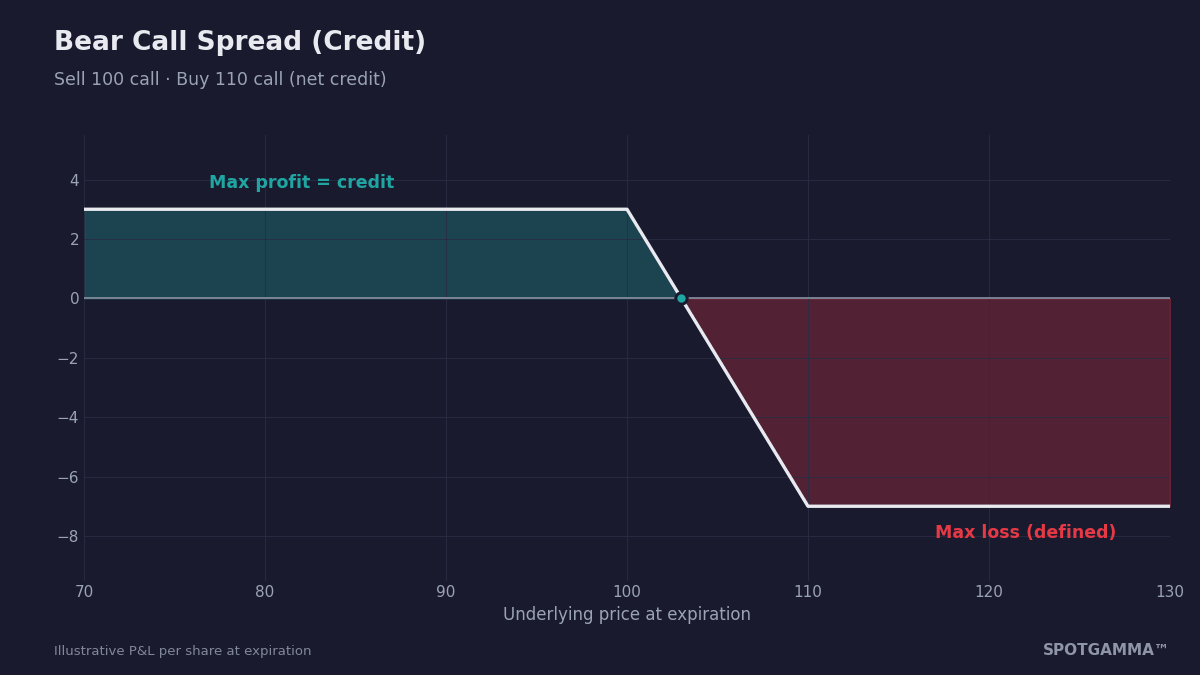
With the stock at $100:
- Sell the 100 call.
- Buy the 110 call.
- Net credit: $3.00 ($300 per spread).
Finish anywhere below 100 at expiration and the $300 is yours. Breakeven is 103. Above 110, the loss caps at $700 — the $10 width minus the $3 credit. As with every credit spread, the payout is asymmetric: $700 at risk to earn $300. The trade’s edge has to come from the ceiling holding more often than the premium implies, which is why strike placement, not credit size, is the real decision.
Bear Call Spread vs. Related Strategies
Where it sits in our options strategy library:
- Bull put spread — the mirror-image credit trade betting a floor holds; together the two make an iron condor.
- Iron condor — this spread plus its downside twin, for traders betting on a full range rather than one side.
- Vertical spreads explained — the complete map of bull/bear, debit/credit builds and how to choose between them.
Using Positioning Data to Trade It Better
Fading a rally works when the ceiling is real. Positioning data shows you which ceilings are:
- Sell at or above the Call Wall. The classic application: the Call Wall is the strike where dealer long gamma is heaviest and rallies have historically stalled, as hedging flows sell into strength. A short call at or above the wall puts that mechanical resistance between price and your strike.
- Check the tape before fading it. Watch HIRO for real-time call-buying pressure before entry — fading a rally that options flows are actively fueling is precisely how this trade goes wrong. A quiet or negative HIRO reading, within a positive gamma exposure (GEX) regime, is the supportive setup; a surge of call buying as price presses the wall is the stand-aside signal.
- Model it before you trade it. Compare strikes, widths, and credits in SpotGamma’s free Options Calculator.
Risks
- The payout is asymmetric — one maximum loss ($700) erases more than two maximum wins ($300 each).
- Upside gaps are the defining hazard: takeover headlines, earnings surprises, and short squeezes can carry a stock through both strikes overnight, past every planned adjustment.
- Rising IV inflates the short call and marks the spread against you even while the ceiling technically holds.
- Early assignment on the short call — most likely when it is in-the-money ahead of an ex-dividend date — leaves you short stock until the position is managed.
FAQ
When does a bear call spread profit?
Whenever the stock finishes below the short strike at expiration — down, flat, or modestly up all qualify. The full credit is the maximum profit, and partial profit remains down to the breakeven at the short strike plus the credit. Time decay delivers the gain gradually, so many traders close early once most of the credit has eroded.
Where should the short call strike go?
At or above a ceiling the market has actually respected. The Call Wall — the strike carrying the largest dealer gamma, where hedging flows have historically capped rallies — is the data-driven anchor. Selling closer to price collects more credit but abandons the structural resistance that gives the trade its logic.
What is the risk if the stock gaps up?
The loss is capped at the width minus the credit — $700 in this example — even if the stock doubles overnight. That cap is exactly what the long call buys you. The practical cost of a gap is that it skips your adjustment points: the loss arrives all at once rather than giving you a chance to manage the position on the way up.
This article is for educational purposes only and is not financial advice. Options involve substantial risk and are not suitable for all investors.