A poor man’s covered call (PMCC) is an options strategy that mimics a covered call by buying a deep-in-the-money LEAPS call instead of 100 shares, then selling a shorter-dated call against it. The long LEAPS call stands in for the stock at a fraction of the cost, while the short call generates the same recurring premium a traditional covered call collects. Formally it is a diagonal spread, but traders run it like a covered call: same thesis, same income engine, far less capital at risk.
Key Takeaways
- The LEAPS leg should be deep in the money — roughly 70–80 delta — so it tracks the stock rather than behaving like a volatility bet.
- Capital outlay is a fraction of buying shares: in the example below, $2,050 of exposure instead of $10,000.
- Max loss is the net debit paid, which is dramatically smaller than the downside of owning the stock outright.
- The short-call strike is the active decision every cycle — the same strike-selection problem a covered call writer faces, with the same data-driven answer.
How the Poor Man’s Covered Call Works
A standard covered call ties up the full price of 100 shares just to have something to write calls against. The PMCC’s insight is that a deep-ITM, long-dated call does the stock’s job for less.
The intrinsic/extrinsic split explains why the LEAPS leg must be deep in the money. An option’s price is intrinsic value (how far in the money it is) plus extrinsic value (time premium). A deep-ITM LEAPS call is mostly intrinsic: you are paying for stock-like exposure, not for time that will decay away. It carries a high delta, so it gains and loses nearly point-for-point with the shares it replaces. An at-the-money or OTM long call would be mostly extrinsic — a decaying wasting asset — and the “covered call” would quietly become a long-volatility trade.
Against that stock substitute you sell a near-dated, out-of-the-money call that is almost entirely extrinsic value. Its time premium decays quickly, and when it expires or is bought back cheap, you sell another. The short leg’s decay works for you; the long leg’s minimal extrinsic value means decay barely works against you.
Example
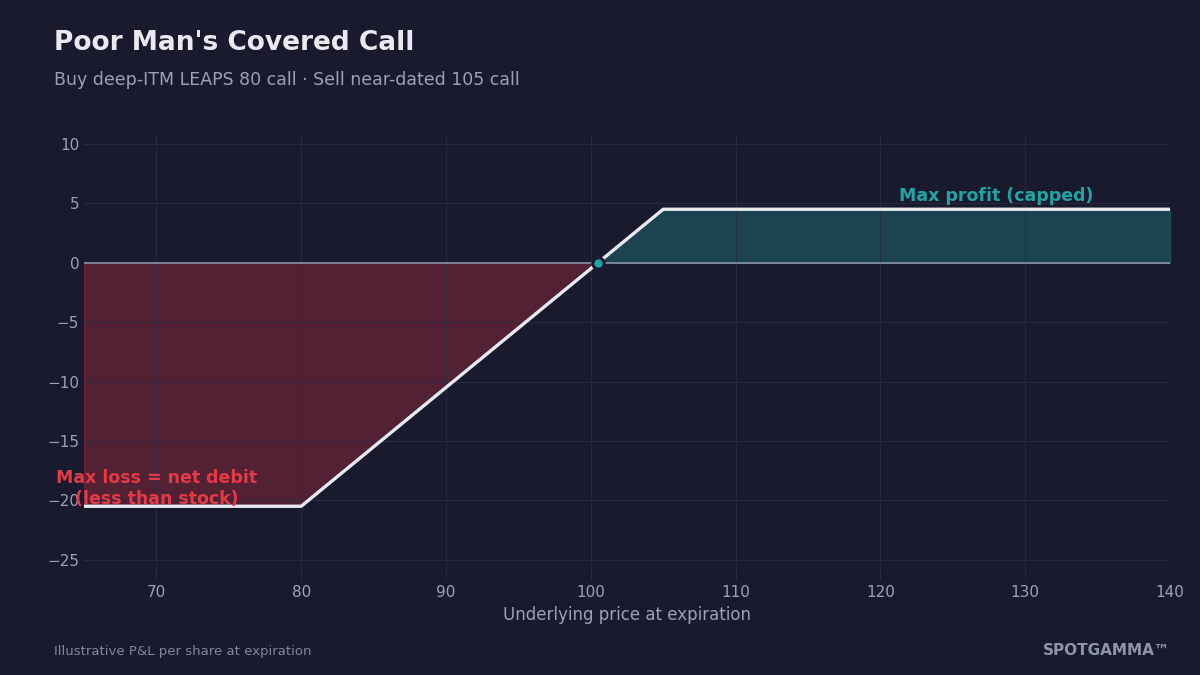
With the stock at $100:
- Buy one deep-ITM LEAPS $80 call for $23.00 — roughly $20 of that is intrinsic value, so you are paying only about $3 of time premium for a year-plus of stock-like exposure.
- Sell one near-dated $105 call for $2.50.
- Net debit: $20.50, or $2,050 — versus $10,000 to buy 100 shares.
If the stock pins at $105 at the front expiration, the position earns roughly $450: the LEAPS gains with the move from $100 to $105 while the short call expires worthless, keeping its full $2.50. Maximum loss is the $2,050 paid — real money, but a fifth of the $10,000 a shareholder has exposed. Breakevens and the shape of the curve at the front expiry are worth seeing before you trade it: build the diagonal in SpotGamma’s free Options Calculator and stress it across price and time.
PMCC vs. Related Strategies
- Vs. the covered call: same short-call income, roughly a fifth of the capital, and a smaller (but total-loss-possible) worst case. The covered call collects dividends and has no expiration on its long leg; the PMCC does not and does.
- Vs. a plain LEAPS call: the PMCC adds a recurring short call that chips away at the LEAPS’ cost basis cycle after cycle, at the price of capped upside each cycle.
- Vs. a generic diagonal spread: structurally identical — the PMCC is simply the diagonal built with a deep-ITM, high-delta long leg so it behaves like stock replacement rather than a two-sided volatility trade.
Using Positioning Data to Trade It Better
Like every entry in our options strategy library, the PMCC has one or two decisions that data can make better than instinct:
- Use the Call Wall for the short strike. The eternal covered-call question — where to cap the upside — has the same answer here: the Call Wall marks the strike carrying the largest dealer gamma, where rallies have historically stalled. Selling the front-month call at or above the wall caps you at a level price has struggled to clear, rather than one picked by round-number habit.
- Buy the LEAPS when IV is low. A long-dated option carries a lot of vega, so the PMCC owner is implicitly long volatility on the back leg. Entering after implied volatility has normalized — not during a spike — keeps the position a stock substitute instead of a vol bet, and check the gamma regime for context on whether the tape is likely to stay contained.
- Keep the LEAPS at 70–80 delta. If the stock falls and the long leg’s delta decays toward 50, the position stops tracking the shares. Rolling the LEAPS down or accepting the changed character is a decision — monitor it rather than discovering it.
Risks
- The whole debit can be lost. If the stock sits below $80 at the LEAPS expiration, the $2,050 is gone — a smaller number than stock risk, but a 100% loss on the position.
- Early assignment on the short call — most likely around ex-dividend dates — forces you to deliver shares you don’t own; the LEAPS covers the margin requirement but you’ll close or exercise legs at spreads you didn’t choose.
- A fast rally through the short strike caps the front cycle while the long leg’s remaining extrinsic value means the package can briefly gain less than the width implies.
- Vega exposure cuts both ways: an IV collapse marks down the LEAPS even if the stock goes nowhere.
FAQ
How does a PMCC differ from a covered call?
A covered call writes calls against 100 shares; a PMCC writes them against a deep-ITM LEAPS call that substitutes for the shares. The PMCC needs far less capital and has a smaller maximum loss, but it collects no dividends, its long leg eventually expires, and the entire debit can be lost.
What delta should the LEAPS call be?
Roughly 70–80 delta. That keeps the long leg mostly intrinsic value, so it tracks the stock closely and carries little time premium to decay, rather than turning the position into a long-volatility trade.
What happens if the short call is assigned?
You are assigned short 100 shares, which the LEAPS call covers for margin purposes. Most traders then either exercise the LEAPS to deliver stock or, usually better, sell the LEAPS (capturing its remaining extrinsic value) and buy shares to close the short position.
This article is for educational purposes only and is not financial advice. Options involve substantial risk and are not suitable for all investors.