Violent selling resumed in force last week as Thursday and Friday brought sharp, broad-market volatility. By Friday’s close, the S&P 500 sat roughly 12% below its October 6 all-time high. The Nasdaq 100 was similarly down about 20% from its peak.
Traders continue to scratch their heads on the reason behind the selloff. Is this the result of losing Jensen Huang as the global leader of the AI revolution? Or from the $1.5 trillion Anthropic IPO reducing liquidity from other tech names?
Through the chaos, it seemed that only volatility itself could catch a bid. The VIX nearly doubled from 22 to 40 as fixed strike IVs leapt as much as +7% into next week.
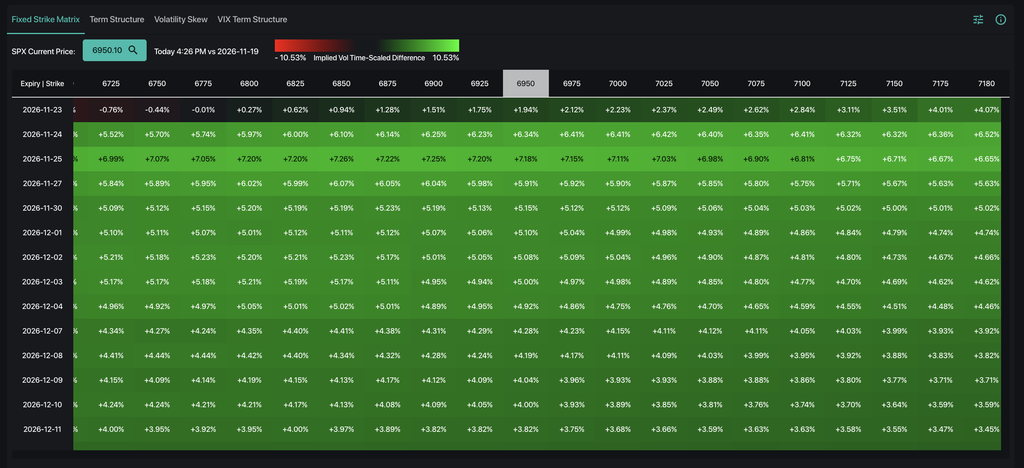
Noting major headline risk, our pre-market Founder’s Note issued a conditional warning about this type of correction on Wednesday, November 18: “Should we get more serious outage headlines, sharp downside selling could come back in which could push the SPX down to the 7000s.”
Given the significant market capitulation, there are two major questions we are looking for answers to: (1) What made last week’s selloff so severe? (2) As we head into the holidays, where could the market go from here?
Correlation Unwinds Into Record Negative Gamma
Regardless of whether the correction of the past two days was kicked off by outage fears or a sudden loss of faith in the AI trade, our positional analysis reveals the selloff began at a deeply sensitive time for the overall market.
We have typically looked to the volatility correlation index COR1M as a high-level indicator showing how traders are positioning across the market. A low reading – such as below 8 as we saw in October – is the signature of a crowded dispersion trade: selling index volatility while buying volatility in individual names.
Last week, we saw this behavior unravel as COR1M shot from 13 to 46 in just four days. By midday Thursday, we flagged to our followers that this was an equity-wide event versus a typical stock rotation. This also marked the largest jump since the Iran war began back in March 2026.
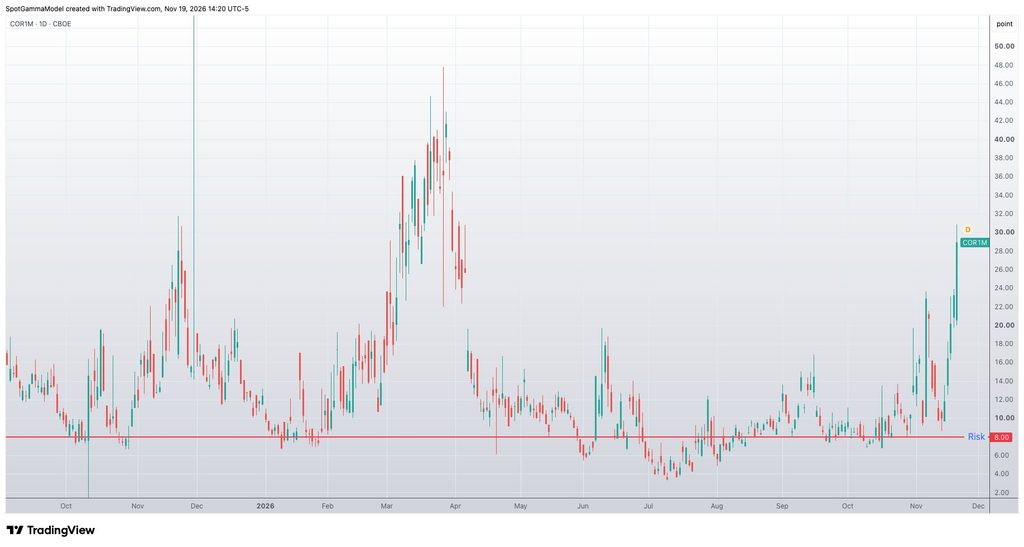
Once this measure of vol correlation begins to snap higher, everything “trades as one” which has typically meant significant – and often bearish – realized volatility. Accordingly, Thursday and Friday’s market drawdown showed virtually all sectors in red with the exception of bonds and the dollar.
As correlation unwound, our TRACE heatmap flashed blood red Thursday and Friday, indicating negative dealer gamma across the board.
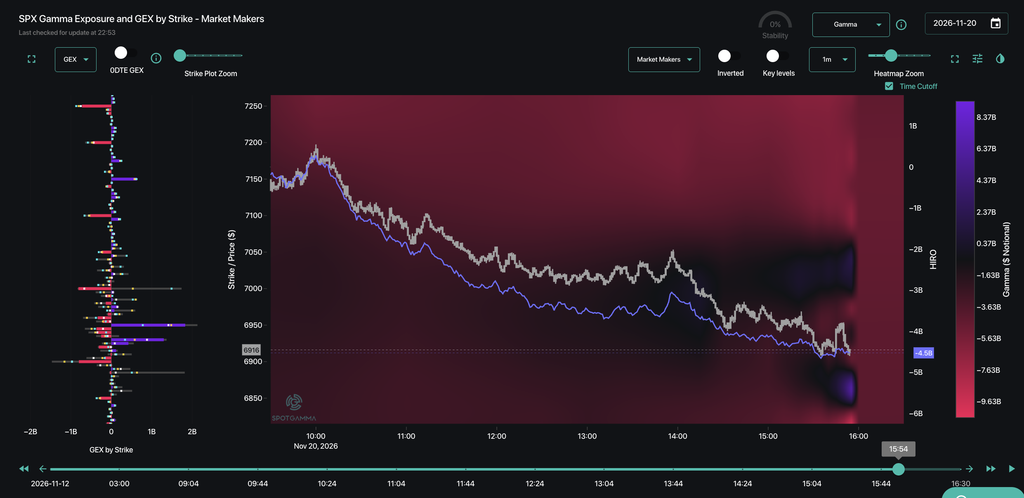
As traders turned bearish, dealers responded by mechanically selling underlying stock and futures to hedge their books. This accelerated the drawdown, turning a drop into a rout.
Yet the same options data that explains the selloff also paints a somewhat nuanced picture into next week. OPEX often marks turning points for the broader market, and the shortened holiday week ahead adds another unusual dimension to the mix.
Thanksgiving Week: Post-OPEX Flows & Shortened Calendar
The monthly options expiration (OPEX) took place on Friday, November 20, when the market hit recent lows. As we shared in our morning Founder’s Note that day, this was “an extremely put-heavy expiration, with about $900bn of delta expiring.”
The last time puts made up 80%+ of expiring positions was April 2025, which took place shortly after the infamous Liberation Day tariff news.
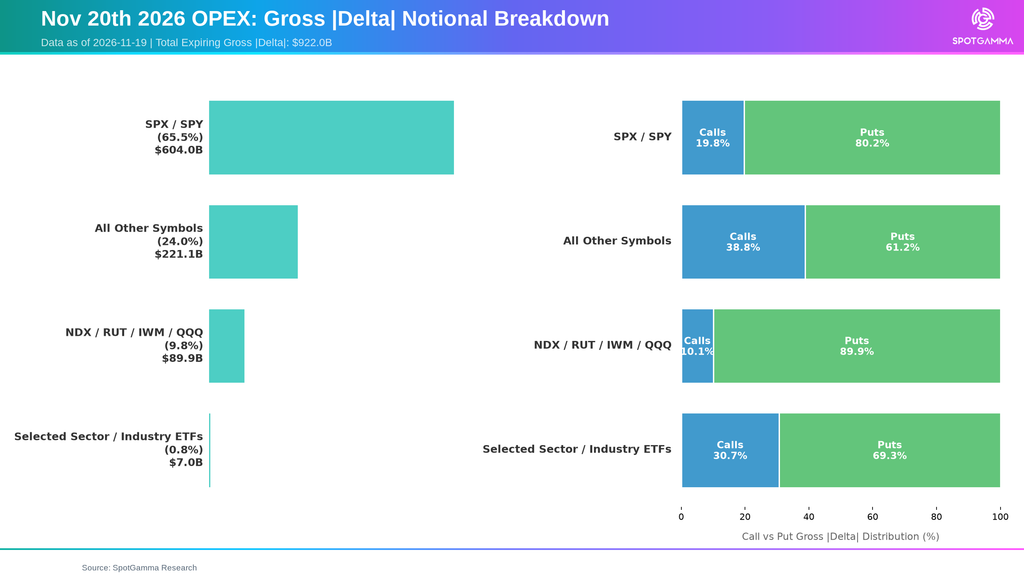
OPEX can often lead to “volatility reversion” behavior. When significant dealer gamma clears with OPEX, positive or negative, the positioning landscape resets.
Given this, we would expect that the clearing of a heavy negative gamma expiration would leave more positive gamma to help stabilize the market. However, dealer gamma for SPX appears to remain negative into next week, albeit less so near SPX 7,000 specifically.
One additional noteworthy point: VVIX, the volatility of VIX itself, jumped from 102 to 146 last week. Traders rushed into tail hedges, buying both VIX calls and SPX puts.
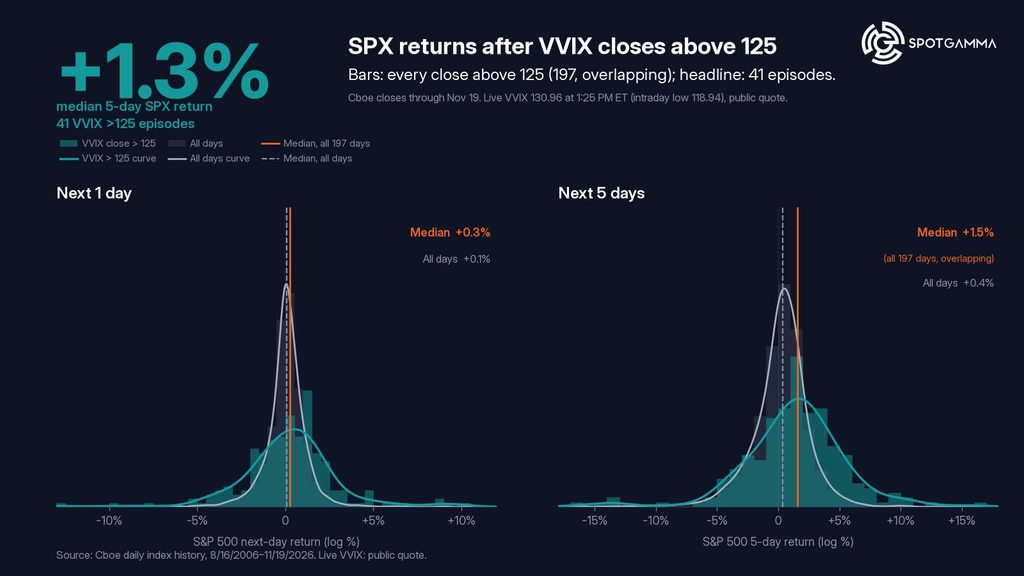
When VVIX closes above 125, the median SPX return over the following 1- and 5-day timeframes points to a generally constructive setup, although volatility-of-volatility can be tricky to pin down. The key point is that as of Friday, traders were bracing for a wide range of outcomes.
To summarize the current viewpoint, positional analysis suggests the market is less fragile after Friday’s OPEX, although by no means fully repaired.
A move back above SPX 7,000 could mean options positioning turns supportive, particularly if put sellers reemerge and IVs begin to come down. A failure to reclaim 7,000 on Monday, or VIX holding near 40, would point to further stress.
What Monday Could Reveal for Traders
Given the nuance we shared above, the key question then becomes how traders will act on Monday. This will determine both the gamma regime and expectations heading into the Thanksgiving weekend.
Should short-dated vol sellers enter the picture, positive gamma would be supplied to the market which could stabilize price. The significant options premiums from last week’s vol spike may make this more attractive for some. Furthermore, traders may be hesitant to enter long options positions over the long Thanksgiving holiday weekend due to theta decay risk.
At the same time, market participants expecting meaningful movement in either direction may wish to capitalize through outright calls and puts despite the premium. With surging realized volatility over the past few weeks, even expensive bets have potential to deliver outsized returns.
We urge caution for anyone shorting options in this environment, and traders should beware the risk of continued violent selloffs or rips. This environment makes defined risk structures all the more critical for those selling options on virtually any underlying asset.