The CEO and two directors bought stock on the open market within six days in mid-September:
- CEO John Fieldly — 18,000 shares at $27.44 on Sept. 10, about $494,000, lifting his direct stake to 956,063 shares.
- Director Damon DeSantis — 20,000 shares at $27.65 on Sept. 14 ($553,000), then 16,000 more at $27.95 on Sept. 15 ($447,200).
- Lead Director Hal Kravitz — 12,000 shares at $28.00 on Sept. 15 ($336,000), a 5% bump to his position. Kravitz paid $28.00, above CELH’s $27.63 closing price that day.

Roughly $1.8 million across three filers, into a stock down 51% over the prior year. Insiders already own about 13% of the company. OpenInsider shows all CELH insiders buying the past two years and the recent purchases are the largest dollar size.
Insiders are expressing a view through stock while the options market is offering relatively inexpensive convexity. In other words, executives have loaded up on shares but the options market has not had a response yet with implied volatility remaining at value levels.
Why now
Insiders bought into management’s expected trough. Management guided that Q3 for the core brand should mirror Q2 before returning to growth as it exits the year. The CEO and two directors subsequently bought shares in the open market ahead of the Q3 blackout.
Q2 was the reset. Revenue of $817.9 million missed the $872.6 million consensus, the namesake brand fell about 11.7%, and shares closed down 18.5% the next day at $23.77. The company pinned the decline on trade spending, shipment timing, club-channel softness, a planned pullback in launches, and SKU optimization — mostly self-inflicted and reversible.
Alani Nu is working. About $364 million in Q2, up 21%, with retail sales up 56% and more than $1 billion in tracked-channel retail in the first half as the brand moved into PepsiCo distribution.
The company is buying too. About $124 million of stock was repurchased in the first half, with roughly $300 million of authorization remaining that management says it plans to use.
The offsets. Multiple securities class actions cover purchases between Feb. 21, 2025 and June 3, 2026, with allegations reportedly including that Celsius misled investors about Alani Nu’s safety for teenagers. The claims are unproven but are live headline risk, and the multiple is still rich.
What is the Options Market Implying?
Implied Volatility
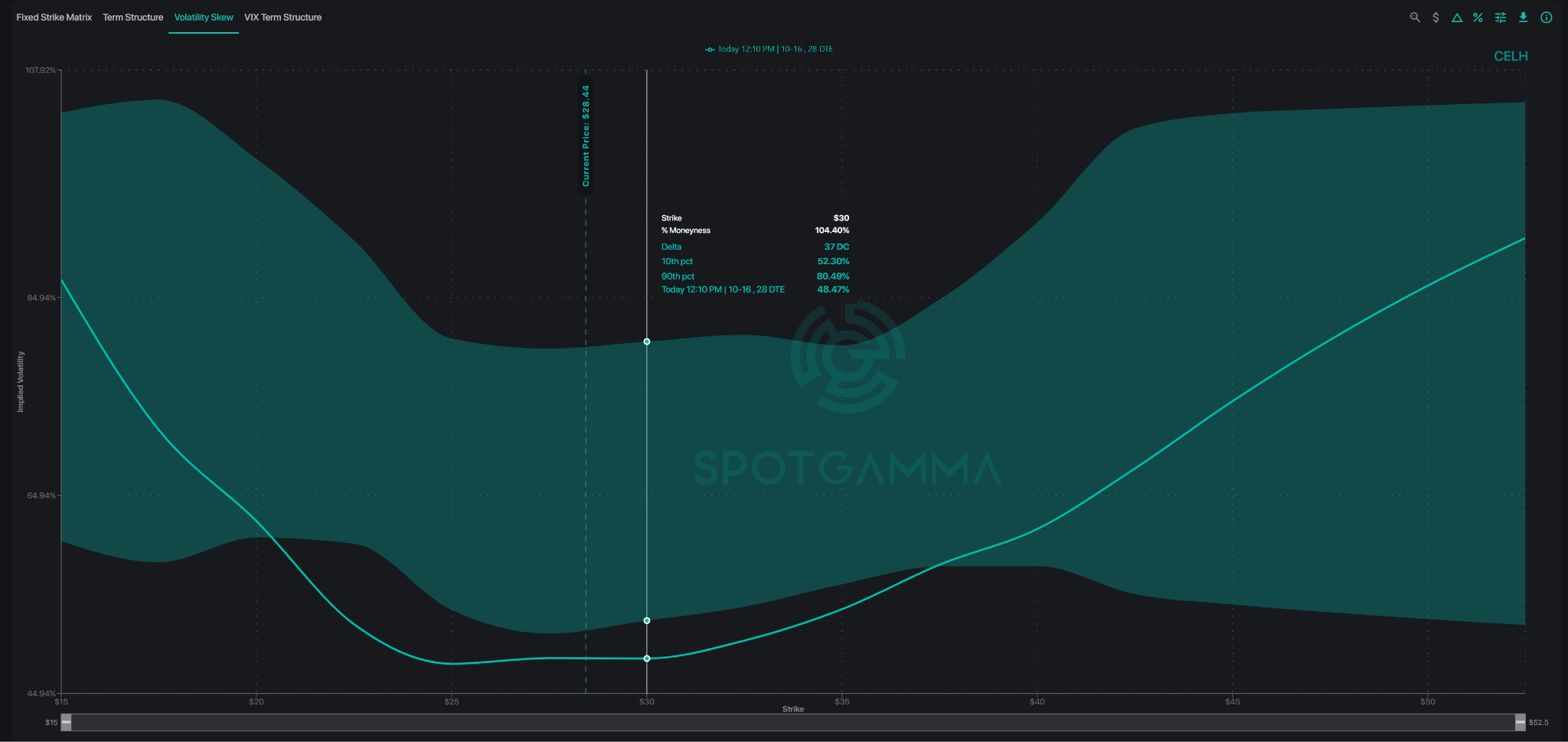
This is the part worth watching. As of Sept. 18, 30-day IV was 48 against a 52-week range of 44 to 82, with a call/put ratio of 1 call to 1.6 puts.
That puts IV rank near 20 — bottom fifth of its own one-year range, in a stock that just gapped 18.5% on earnings.
Volatility Skew
The skew shows both tails are bid, calls as well as puts, and the call/put ratio says downside protection is where the volume sits. But CELH has a history of outlier moves. Both wings are being priced off a depressed base. Combine that with three executives buying stock with their own cash, and the upside tail becomes the more intriguing side to own.
Expected move
The Q3 earnings report is confirmed on Nov. 5, after the close. At 51% IV, the volatility-implied one-standard-deviation range over the roughly 49 days through the post-earnings expiration is about ±19%. Daily expected move is about 3.2%, near $0.90. The last print delivered more than 18% in a session.
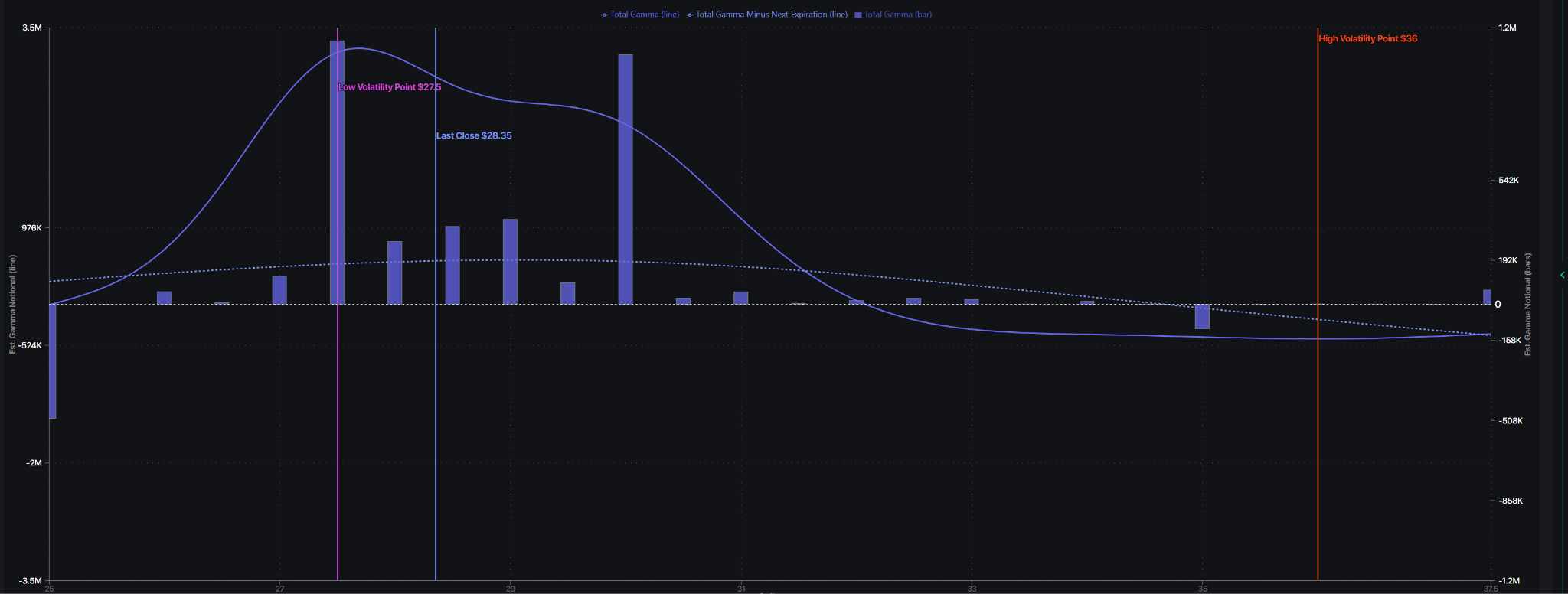
The SpotGamma synthetic OI tool below shows a swath of positive gamma at current levels between 27-30. The Synthetic OI map shows positive gamma concentrated from roughly $27–$30, a positioning regime that can dampen realized volatility and help pin price around current levels. Above roughly $31, the profile begins shifting toward negative gamma, where dealer hedging could instead amplify a directional move. With meaningful short interest still outstanding, that creates an asymmetric positioning setup if CELH breaks higher.
Positioning fuel.
Short interest was recently around 11.6% of float and declining, versus a peer-group average near 6%. The most recent published short interest data showed 28.91 million shares short as of Aug. 31, about 11.6–11.7% of float, down from 12.1% on Aug. 14 and 13.9% on July 31.
A crowded short base plus low IV plus a dated catalyst is the standard recipe for a gamma-driven move if the Q3 print confirms the trough.
What it implies.
At a 20 IV rank, premium sellers are not being compensated for the tails this name has historically delivered. Options are inexpensive relative to CELH’s own recent history.
Owning convexity into November is the cheaper expression, and it matches what insiders did with cash. The same math makes downside hedges inexpensive for anyone staying long through the print.
The stock still isn’t cheap. The optionality might be.
Investors are still waiting for the fundamental story to clean up. Insiders aren’t — they’re buying with cash, and they’re doing it while options sit near the low end of their one-year volatility range. That’s not a case for the stock being cheap. It’s a case for the optionality being cheap.