DICK’S Sporting Goods (DKS) has quietly developed an interesting insider-buying setup following its sharp post-earnings selloff.
The most notable transaction came September 22, when CFO Navdeep Gupta purchased 7,707 shares at $129.75, putting nearly $1 million of his own capital into DKS.
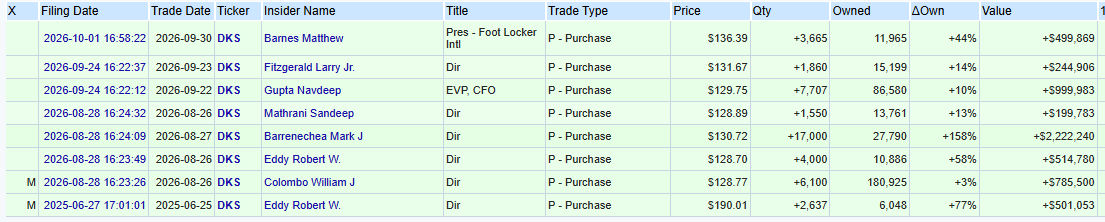
That purchase followed a cluster of insider buying around the same price zone. Mark Barrenechea bought approximately $2.2 million worth of stock, while Robert Eddy, Sandeep Mathrani, William Colombo and Larry Fitzgerald also made open-market purchases near the $129–$133 area.
The buying continued this week, with Foot Locker International President Matthew Barnes purchasing roughly $500,000 of DKS at $136.39. That transaction is particularly notable because Barnes operates inside the recently acquired Foot Locker business, whose weakness has been one of the primary concerns weighing on DKS.
Combined, insiders have now purchased roughly $5.6 million of DKS shares since the August earnings selloff, with most of that buying concentrated around the $129-$136 area.
That doesn’t mean $130 has to be the bottom.
But when multiple insiders—and eventually the CFO—begin accumulating shares around the same level following a 30% earnings-driven decline, the area deserves attention.
Why DKS Fell
The selloff wasn’t caused by weakness across the entire company. But when multiple insiders—including the CFO—commit fresh capital around the same level following a roughly 30% earnings-driven decline, that price zone deserves attention.
DICK’S core business remained relatively healthy, including 4.9% comparable-sales growth, but recently acquired Foot Locker continued to struggle. Foot Locker comparable sales declined 3.6%, and management subsequently lowered its full-year earnings outlook.
That created the central debate around DKS:
Is the market correctly pricing a difficult Foot Locker integration, or has the selloff begun discounting too much weakness relative to the strength of the core DICK’S business?
The insider activity suggests several executives and directors see the risk/reward as attractive around $130.
What SpotGamma Positioning Shows
For options traders, the important question becomes whether positioning starts migrating higher as DKS attempts to recover—or whether resistance continues to suppress rallies.
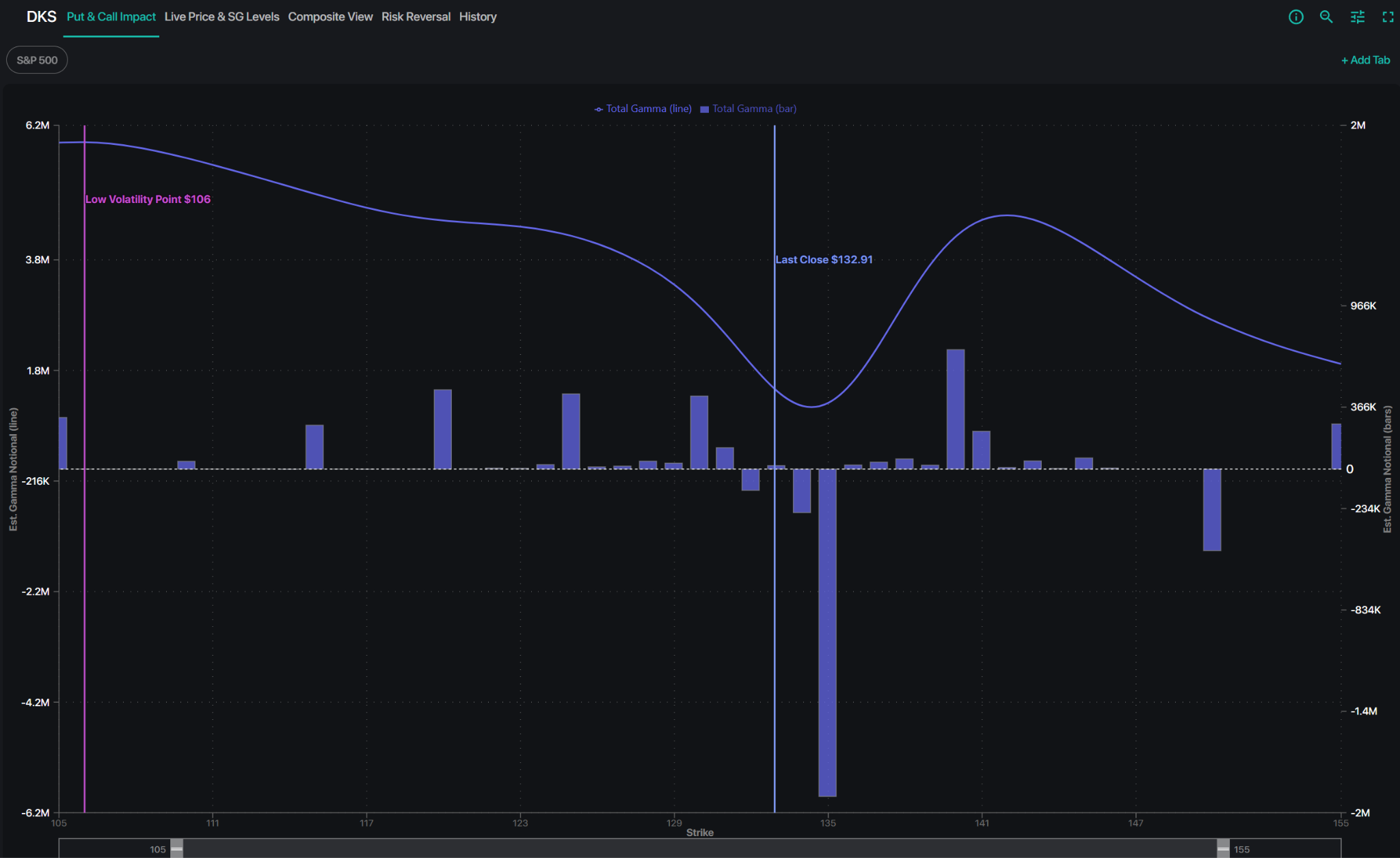
SpotGamma’s Synthetic OI model highlights $135 as the key near-term pivot, with the Put Wall concentrated around that level. Meanwhile, meaningful gamma concentrations at $130 and $140 help define the immediate trading range. For now, that puts roughly $130-$140 in control as DKS attempts to build a post-earnings base.
DKS is therefore attempting to establish a post-earnings base within this range. DKS has an IV rank of 27 so options premiums are in the lower third of historical levels the past year.
The volatility skew adds another interesting layer. With DKS around $136, implied volatility remains relatively subdued near spot and through much of the $120-$160 strike region.
What stands out is the upside wing. IV rises considerably above roughly $180, meaning traders are paying progressively more for exposure to a large recovery move. That does not necessarily predict a rally, but it does show that upside-tail optionality carries a meaningful premium compared with options closer to the current stock price.
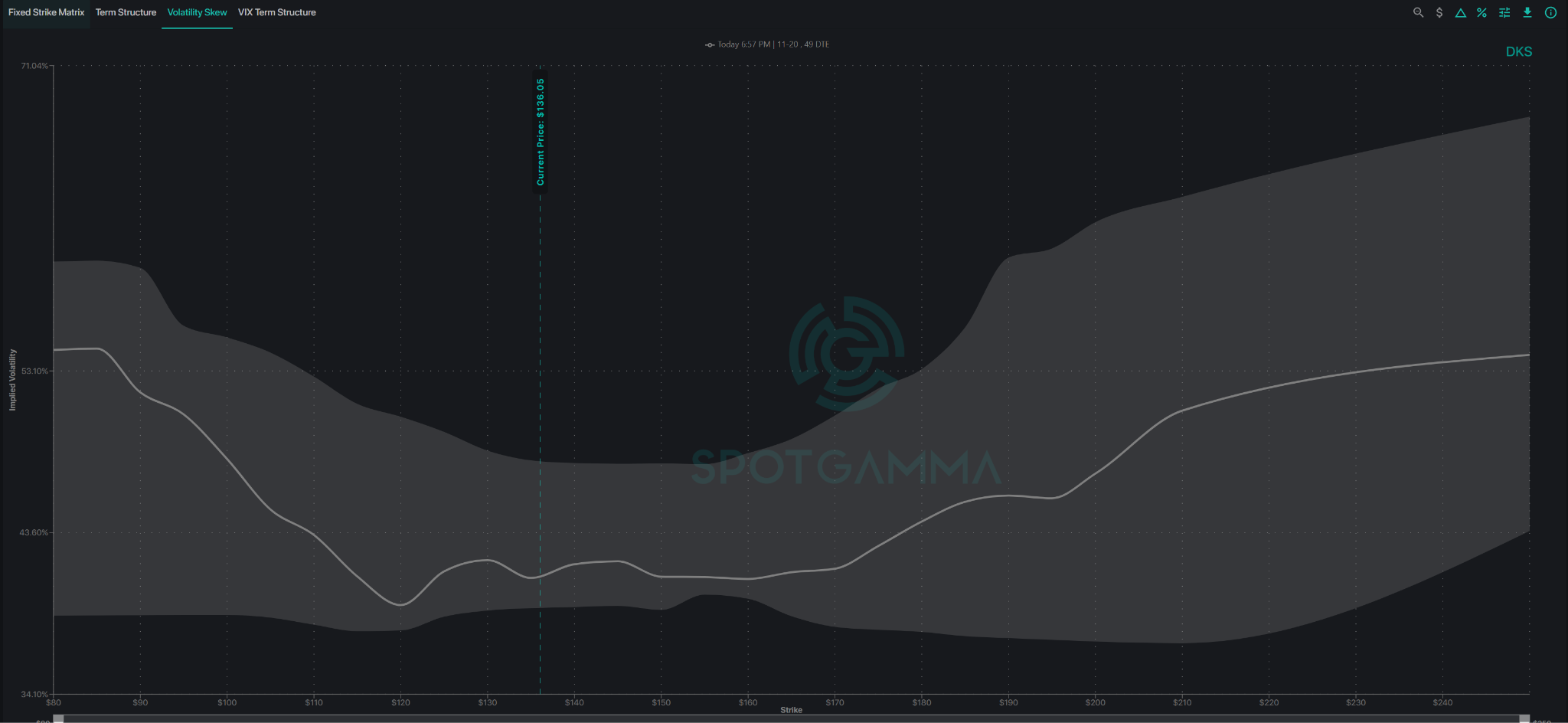
- Near spot: Relatively subdued IV. Implied volatility is comparatively inexpensive around the current stock price and across much of the ~$120–$160 region.
- Below ~$110: Downside tail premium increases. The market is still charging more for protection against a substantial deterioration in the Foot Locker/integration story.
- Above ~$180: Upside IV expands sharply. This is the most interesting feature of the surface, with large upside moves carrying increasingly expensive optionality.
Trader Takeaway
The interesting part of DKS isn’t simply that insiders bought stock.
It’s the concentration of purchases near the same level following a major repricing of the company.
Several directors began buying near $130 immediately after the earnings collapse, and the CFO subsequently committed nearly $1 million at $129.75.
For traders, the setup is relatively straightforward: $130–$135 is the key insider-buying and options-positioning zone, while $140 is the first important upside level to reclaim. A sustained break below the recent post-earnings lows would weaken the developing base thesis.
The unusual feature here is the overlap between two independent signals. Insiders have committed roughly $5.6 million of fresh capital largely around $129–$136, while options positioning independently identifies $130–$140 as the critical near-term range. Neither establishes that the low is in. Together, however, they make this price zone unusually important to watch.