With 10-year treasury yields now at two-decade highs, the topic of rates has dominated markets. Rising rates adds meaningful stress to the economy at large — creating both risk and opportunity for traders.
The market’s most rate-sensitive corners have taken the brunt of the damage. Small caps (IWM), utilities (XLU), homebuilders (ITB), and industrials (XLI) have all sold off as elevated yields raise financing costs.
However, the setup heading into October is more nuanced than recent price action suggests. If yields roll over and the Fed holds steady at its October FOMC meeting, current options positioning suggests that these beaten-down sectors may be primed for a rebound.
The rates picture also moved sharply last week. Cooler-than-expected PCE and NFP data drove October hike odds from 70% on Monday to 22% by Friday. Similarly, CPI on October 14 and the FOMC on October 28 leave room for near-term swings.
Bond Volatility Flashes Higher — And Potentially Bullish
As we noted in last week’s Founder’s Note, TLT (the 20+ year Treasury bond ETF) is showing extreme implied volatility. Implied volatility reflects the option market’s expectation for future movement, compared to realized volatility which measures what has already happened.
Interestingly, TLT’s implied volatility percentile now sits at 100%, the top of its prior year range. One month at-the-money IV specifically has climbed from 12% to 16% in a month.
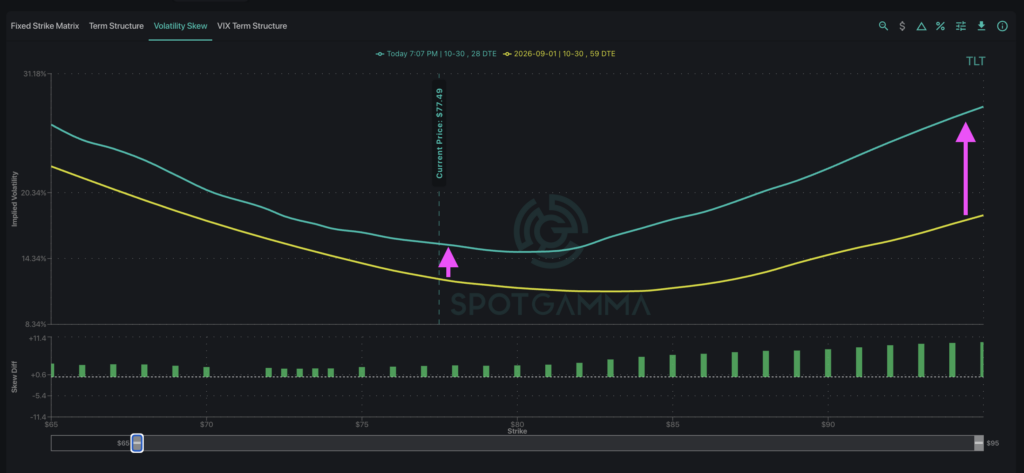
Positioning has also flipped decisively towards calls. TLT options have shifted from put-skewed to call-skewed, with call skew now at the 81st percentile.
Skew measures whether downside puts or upside calls carry richer pricing. Rising call demand points to growing appetite for bond upside compared to one month ago.
With TLT trading near multi-decade lows, the shift toward elevated call skew is consistent with traders paying up for upside exposure in bonds — a setup that would generally benefit from a pullback in yields.
Call Flow Builds Amidst the Drawdown
Few sectors illustrate the rate story better than utilities. XLU has pulled back 16% from its July all-time high — a steep drawdown in a sector prized for stability.
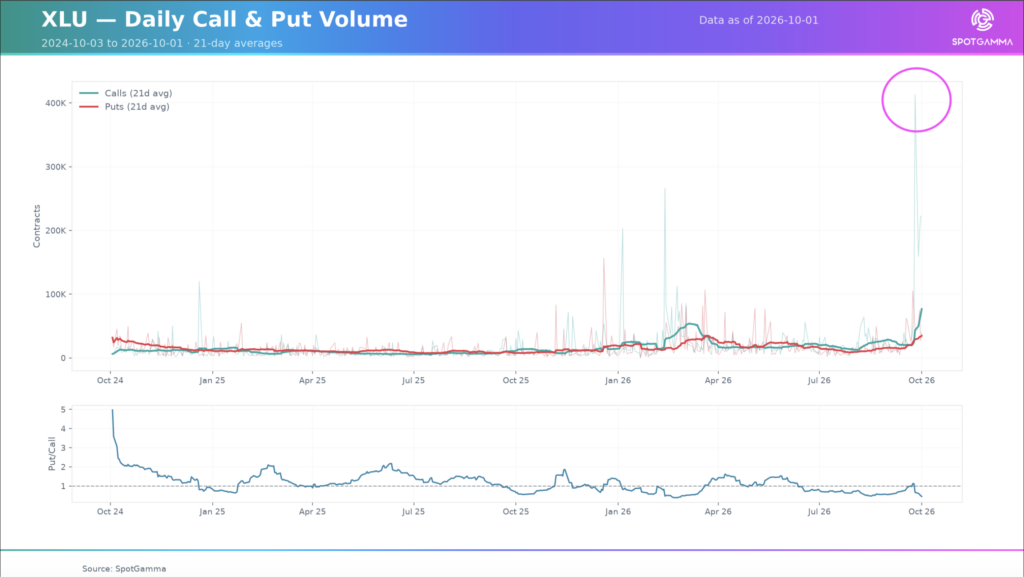
Beneath that weakness, something notable has developed: XLU recently printed one of its largest call-volume sessions in two years, with more than 400,000 contracts changing hands. When a seemingly washed-out sector begins attracting that degree of upside options activity, it may be worth paying attention.
META’s IV Rank is 62%, placing current implied volatility in the upper half of its one-year Some of the more notable trades highlighted this week in our Opening Setup and FlowPatrol reports included:
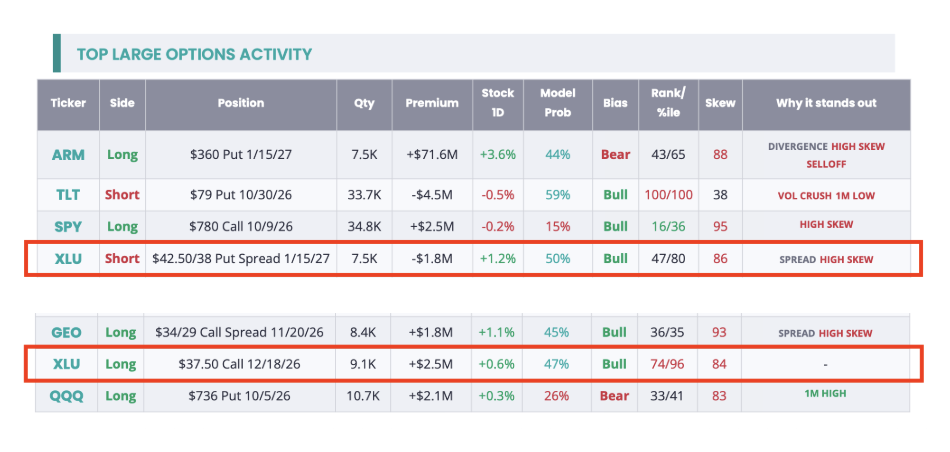
- 53K lot XLU October 30th 41 calls bought to open
- 22K lot XLU October 16th 41 calls bought to open
- 9K lot XLU December 18th 37.5 calls bought to open
- 8K lot XLU January 15th 38/42.5 put spreads sold to open
The concentration stands out across both size and expiry. More than 75,000 contracts accumulated specifically at the $41 strike across October expirations. Longer-dated flow added roughly $2.5 million in December $37.50 calls, with $1.8 million in premium tied to the above January put spread.
With XLU near $40, SpotGamma’s key levels help frame the setup. The Put Wall for XLU currently sits at $38, forming relatively strong support should the ETF trade lower.
Constructive positioning is not confined to just XLU, and extends to several other rate-sensitive names. Single stocks under the utilities sector, including VST, CEG, XEL, and CPK show elevated call skew percentiles, suggesting bullish positioning to the upside.
The October Playbook: Asymmetry in Rate-Sensitive Sectors
The AI trade adds another layer to the utilities thesis. Utilities stand to benefit meaningfully from the AI data center buildout, which is driving significant growth in power demand. Micron’s earnings last week reminds us that AI data center infrastructure demand continues to expand — and every incremental rack of compute ultimately requires power.
The playbook heading into October has become increasingly about asymmetry. Rate-sensitive sectors have already absorbed significant pain, expectations for an October hike have fallen sharply, and upside-focused options activity has emerged in areas where price action has been particularly weak.
That does not mean the volatility risk has passed. Bond volatility remains at extremes, and the CPI/FOMC gauntlet still lies ahead. For traders looking for opportunity amid elevated rates, the combination of depressed prices, falling hike odds, and growing call interest in utilities creates a setup worth monitoring.