A covered call is an options strategy in which you own at least 100 shares of a stock and sell one call option against them, collecting a premium in exchange for agreeing to sell your shares at the strike price. The premium is yours to keep no matter what happens. In return, your upside is capped at the strike: if the stock rallies through it, your shares are called away at that price. The result is a position that earns income in flat or modestly rising markets while giving up the right tail of the stock’s return.
Key Takeaways
- One short call per 100 shares owned — the shares “cover” the obligation, so there is no naked-call risk.
- The premium cushions downside slightly and lowers your effective cost basis, but the stock itself remains your dominant risk.
- Max profit = (strike − purchase price) + premium, realized if the stock finishes at or above the strike at expiration.
- Strike selection is the whole decision — and the premium is only good value when implied volatility is rich.
How the Covered Call Works
An out-of-the-money call is pure extrinsic value: time premium with no intrinsic worth. When you sell one against stock you own, you convert the possibility of a large rally into cash today. Each day the stock fails to threaten the strike, a slice of that premium decays into your pocket; if the option expires worthless, you keep the shares and the full credit, free to sell another.
It helps to be honest about what is being traded. The call buyer pays you for the stock’s upside beyond the strike. If the stock never gets there, you were paid for nothing — the ideal outcome. If it blows through the strike, you still profit (stock gain to the strike, plus the premium), but you watch further gains accrue to someone else. The covered call is therefore not free income; it is the systematic sale of your best months in exchange for cash in the ordinary ones.
Premium is the product, which makes implied volatility the price tag. Selling calls when IV is depressed means selling your upside cheaply — the chief sin of covered-call writing. The same strike on the same stock can pay twice as much when the options market is pricing bigger moves.
Example
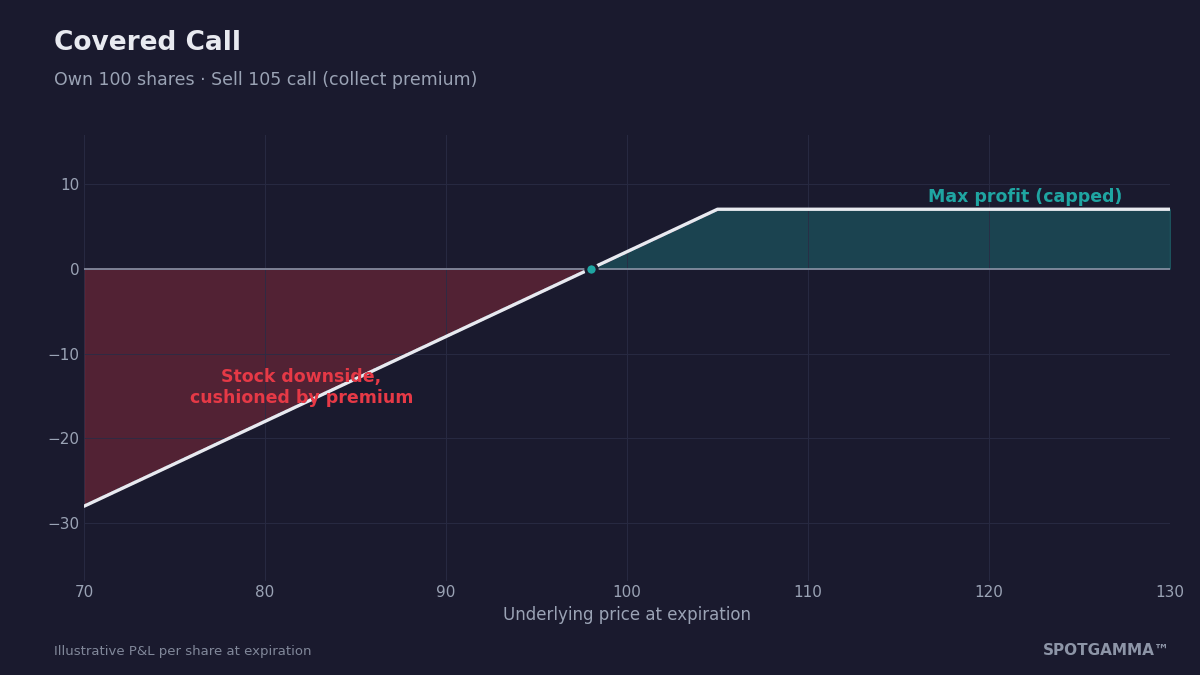
With the stock at $100:
- Own 100 shares purchased at $100.
- Sell one 105-strike call for $2.00 ($200).
Three outcomes at expiration. If the stock sits anywhere below 105, the call expires worthless and you keep the $200 — your cost basis is effectively $98, which is also the breakeven. If the stock finishes above 105, your shares are sold at 105: you earn $500 of stock appreciation plus the $200 premium, for the maximum profit of $700, no matter how high the stock trades. And if the stock falls, you lose on the shares just as any stockholder does, minus the $2 cushion. The payoff diagram shows the signature shape: stock-like downside, income in the middle, and a hard ceiling above 105.
Covered Calls vs. Related Strategies
The covered call anchors a whole family of income structures in our options strategy library:
- Poor man’s covered call — replaces the 100 shares with a deep-in-the-money LEAPS call, running the same short-call engine on a fraction of the capital.
- Covered strangle — adds a short put below the market, collecting a second premium in exchange for committing to buy more shares lower.
- Wondering whether the premium-selling trade is worth it at all? See is selling options profitable, and for the painful special case, selling covered calls below your cost basis.
Using Positioning Data to Trade It Better
The eternal covered-call question is which strike to sell. Dealer positioning data replaces the guesswork with a map:
- Let the Call Wall answer the strike question. The Call Wall marks the strike carrying the largest dealer gamma — the level where rallies have historically stalled as hedging flows lean against further upside. Selling your call at or above the wall caps your stock at a level the market itself has struggled to clear.
- Check IV before you sell. Premium is the product. When implied volatility is low, you are selling your upside at clearance prices; selling into richer IV — and into a supportive gamma exposure (GEX) backdrop — is when the trade pays you properly for the cap you accept.
- Model the trade-off first. Compare strikes and expirations side by side in SpotGamma’s free Options Calculator before committing shares.
Risks
- The stock is the risk: a $2 premium does almost nothing against a 20% drawdown. Covered calls are not a hedge.
- Opportunity cost is real and recurring — one runaway rally surrendered above the strike can outweigh many months of collected premium.
- Early assignment can take your shares before expiration, most commonly when the call is in-the-money ahead of an ex-dividend date.
- Selling calls below your cost basis after a decline can lock in a loss if the stock snaps back through the strike.
FAQ
Can you lose money on a covered call?
Yes — on the stock. The short call only cushions the first $2 of decline in the example; everything below the $98 breakeven is a loss, just as it would be for any shareholder. The call itself can never lose you money in isolation, because it is covered by shares you already own.
What strike should you sell a covered call at?
Far enough above the market that you are paid fairly for capping your upside, and ideally at a level price is unlikely to clear. Positioning data helps here: the Call Wall marks the strike where dealer hedging has historically stalled rallies, making at-or-above-the-wall a data-driven choice rather than a guess.
What happens if the stock goes above the strike?
Your shares are called away at the strike at (or sometimes before) expiration. You keep the premium plus all appreciation up to the strike — the position’s maximum profit — but you forfeit gains beyond it. Traders who want to keep their shares typically buy the call back or roll it up and out before assignment.
This article is for educational purposes only and is not financial advice. Options involve substantial risk and are not suitable for all investors.