A protective put is an options strategy that buys a put against stock you own, setting a hard floor under your losses while leaving the upside open. If the stock falls, the put’s right to sell at the strike caps the damage at a known, fixed amount; if the stock rises, you keep the gains minus the premium paid. It is insurance in the most literal sense available in markets — a defined cost in exchange for the removal of tail risk.
Key Takeaways
- Own stock, buy one put per 100 shares: downside is floored at the strike (plus the premium), upside remains unlimited.
- The cost is the premium — a recurring drag if you hedge continuously, which is why timing and strike choice matter more than the mechanics.
- Worst case is known in advance: stock price minus the strike, plus the premium paid. Nothing that happens overnight changes it.
- Unlike a stop-loss order, the put cannot be gapped over or whipsawed out — protection holds through halts, gaps, and fast markets.
How the Protective Put Works
A put is the right to sell at the strike, no matter where the stock trades. Married to a long stock position, that right converts open-ended downside into a fixed deductible: below the strike, every dollar the shares lose is matched by a dollar of intrinsic value the put gains. Above the strike the put simply expires unused, like any insurance policy in a good year, and your cost was the premium.
The premium is mostly extrinsic value, and its size depends on three choices: the strike (higher floors cost more), time (longer policies cost more, though less per month), and the level of implied volatility when you buy. The first two are yours to choose; the third is set by the market, and it is where most hedging money is wasted — buying protection after fear has already repriced it.
As a cornerstone of our options strategy library, the protective put is also the building block of fancier hedges: cap the upside to pay for it and you have a collar; spread the put and you have cheaper, partial protection.
Example
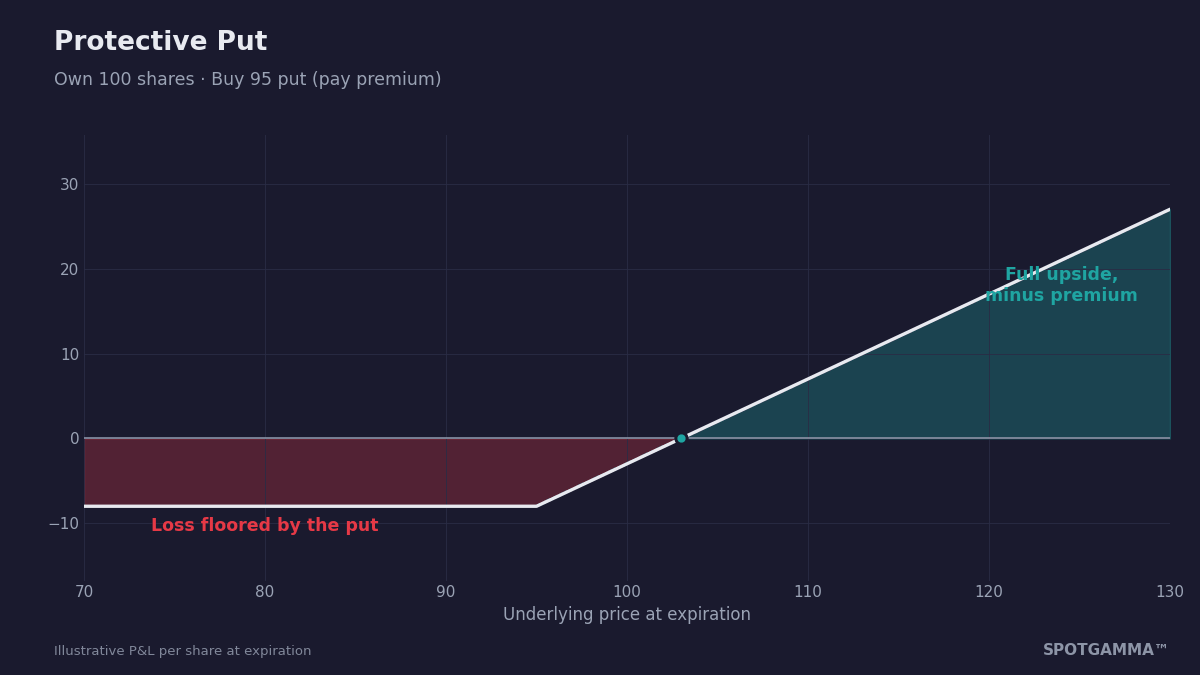
You own 100 shares at $100:
- Buy 1× the $95 put for $3.00 ($300).
- Loss floored at $800: the $5 fall to the strike plus the $3 premium, no matter how far the stock drops.
- Upside: fully open, reduced by the $3 premium — the position outperforms unhedged stock everywhere below $92, and trails it by exactly $300 everywhere above $95.
- Breakeven versus doing nothing: $103 — the stock must rise $3 for the hedged position to be whole on the premium.
Run the same structure at different strikes in SpotGamma’s free Options Calculator and watch the trade-off: each dollar of higher floor costs progressively more premium.
Protective Put vs. Collar and Bear Put Spread
- vs. the collar: a collar sells a covered call to finance the put, often cutting the net cost to zero — at the price of capping your upside. The pure protective put keeps the upside and sends you the bill.
- vs. the bear put spread: spreading the put (buying the 95, selling a lower strike) reduces cost but turns the hard floor into a window — protection ends below the short strike. Reasonable when you fear a correction, not a collapse.
Using Positioning Data to Trade It Better
Insurance has a price and a placement, and data improves both:
- Buy protection when IV is low, not when you need it. Hedges are cheapest when nobody wants them. Check IV rank before the known event, not during the selloff — the same put that costs $3.00 in a quiet tape can cost multiples of that after fear repricing, which is precisely when hedgers tend to show up.
- Anchor the strike to the Put Wall. The Put Wall marks the strike with the heaviest put gamma, where dealer hedging has historically slowed declines — structural support on the positioning map. A floor set at or just below the wall coincides with the level the market itself defends, which often lets you buy a cheaper, lower strike with similar practical protection.
- Use the gamma regime to size urgency. In negative GEX regimes, moves extend further and faster as hedging amplifies selling — conditions where carrying the full put, rather than a spread, earns its premium.
Risks
- The drag is real. A 3% quarterly premium compounds into a serious performance tax if you roll protection continuously; most of the time the put expires worthless, by design.
- IV crush works against late buyers. Protection bought during panic loses value quickly as volatility normalizes, even if the stock stays weak.
- The floor is not at the strike. Your true worst case includes the premium — a $95 put bought for $3 floors you at $92 of value, not $95.
- Expiry is a cliff. The day the put expires, so does the floor. A hedge that lapses right before the event it was bought for is a self-inflicted wound; match tenor to the risk window.
FAQ
What strike should a protective put be?
It depends on the deductible you can live with: 5–10% out-of-the-money is a common balance of cost and coverage. Positioning data refines the choice — setting the floor at or near the Put Wall aligns it with the strike where dealer hedging has historically slowed declines, often at a lower premium than hedging tight to the current price.
When is the best time to buy protective puts?
When implied volatility is low and the market is calm — before the risk is priced in. Buying after a selloff has begun means paying panic prices for protection; checking IV rank ahead of known catalysts is the difference between cheap insurance and expensive regret.
Protective put vs stop-loss order?
A stop-loss is free but fragile: it can be gapped over on a bad open, filled far below your trigger, or whipsawed out of a position that then recovers. The put costs premium but is absolute — the right to sell at the strike survives gaps, halts, and overnight news, and you keep the shares if the stock bounces.
This article is for educational purposes only and is not financial advice. Options involve substantial risk and are not suitable for all investors.