The Fed is widely expected to stand pat this Wednesday, but the options market is pricing anything but a quiet week. With SPX trading in a negative-gamma environment and short-dated implied volatility elevated around a crowded catalyst calendar, the bigger question isn’t simply what the Fed will do. It’s whether dealer positioning will amplify the market’s response.
The Federal Reserve’s October 27–28 meeting arrives at a particularly sensitive moment for financial markets. Treasury yields remain elevated, technology stocks have experienced a sharp pullback, and options positioning suggests the S&P 500 could remain vulnerable to outsized moves.
With markets assigning roughly a 90% probability to the Fed holding rates steady, Wednesday’s decision appears relatively straightforward. But the more important question for investors is whether Fed Chair Kevin Warsh signals another rate hike before year-end.
For equity traders, the outcome will matter. However, the options market’s positioning may ultimately determine the magnitude of the reaction.
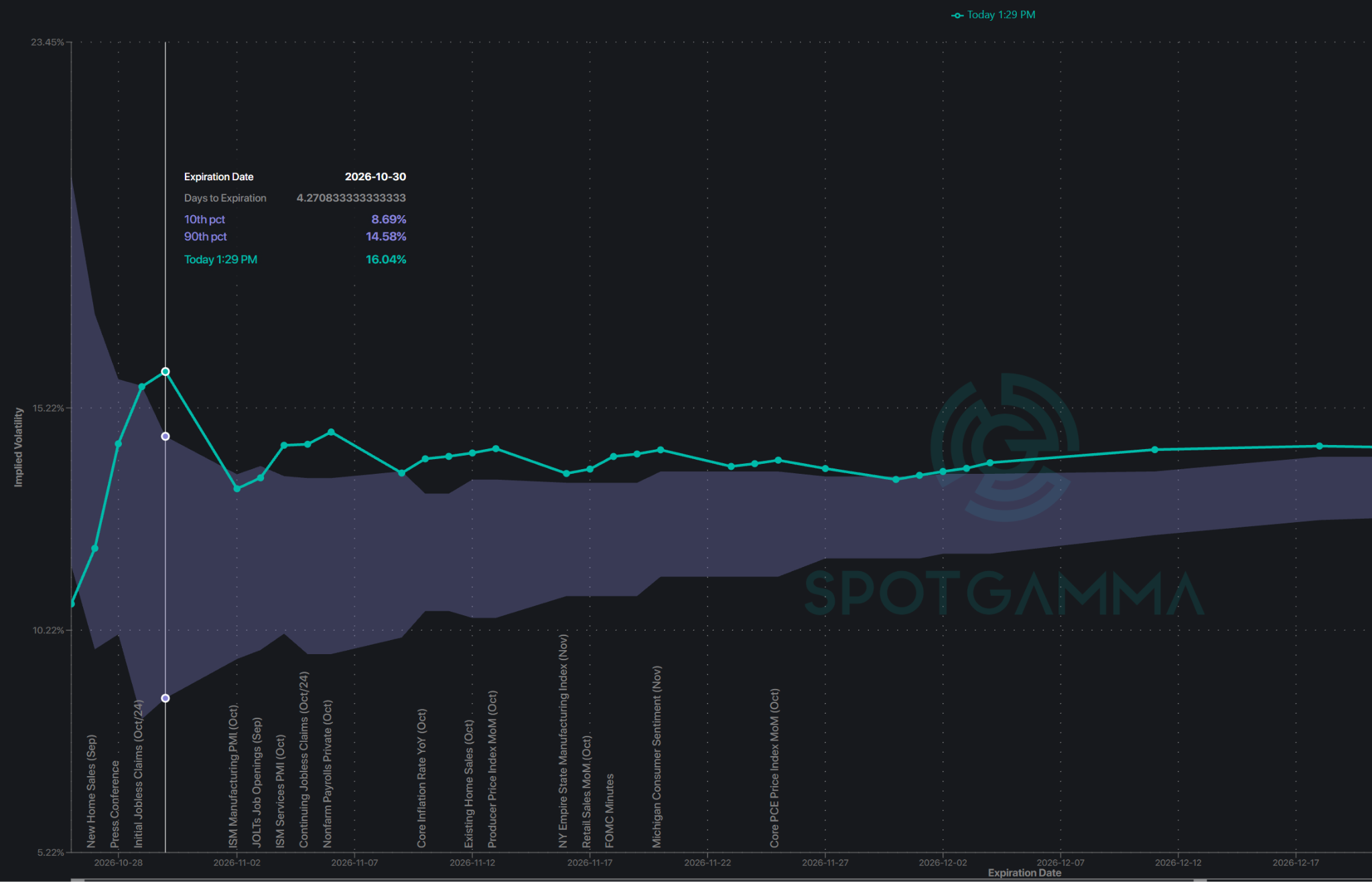
The SPX implied volatility term structure shows a pronounced event-driven volatility premium concentrated in this week’s expirations, with October 30 standing out near 16% IV, above the roughly 14% levels seen across subsequent weeks. This elevated pricing reflects the unusually crowded catalyst calendar, including Wednesday’s FOMC decision, major technology earnings, and key economic releases. Notably, the premium extends through Friday rather than being isolated to the Fed announcement, suggesting traders are pricing the cumulative risk of both FOMC and mega-cap earnings.
For options traders, this creates the potential for significant post-event volatility compression if realized moves fall short of expectations, while also highlighting the risk of selling premium into an already fragile, negative-gamma market environment.
1. The Fed: A Pause Is Expected, but Is It Enough?
Following September’s 25-basis-point rate increase, the federal funds target range stands at 3.75%–4.00%. Current futures pricing suggests:
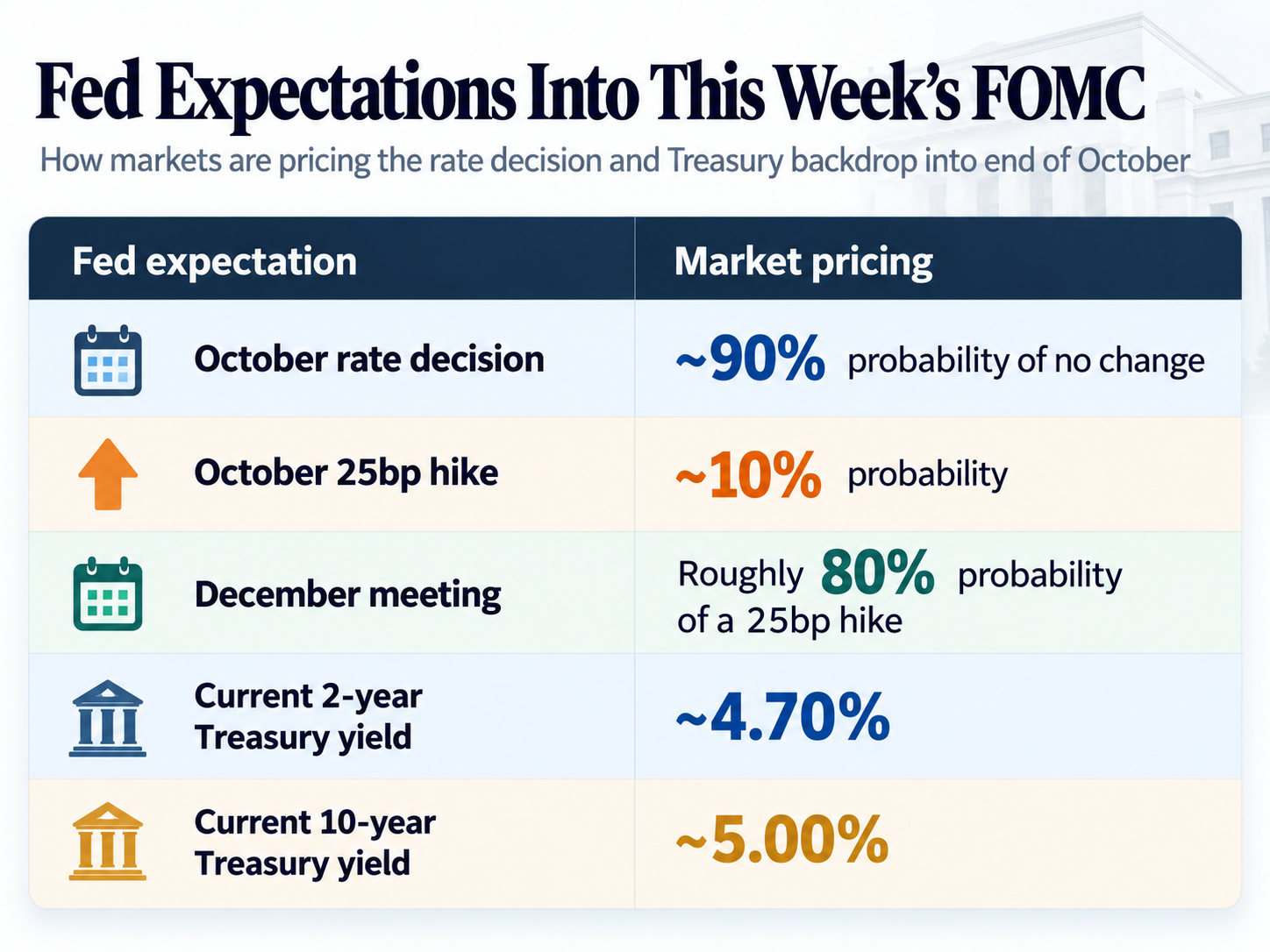
The market is therefore looking beyond Wednesday toward the future path of monetary policy.
Persistent inflation, elevated energy prices, and resilient economic activity complicate the Fed’s ability to signal an end to tightening.
Importantly, the 10-year Treasury yield hovering near 5% is already creating a more challenging backdrop for equity valuations. Higher long-term yields increase the discount rate applied to future corporate earnings, particularly affecting growth companies with valuations dependent on distant cash flows.
The key distinction: A widely expected pause is not necessarily bullish. Equity markets need a less-hawkish outlook than currently discounted to generate a meaningful relief rally.
2. Options Positioning: Negative Gamma Changes the Equation
According to SpotGamma’s latest positioning analysis, SPX fell below its Risk Pivot of 7690, placing the index in a negative dealer gamma environment. Monday’s rebound has brought SPX back to retest that key level.
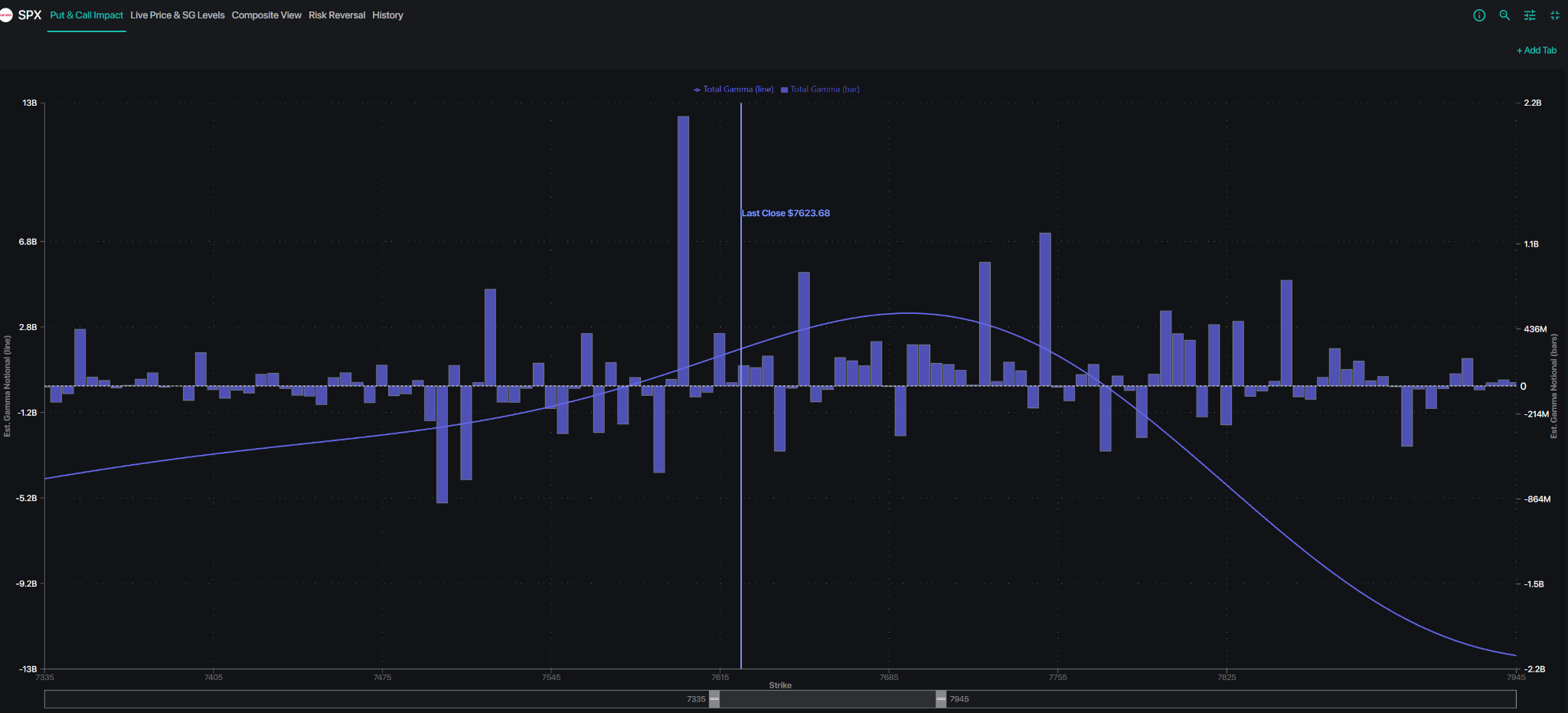
This matters because dealer hedging can become procyclical:
- As stocks decline, dealers hedging short gamma may need to sell additional futures, reinforcing downside pressure.
- As stocks rally, those same hedging dynamics can require additional buying, accelerating upside moves.
Meanwhile, the VIX finished last week near 19.45, with SpotGamma observing a roughly nine-percentage-point premium over one-month realized volatility.
The volatility term structure also reflects the crowded catalyst calendar. SpotGamma estimates forward implied volatility around October 28–29 near 20%, compared with approximately 14% for the broader near-term curve.
3. Sentiment: Defensive Hedging Rises Despite Selective Dip Buying
The recent technology selloff has meaningfully changed market sentiment.
While the S&P 500 remains relatively close to its highs, weakness in semiconductors and AI infrastructure stocks has been substantially more pronounced.
Options flows reveal an interesting divergence.
Index investors have increased their demand for downside protection, while selective call buying has appeared in heavily sold technology names.
At the same time, implied correlation has risen sharply, suggesting traders are increasingly paying for the possibility of stocks moving together rather than independently.
This combination creates two competing forces: institutional demand for portfolio protection and speculative positioning for an oversold rebound.
With dealer gamma negative, either side could gain momentum quickly.
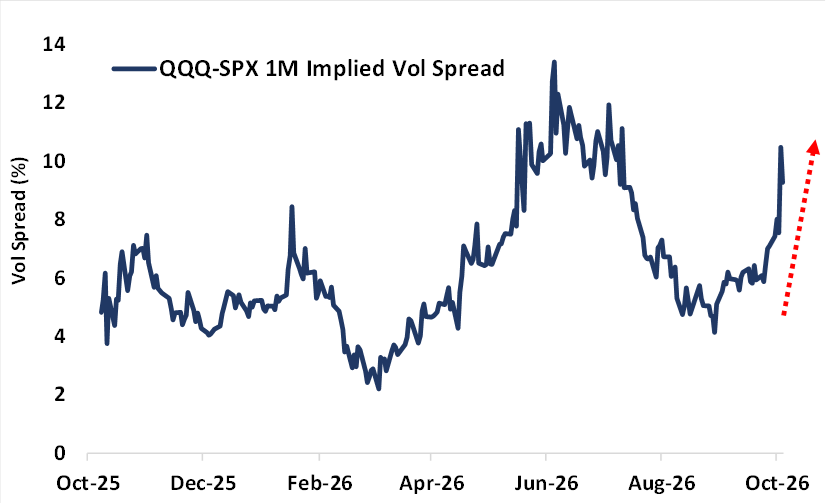
Cboe’s October 26 volatility report reinforces this defensive shift, with SPX downside convexity reaching the 99th percentile while retail call demand in mega-cap technology fell to a six-month low and put demand climbed to a one-year high. Meanwhile, the QQQ-SPX implied volatility spread has widened to approximately 10 volatility points, more than two standard deviations above its historical average. The combination suggests investors are increasingly paying for downside protection while reducing speculative upside exposure ahead of FOMC and major technology earnings.
4. Potential Scenarios for Markets
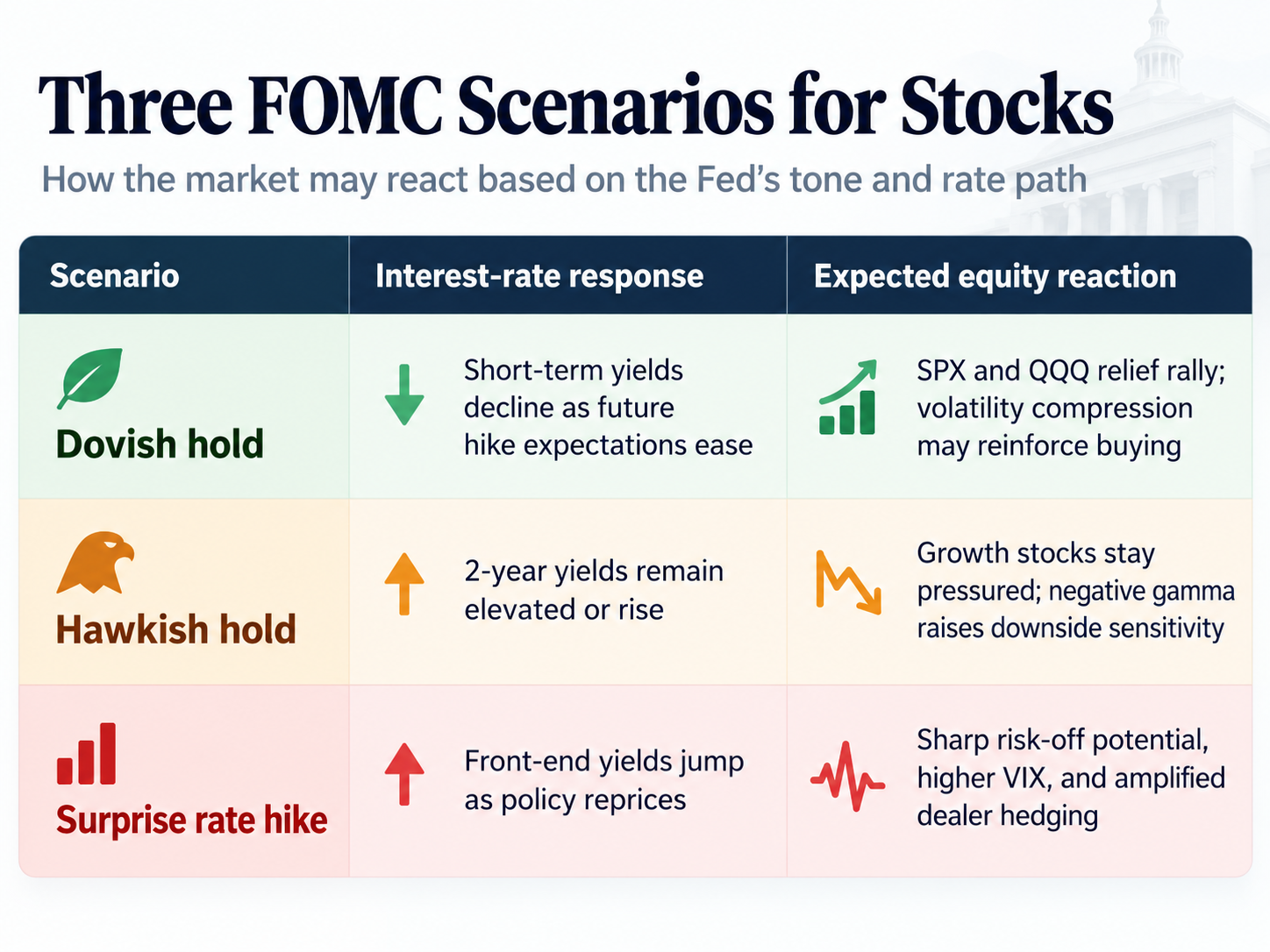
A dovish surprise could produce a particularly powerful reaction if falling implied volatility encourages option sellers to return and dealer positioning becomes more stabilizing.
Conversely, a hawkish surprise could quickly undermine the recent dip-buying narrative, particularly if the 10-year Treasury yield moves decisively back above 5%.
5. What Are SPX Options Actually Pricing?
As of Monday morning, SPX options imply approximately:
- ±1.15% through Wednesday’s close, including the FOMC decision.
- ±1.74% through Friday’s close, incorporating subsequent earnings and economic releases.
These are cumulative, options-implied one-standard-deviation ranges, not forecasts of the Fed announcement’s isolated impact.
The important distinction for options traders is that expensive event volatility can create opportunities on either side of the market.
Buying short-dated straddles requires a sufficiently large realized move to offset elevated premiums and subsequent implied-volatility compression. Meanwhile, selling premium into a negative-gamma environment exposes traders to potentially accelerating moves.
Defined-risk vertical spreads can offer a more controlled way to express a directional view, particularly after the initial interest-rate and gamma response becomes clearer.
6. What Traders Should Watch
With the Fed widely expected to hold rates steady, the market’s response may depend less on the announcement itself and more on how Treasury yields, implied volatility, and dealer positioning react afterward.
The key SPX level is 7690.
A sustained recovery above SpotGamma’s Risk Pivot, accompanied by falling implied volatility and improving dealer gamma, would support a more stable trading environment and potentially a relief rally.
Conversely, a rejection at 7690, particularly alongside rising Treasury yields and persistent demand for downside protection, would suggest continued vulnerability to amplified market moves.
The distinction matters because Wednesday’s FOMC decision is only the beginning of the week’s event risk. Microsoft, Alphabet, Amazon, GDP, and PCE data could all materially affect positioning before Friday’s close.
For traders, the objective isn’t necessarily to predict the Fed. It’s to understand the market structure in which the Fed’s decision will be absorbed.
The Fed may determine the initial direction. Options positioning could determine the magnitude and persistence of the move.
The Takeaway
The Fed is widely expected to hold rates steady, making the tone of its guidance more important than the decision itself.
For equities, the most constructive combination would be falling Treasury yields, declining implied volatility, and SPX reclaiming its Risk Pivot as dealer gamma improves.
A continued rise in yields, persistent demand for downside protection, and failure to recover that gamma threshold would suggest that the market remains vulnerable heading into November.
The Fed may determine the initial direction. Options positioning could determine how far the market travels.