A bear put spread is a defined-risk options strategy that buys a put option and sells a second put at a lower strike in the same expiration, paying a net debit that is the most the trade can lose. The long put profits as the stock falls; the short put below it finances part of the cost and caps the gain at the lower strike. It is the standard way to own downside exposure to a specific target without paying full freight for a plain long put.
Key Takeaways
- Buy a put, sell a lower-strike put, same expiration — max loss is the debit, max profit is the strike width minus the debit.
- The short strike is the downside target: profit accrues to that level and stops there.
- Selling the lower put trims cost, slows theta, and blunts the put-IV premium that makes bearish bets expensive when fear is already high.
- Breakeven is the long strike minus the debit — the stock must actually fall for the trade to pay.
How the Bear Put Spread Works
Buying a put outright means paying for extrinsic value twice over: time premium that decays daily, and the volatility markup that puts usually carry because downside protection is perpetually in demand. The bear put spread sells a lower-strike put against the long one, handing back the gains below that strike in exchange for cash today. Since the short leg has extrinsic value and vega of its own, part of the long leg’s decay and IV exposure cancels out.
At expiration the arithmetic is clean. Above the long strike, both puts expire worthless and the debit is gone. Between the strikes, the long put gains dollar-for-dollar as the stock falls. At and below the short strike, gains on the long put are offset one-for-one by losses on the short put — profit locks at the width minus the debit.
One behavior worth knowing in advance: on a sharp selloff before expiration, the spread will show less profit than the equivalent long put, because the short leg inflates with the same fear you are profiting from. The spread earns its full value with time, or with price settling below the short strike — it is a destination trade, not a panic trade.
Example
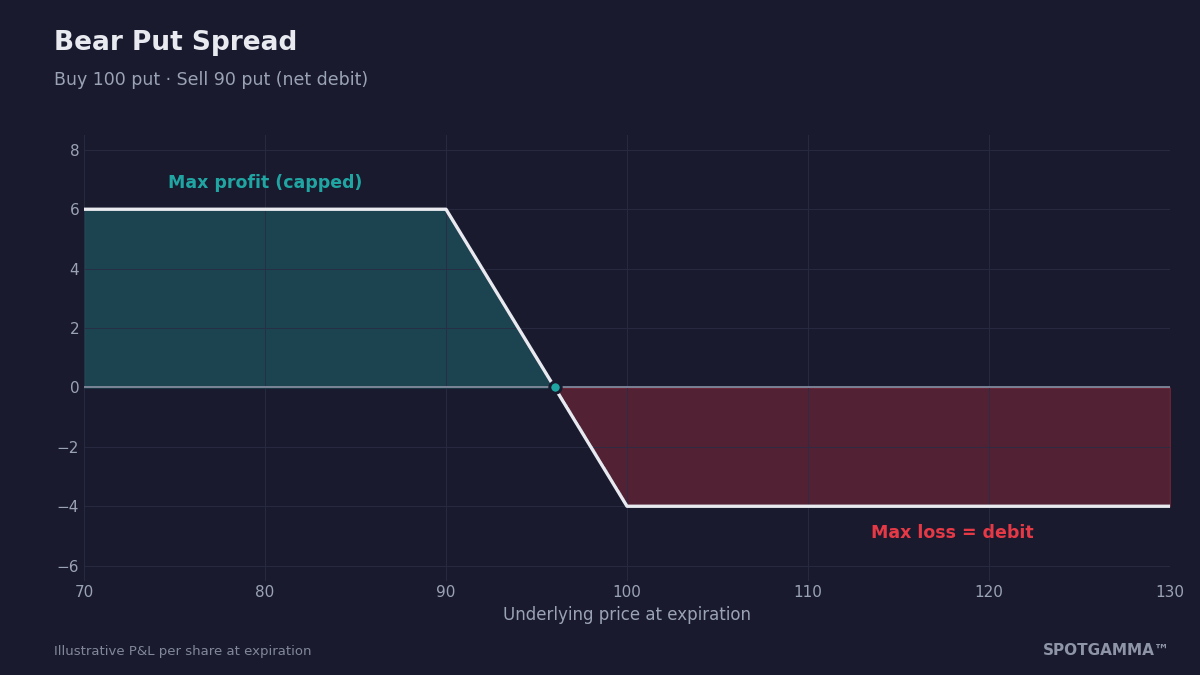
With the stock at $100:
- Buy the 100 put.
- Sell the 90 put.
- Net debit: $4.00 ($400 per spread).
The maximum loss of $400 occurs anywhere above 100 at expiration. Breakeven is 96. Below 90, profit is capped at the maximum of $600 — the $10 width minus the $4 debit. The structure risks $400 to make $600, and that payout reflects the work required: the stock has to fall through 96 before the trade makes its first dollar.
Bear Put Spread vs. Related Strategies
Where this fits in our options strategy library:
- Vertical spreads explained — the four-spread overview, including how debit and credit builds mirror each other.
- Bull put spread — the same two strikes sold the other way around: the trader on the other side of your bear put spread is effectively running one.
- Protective put — for hedging stock you own rather than trading direction; the spread version of that hedge is built the same way as this trade.
Using Positioning Data to Trade It Better
The short strike is the decision, and the positioning map gives it a data-driven home:
- Target the Put Wall. The Put Wall marks the strike carrying heavy put gamma, where declines have historically decelerated as dealer hedging absorbs the selling. Setting the short strike at the wall aims your maximum profit at a level the market actually gravitates toward — selling strikes far below it pays for distance the decline may never cover.
- Mind the gamma regime. When gamma exposure (GEX) flips negative, dealer hedging amplifies moves instead of dampening them — declines extend farther and faster. That environment favors owning downside structures like this one over selling upside, while positive-gamma pinning quietly works against bearish debit trades.
- Model it before you trade it. Stress the spread against the outright put across price, time, and IV in SpotGamma’s free Options Calculator.
Risks
- The entire debit is lost if the stock holds above the long strike — markets spend most of their time not crashing.
- Profit is capped at the short strike: in a true collapse the spread stops earning at $600 while a long put keeps gaining.
- Marked-to-market gains lag during fast selloffs because the short leg richens with rising IV; the full payoff requires time or settlement below the short strike.
- The short put can be assigned early once deep in-the-money, delivering long shares you did not plan to own until the position is managed.
FAQ
When is a bear put spread better than buying a put?
When downside protection is already expensive and you have a target in mind. Put IV is typically richest exactly when traders want bearish exposure, and the spread sells some of that costly premium back. If you expect an orderly decline to a level rather than a crash without bottom, the spread is usually the better-priced expression.
What is max profit on a bear put spread?
The strike width minus the debit — $600 in this example ($10 width minus $4.00 paid). It is earned when the stock finishes at or below the short strike at expiration, and no deeper decline adds anything further.
How does implied volatility affect the spread?
Far less than it affects a single put, because the two legs’ vega partially offset. Rising IV helps the position only modestly and falling IV hurts it only modestly. The practical consequence: a spike in fear benefits a long put more in the short run, while the spread depends on price reaching the target rather than on volatility itself.
This article is for educational purposes only and is not financial advice. Options involve substantial risk and are not suitable for all investors.