The S&P 500 delivered a high octane four-day run last week, establishing all-time highs with a 6% rise from weekly lows. Shifting interest rate expectations, easing Middle East tensions, and strong corporate earnings powered the dramatic rally.
The sharp surge brought out notable divergences across the tech space. Software outperformed the broader market, with strong positive post-earnings moves in Palantir (+27%), Atlassian (+35%), and Twilio (+25%).
The semiconductor and memory complex, by contrast, showed relative weakness. SanDisk and Western Digital both pulled back following earnings despite results that beat Wall Street consensus. As far as the AI trade goes, the market continues to demand stronger returns from data center investments and larger guidance increases.
In the wake of the summertime melt-up, the memory space presents one of the most interesting setups this week. While implied volatility has declined for indices as well as many single-stock names following earnings, the memory sector has not similarly benefited from last week’s rally. This is the type of divergence that can create tactical trading opportunities for individual names and ETFs.
Trade Setup: Memory on a Pullback
The contrast between the memory sector and the broader market points to interesting plays. SMH, QQQ, and SPY each now show Risk Reversal Rank above 95%, indicating very high call skew relative to put skew. This extreme bullish positioning points to increasingly high trader expectations across the AI and tech sector.
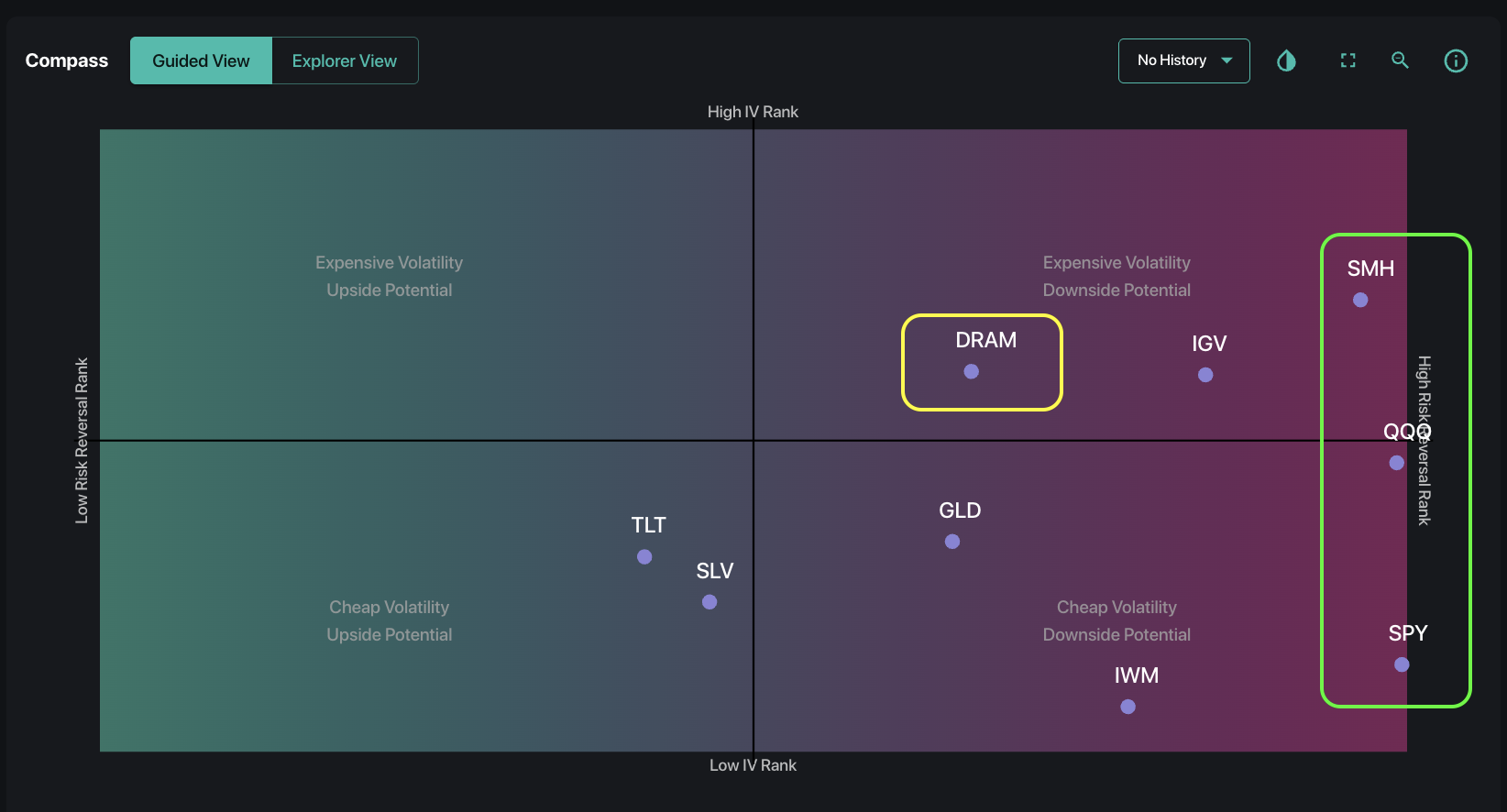
On the other hand, the memory ETF DRAM has more tempered options market enthusiasm. Positioning remains slightly bullish with a Risk Reversal Rank of 67% — not showing quite the same extremes as the broader indices and ETFs.
Having pulled back from recent highs, DRAM’s options positioning points to a potential rebound. SpotGamma’s Synthetic OI model shows positive dealer gamma below spot and negative dealer gamma to the upside. Positive dealer gamma is generally associated with lower realized volatility as market maker hedging acts against price moves, while negative gamma can similarly contribute to higher realized volatility.
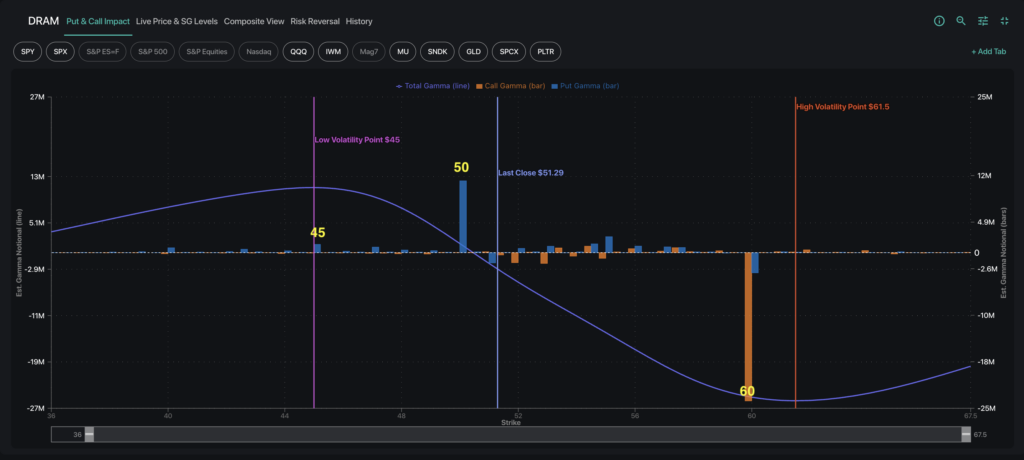
In practice, positioning for DRAM suggests hedging flows may cushion further downside, while moves higher could accelerate quickly. Our Synthetic OI model identifies a Low Volatility Point near the 45 strike and a High Volatility Point near 60.
With DRAM showing an IV Rank above 60%, spread structures may be attractive given the elevated options premium. One example is a protected bullish risk reversal into weakness: selling a put spread to help finance the purchase of a call spread. This type of structure benefits from upward movement while defining risk on both sides.
Three Catalysts to Watch in August
Looking ahead, three key market events stand out for the month ahead: the CPI report on August 12 may be an important input for the next Fed meeting, monthly OPEX falls on August 21, and NVDA reports earnings on August 26.
Elevated forward implied volatility continues to be seen throughout the SPX term structure chart. On that basis, the current data suggests the options market may be underpricing potential price movement around these risk events.
o spike volatility.
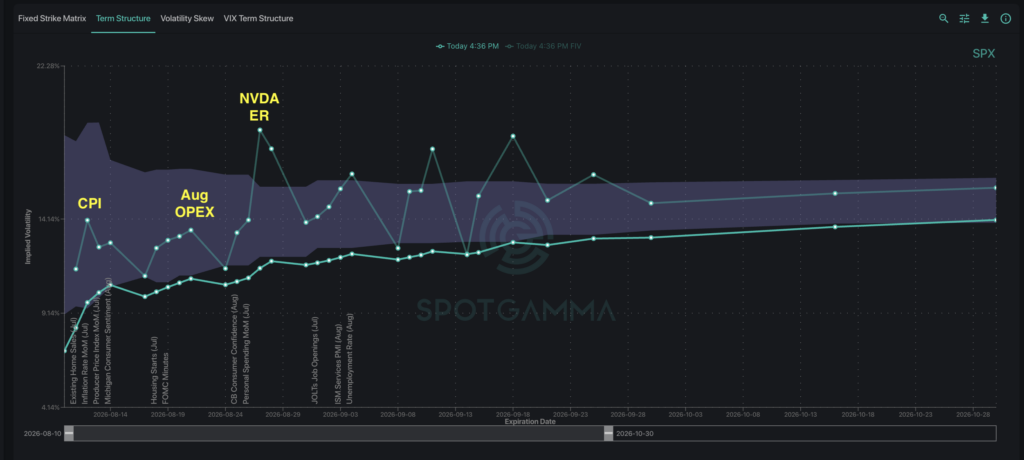
While these risk events could generate volatility, we encourage traders to look at both gamma positioning and intraday flows when searching for trading opportunities similar to the above analysis of DRAM.
For slightly longer-term trading, it has become increasingly important to monitor rate cut expectations. If incoming macro data materially changes those expectations, the landscape of potential trade opportunities could similarly shift.