Over the past week, the topic of volatility has returned to the forefront. While the market has been largely range-bound, underlying support remains tenuous. Simultaneously, traders have begun more actively paying for downside protection. Given the backdrop of flaring geopolitical conflict, we see assymetric downside risk forming as trader uncertainty and negative gamma threaten to unlock the market’s trapdoor.
Over the past two weeks, SPX has consistently wavered within a somewhat stable price zone near SPX 6,900. This area is marked by largely positive gamma, where dealers hedge by trading against price action — buying dips, and selling rallies.
This is where the “trapdoor” concept comes into play: below the SPX 6,900 level, dealer gamma changes from positive to negative. This shift means that hedging requirements will also flip as dealers begin to trade with price action. Should the market persist below this threshold, the risk is that any drop could accelerate further downside.
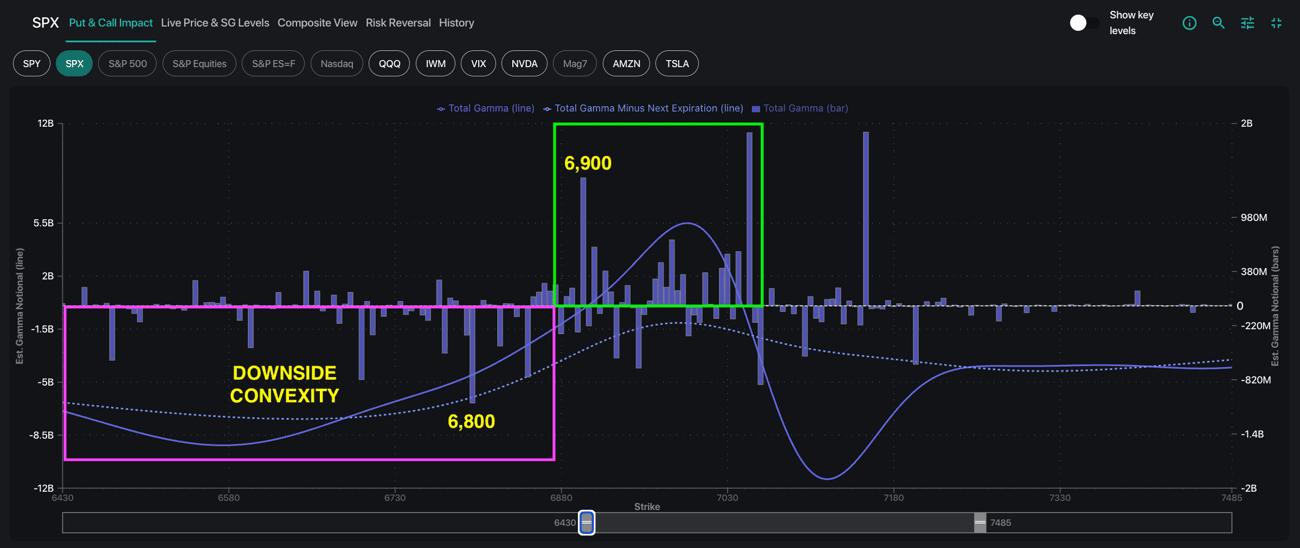
In a common theme we have discussed recently, the source of virtually all positive gamma remains extremely short-dated option selling. Should these 0DTE traders get spooked and move to the sidelines, we see negative gamma across all strikes for SPX — a sign that the stability may be thinner than it appears.
If 6,900 cannot be decisively reclaimed, then mechanical dealer hedging could turn a modest pullback into a sharper move lower. This would activate the market “trapdoor” we mentioned above, dissolving the relative index stability that many traders have grown accustomed to.
Traders Move Into Defensive Positioning
Volatility skew for SPX delivers one of the clearest warning signs at present. Put skew hovers at the 99th percentile compared to the previous year’s values, while call skew remains at just the 2nd percentile. This level of put-buying clearly shows traders are bracing for downside, while showing little urgency to chase upside.
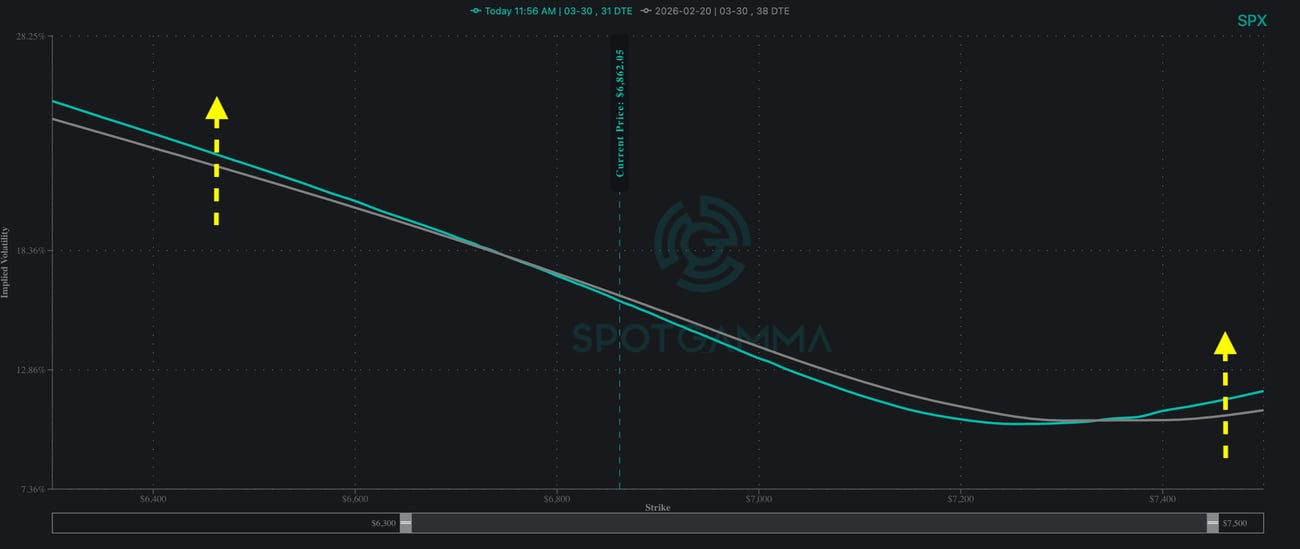
The skew curve has steepened further over the prior week — with an interesting exception above SPX 7,300. This doesn’t mean market participants are simultaneously anticipating massive imminent upside, although it does mean tail risk, in both cases, is still present.
All of this is not to say that a selloff is inevitable, but rather that the risk of downside vol has grown disproportionately to upside expectations. When market participants simultaneously prepare for downside while dealer gamma flips negative, we should take note. Structural positioning suggests any serious move lower could be faster and more forceful than many expect.
The Week Ahead: Headline News, Earnings, and Data Prints
While traders should certainly watch for the trapdoor scenario we outlined above, it’s important to acknowledge growing causes of market uncertainty. Headline news on the conflict with Iran, tariff concerns, and the growing impact of AI remain top of mind. These ongoing events can trigger movement downward — or catalyze a market rebound, if conditions clear and worries ease.
Looking at known calendar events, earnings season is winding down with a few major names on tap. TGT and ROST (Tuesday) could provide indication of consumer sentiment. AVGO (Wednesday) will be the key semiconductor read-through after NVDA, while COST (Thursday) rounds out the week. For those interested in trading these names, we wrote about strategic ways to play earnings just this past week.
On the economic data front, the upcoming week’s releases provide color for consumer sentiment and economic growth. Monday brings ISM Manufacturing, Wednesday features ADP Employment plus ISM Services, and Friday brings the release of Nonfarm Payrolls (NFP) right before the open.
Given market uncertainty and the threat of volatility from negative gamma, awareness remains critical for traders. As always, we encourage our readers to watch dealer positioning and vol dynamics carefully, while keeping an eye on evolving headlines.