Elon Musk’s Tesla (TSLA) and SpaceX (SPCX) report earnings on consecutive evenings this week, but growing merger speculation introduces an unusual wildcard for options traders.
SpaceX reports Tuesday, October 20, followed by Tesla on Wednesday. Recent Barclays commentary has fueled speculation about a potential all-stock merger, although neither company has announced a deal.
The timing creates a unique two-stage volatility event, where SpaceX’s results could influence Tesla’s trading ahead of its own report.
With options pricing roughly 6–8% moves in both stocks, can earnings and merger speculation produce reactions large enough to overcome elevated option premiums?
We examine what the options market is pricing, how SpotGamma’s dealer positioning and volatility signals compare, and which defined-risk strategies may offer attractive opportunities.
1. What the Options Market Is Pricing
Both companies enter earnings with substantial event risk embedded in their options.
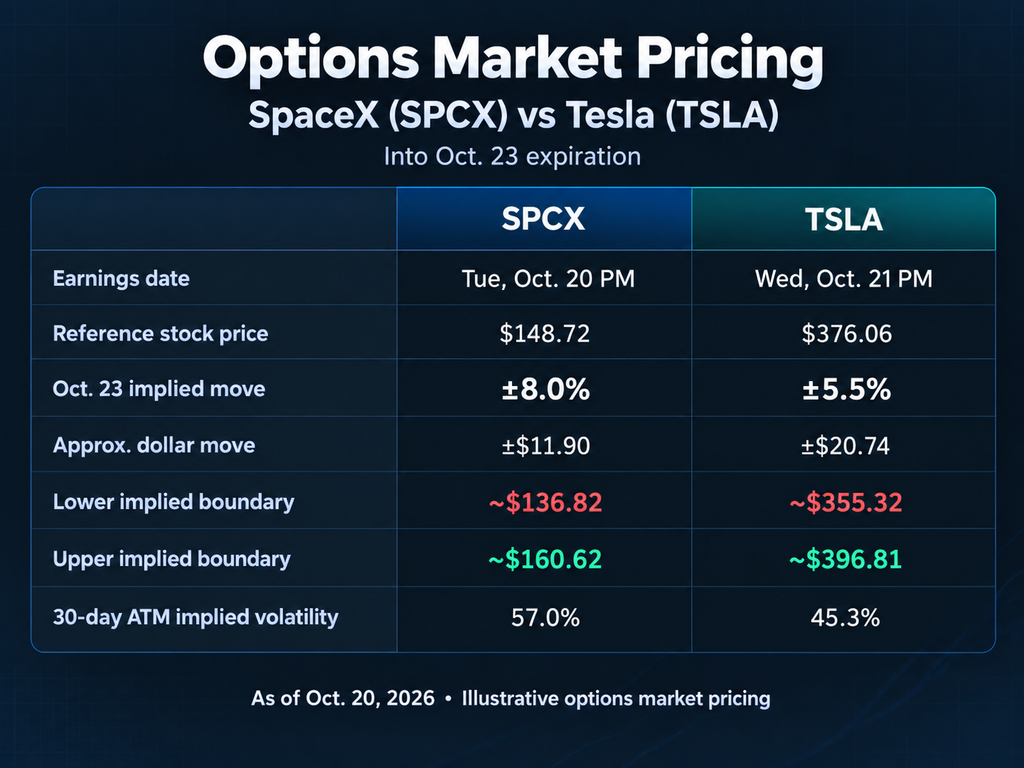
SpaceX’s options are pricing a move of approximately 8.0%, compared with roughly 5.5% for Tesla. The latter of which has decreased since last week.
These are substantial expectations, although neither would be unprecedented.
SpaceX declined approximately 13.6% following its previous earnings report, while Tesla suffered a 14.5% drop after its July results.
Historically, Tesla has demonstrated considerable earnings volatility. Over its last eight quarterly reports, its median absolute reaction was approximately 4.5%, compared with an average closer to 7.8%, reflecting occasional outsized moves.
The takeaway: Both names are pricing significant volatility, but the distribution of potential outcomes remains highly sensitive to unexpected guidance and merger-related headlines.
Importantly, the straddle-implied range extends through Friday expiration and includes ordinary trading movement beyond the earnings announcements themselves.
2. What Wall Street Expects
While the merger rumors may dominate headlines, both companies face meaningful fundamental tests.
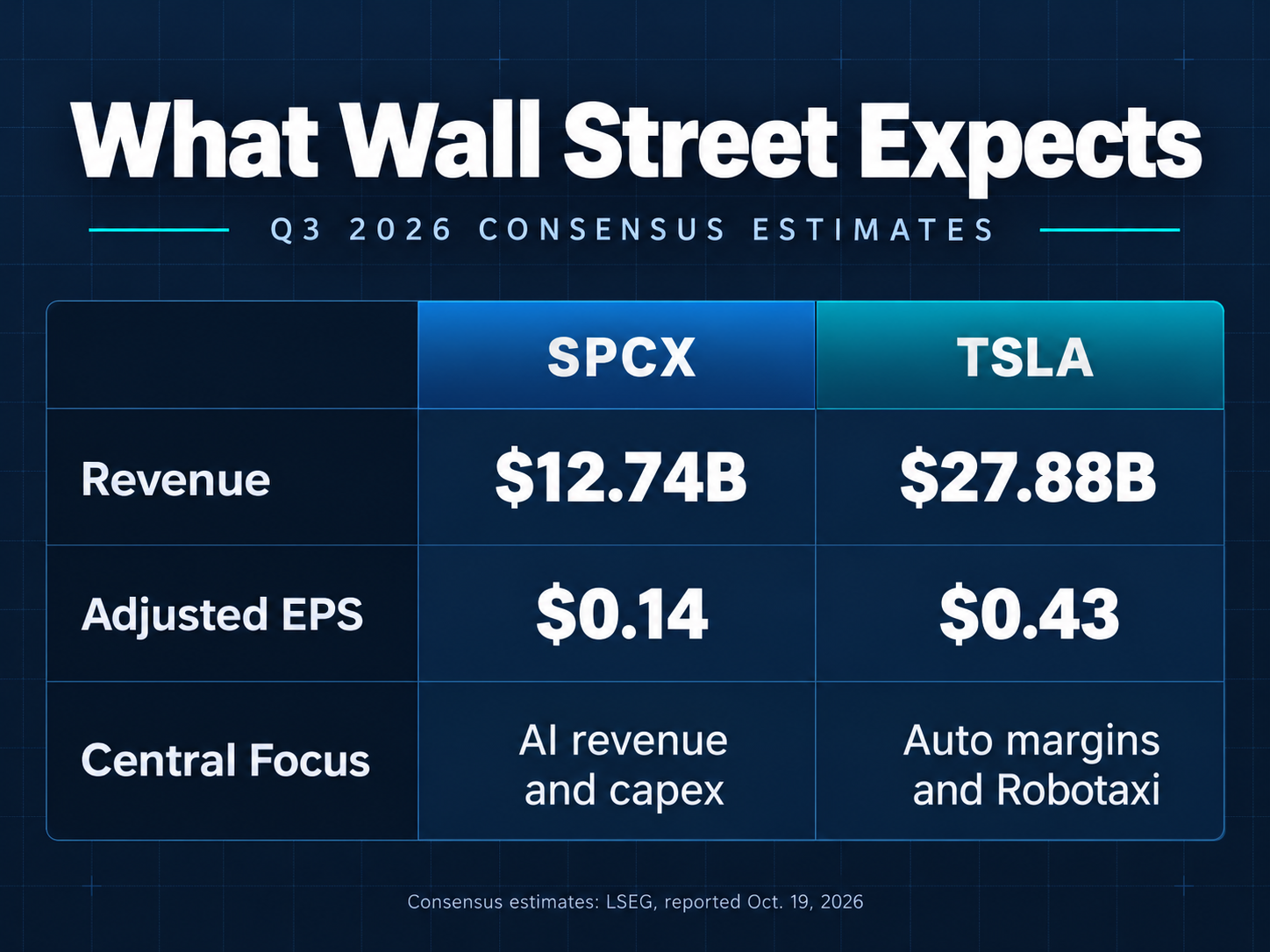
SpaceX: Can AI Growth Justify the Spending?
SpaceX enters its second earnings announcement since its June IPO with investors focused on the expansion of Starlink and its increasingly ambitious AI infrastructure business.
Last quarter, the company reported approximately $7.8 billion in revenue but spent $18.4 billion on capital expenditures, including $15.8 billion on AI computing infrastructure.
Investors will be closely watching Starlink subscriber growth, AI monetization, cash burn and updated capital expenditure guidance.
Tesla: Margins Versus the Autonomous Future
Tesla delivered 486,532 vehicles during the quarter, exceeding expectations, while deploying 13.7 GWh of energy storage products.
However, deliveries alone are unlikely to determine the stock’s reaction.
Automotive margins, free cash flow, and progress toward commercializing Robotaxi and Optimus remain central to Tesla’s valuation.
With annual capital spending expected to exceed $25 billion, investors are increasingly focused on how Tesla intends to finance its longer-term growth initiatives.
3. What Skew, Compass, and Dealer Gamma Reveal
Options positioning reveals an interesting contrast between the two companies heading into earnings.
As of October 19, SPCX’s 30-day 25-delta puts carried approximately 4.56 volatility points of premium over comparable calls, versus 2.48 points for TSLA. This suggests relatively stronger demand for downside protection in SpaceX.
Both stocks also exhibit inverted volatility term structures, with near-term options carrying elevated premiums ahead of earnings.
SpotGamma Compass: Relative Upside Potential
The SpotGamma Compass Map places both stocks in the lower-left quadrant, reflecting midrange implied volatility ranks and relatively low risk reversal ranks.
This positioning suggests that upside options may offer more favorable relative pricing, although neither stock exhibits exceptionally cheap volatility. TSLA sits slightly farther toward the upside-potential side of the Compass than SPCX.
Importantly, the Compass measures relative options pricing, not the probability of a bullish earnings reaction.
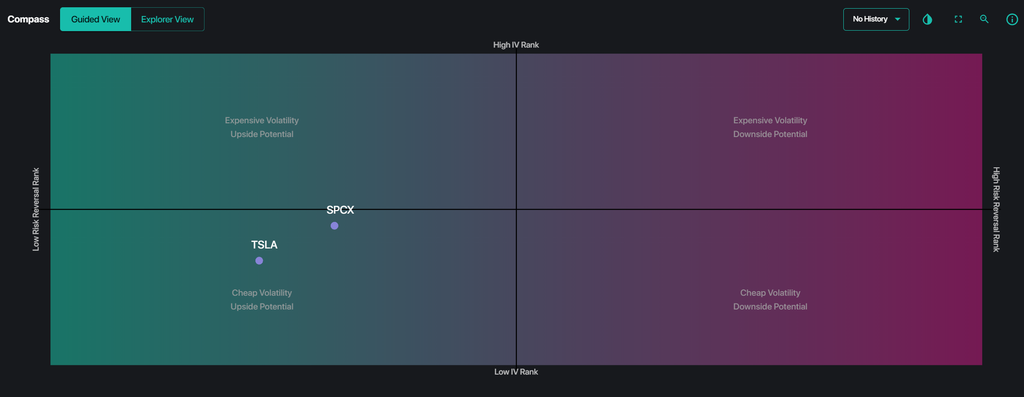
SpotGamma Compass Map — TSLA and SPCX Relative Upside Potential
Dealer Gamma: TSLA Faces Greater Volatility Risk
The gamma maps highlight another important distinction.
SPCX: Substantial positive gamma concentrations around $155–$170, particularly near $160, suggest dealer hedging could help stabilize prices and suppress volatility following earnings. However, negative gamma builds above $180, potentially amplifying upside momentum if shares break through the positive gamma region. The $195 High Volatility Point marks an important upper volatility reference.
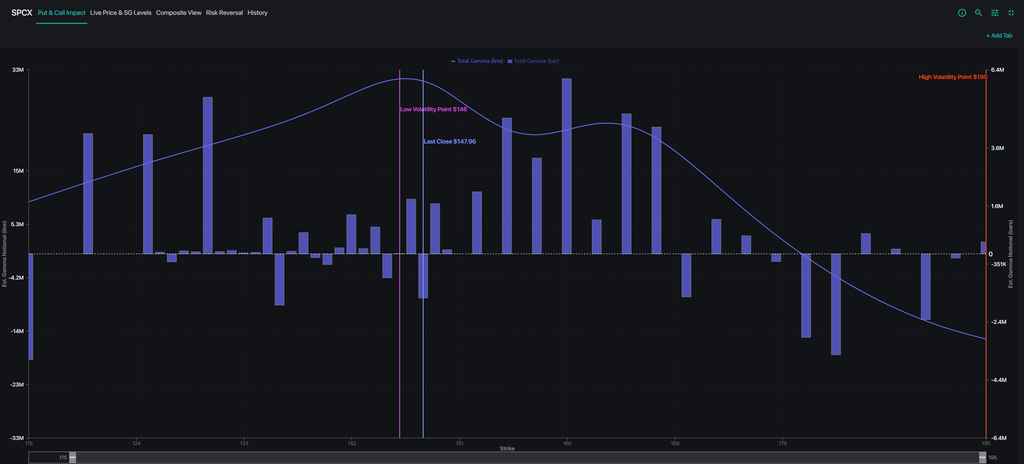
SPCX Synthetic Dealer Gamma Exposure — $146 Low Volatility Point
TSLA: Dealer gamma shows a significant shift from yesterday’s negative gamma environment toward predominantly positive gamma exposure, suggesting greater potential for price stabilization heading into earnings. With shares last closing near $368, substantial positive gamma concentrations around $370–$380 could help dampen volatility, while the newly established $390 Low Volatility Point marks the peak of aggregate positive gamma exposure and a potential stabilization zone.
However, notable negative gamma pockets remain near $350, $385, and $400, where hedging activity could amplify localized price swings.
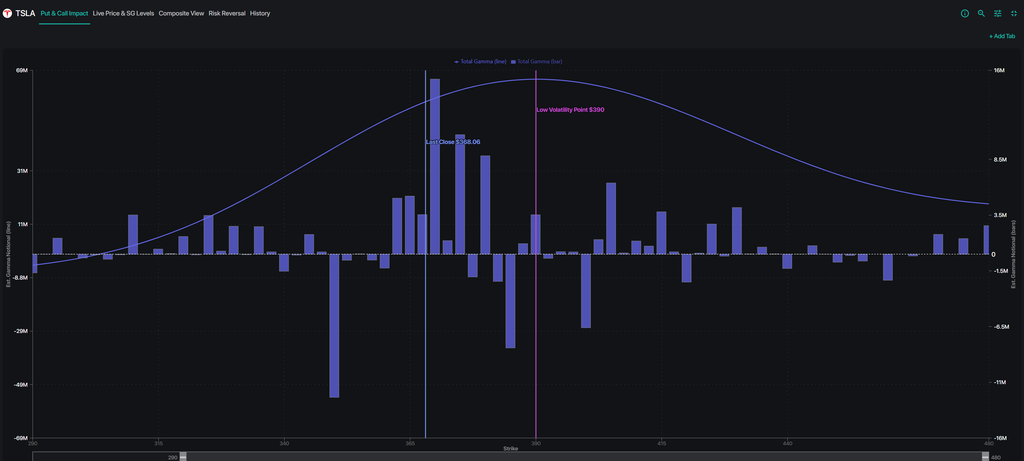
TSLA Synthetic Dealer Gamma Exposure — $390 High Volatility Point
TSLA appears more vulnerable to an amplified directional move, while SPCX has a more balanced gamma profile with identifiable areas of potential stabilization and acceleration. These synthetic positioning estimates are not confirmed dealer inventories.
Merger speculation could also keep volatility elevated beyond the initial reports, potentially limiting the usual post-earnings IV collapse.
4. The Merger Wildcard: Could SpaceX Buy Tesla?
The potential combination of Tesla and SpaceX has attracted renewed attention following Barclays’ analysis suggesting that an announcement could arrive ahead of Tesla’s December 3 annual shareholder meeting.
The bank has outlined a potential all-stock structure with SpaceX as the acquirer, although neither company has confirmed a transaction or publicly established deal terms.
From an investment perspective, a merger would create exposure to an enormous collection of businesses spanning electric vehicles, robotics, autonomous transportation, satellite communications, launch services and AI infrastructure.
However, the combined capital requirements would be equally significant.
For options traders, there are three major considerations.
- Correlation risk: A merger-related announcement could create sharp, interconnected moves in both securities, potentially reducing diversification benefits. The direction and magnitude would depend heavily on transaction terms and relative valuations.
- Gap risk: A credible announcement could generate a move well beyond the options-implied ranges, particularly if proposed transaction terms materially change the market’s valuation assumptions.
- Volatility persistence: Even without an announcement, continued speculation could support longer-dated options premiums after quarterly earnings uncertainty has passed.
A merger is not a confirmed outcome, and its eventual impact would depend heavily on valuation, exchange ratios, dilution and shareholder approval.
5. Three Potential Trading Scenarios
Bullish: Strong Earnings Fuel a Breakout
Better-than-expected SpaceX results Tuesday could establish positive momentum heading into Tesla’s Wednesday report. Improving Tesla margins or encouraging Robotaxi developments could push shares beyond their upper implied ranges, with negative dealer gamma potentially accelerating the move.
Neutral: Results Meet Expectations
If neither company delivers a major surprise or merger update, both stocks could remain within their implied ranges. Short-dated implied volatility would likely decline, benefiting premium sellers, although lingering merger speculation could limit the volatility reset.
Bearish: Capital Spending Raises Concerns
Disappointing SpaceX cash flow or higher AI spending guidance, followed by weaker Tesla margins, could pressure both stocks. A breakdown through key negative gamma regions could reinforce downside momentum as dealer hedging flows amplify selling.
6. The Options Trader’s Takeaway
SpaceX’s Tuesday results may influence expectations for Tesla before Tesla reports Wednesday, potentially changing both directional positioning and options pricing.
Rather than chasing expensive outright options ahead of either announcement, defined-risk vertical spreads may offer a more controlled way to express a directional view.
Potential Trade Ideas
TSLA’s gamma profile suggests greater potential for volatility expansion, while SPCX’s more balanced positioning and relatively expensive downside protection favor a different approach.
Two defined-risk options structures worth considering are a bullish call debit spread in TSLA and a put credit spread in SPCX.
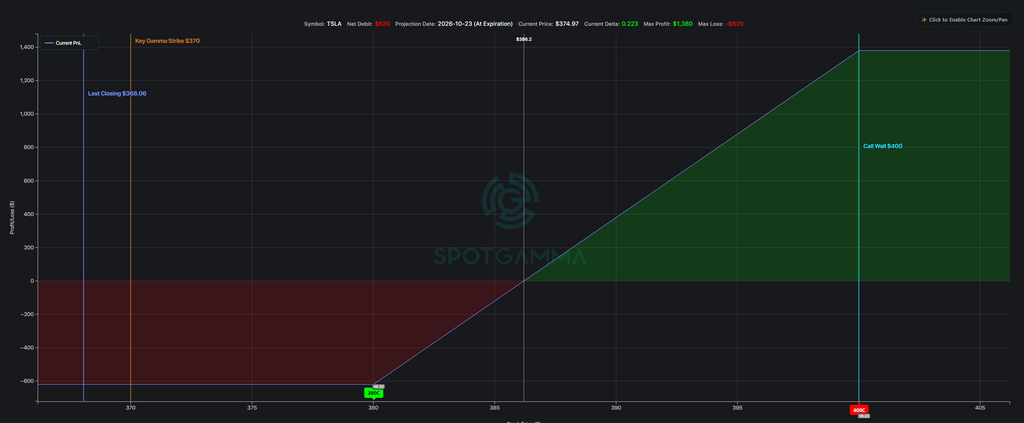
TSLA: October 23 $380/$400 Bull Call Spread
At a $6.25 debit, this $20-wide spread risks $625 to potentially earn $1,375, offering approximately 2.2:1 maximum reward-to-risk with a $386.25 expiration breakeven.
The setup provides bullish exposure to a potential earnings breakout, particularly if TSLA pushes through its $390 High Volatility Point. Maximum profit requires shares to reach $400 or higher at expiration.
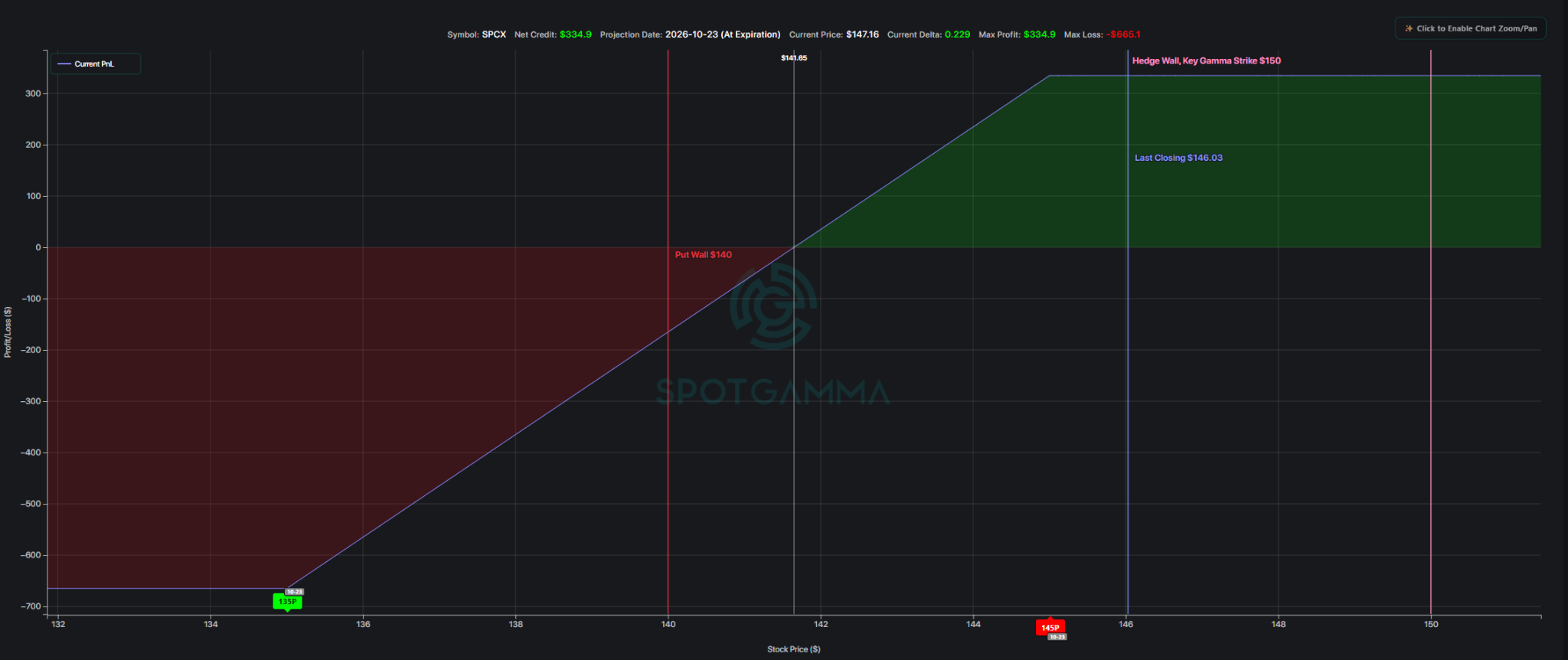
SPCX: October 23 $145/$135 Bull Put Spread
At a $3.35 credit, this spread offers $335 maximum profit against $665 maximum risk, with a $141.65 expiration breakeven.
The strategy benefits from elevated downside premiums and a neutral-to-bullish reaction, but negative gamma concentrated near $140–$145 introduces meaningful downside gap risk.
For traders seeking additional time, November 6 or November 20 expiration spreads offer alternatives, although the premiums and reward-to-risk profiles will differ.
Both examples use midday Tuesday indicative pricing and should be reassessed against live quotes before entry. The TSLA debit spread provides bullish convexity but is not a pure long-gamma trade across all prices; the SPCX credit spread generally carries short-gamma exposure.
Bottom line: The options market is pricing substantial moves in both stocks, but the combination of earnings, merger speculation, and contrasting gamma profiles creates opportunities for volatility to exceed expectations. The most important signals may emerge as dealer positioning and implied volatility adjust after each report.