Market sentiment was mixed last week following NVDA earnings and Jackson Hole. While NVDA’s solid outlook pushed the market to within inches of all-time highs, Warsh’s hawkish tone seemed to increase the probability of a September rate hike.
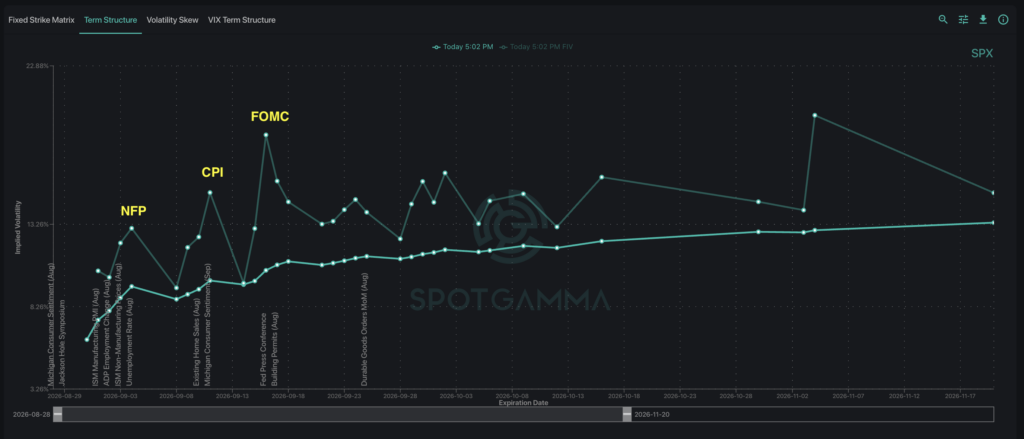
Throughout August, the S&P 500 has closed in a narrow 2.6% band (SPX 7,600 – 7,800). The term structure remains solidly in contango, with forward IV highlighting NFP, CPI, and FOMC as upcoming dates to watch.
In this market, traders may naturally wonder “What’s the trade now?”
Earnings season sits behind us, VIX has reset down to yearly lows, and oil has demonstrated surprising price stability compared to the turbulent March-May timeframe. The AI trade carries on, although not quite with the same enthusiasm as earlier this year.
Despite NVDA’s blockbuster earnings and a subsequent 9% rally, semiconductor and memory stocks have remained flat for the past month. Both sectors are down meaningfully from June highs: SMH has dropped 17%, while memory ETF DRAM has fallen over 30%.
In contrast, software stocks have surged against the rest of tech. Strong earnings reactions (CRM +23%, OKTA +29%, CRWD +21%) seemingly ignited traders’ risk appetite. The narrative appeared to shift away from ‘SaaSpocalypse’ as larger firms in the space increasingly report benefits from AI usage.
This resurgence in software suggests increased interest as traders and investors rotate capital from crowded semiconductor positions. The move has also taken place broadly across the sector rather than isolated to a handful of names, establishing constructive setups in software laggards.
The Software Sector’s Bullish Trend
Positioning across software stocks has taken on a mixed lean following the latest round of earnings. Despite a notable rally in the sector, implied volatility across many software names has come down.
SpotGamma’s Compass tool (shown below) helps visualize options positioning by plotting IV Rank against Risk Reversal Rank. Most software names show some degree of call skew, as traders participate in the upside bid in anticipation of further gains.
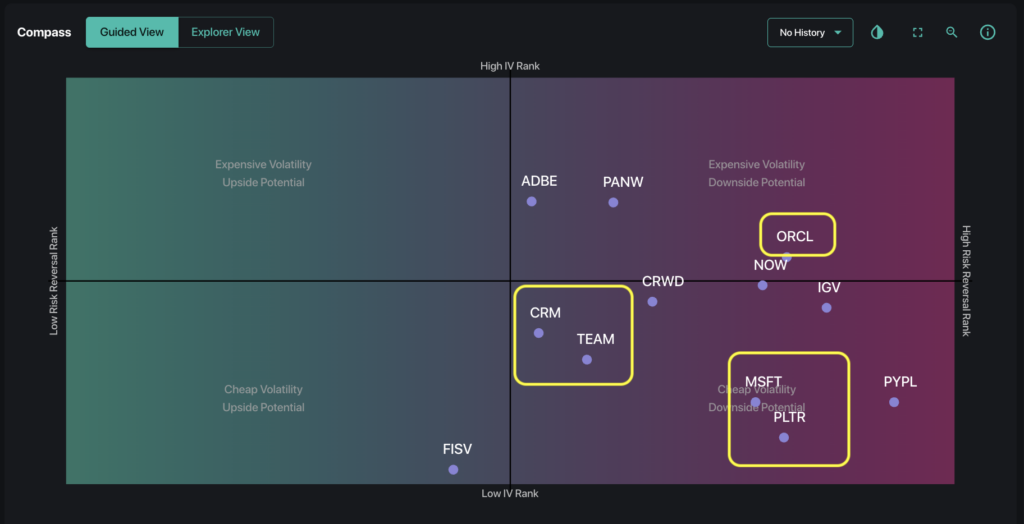
However, the upside demand does not appear to be yet reaching extremes: CRM, TEAM, MSFT, and PLTR all show IV Ranks below 50% following post-earnings moves. This suggests inexpensive options prices relative to the prior year range.
Stocks such as CRM and TEAM do not appear to show extreme upside positioning, despite their massive post-earnings rallies. It is likely that options traders do not anticipate the same degree of continued upside momentum in these names, compared to before earnings.
Several stocks shown above have yet to report their quarterly earnings: ORCL, ADBE, and PANW. These may present interesting setups as positioning does not appear to be at extremes, and earnings-driven volatility has yet to be realized.
ORCL: The Next Constructive Gamma Setup?
Last month, we identified constructive dealer gamma profiles in two software stocks: ServiceNow (NOW) and Microsoft (MSFT). Both showed positive dealer gamma below spot and negative dealer gamma above. This setup can cushion downside movement, while accelerating upside momentum.
Over the following month, NOW stock rose from 106 to 145 (+37%), while MSFT rose from 381 to 514 (+35%). Currently, ORCL presents a similar setup for traders.
ORCL is down over 35% from June highs and now trades at ~$151, with earnings expected to arrive in two weeks. The company faces significant headwinds regarding concerns over AI spend, including growing credit risk acting as a headwind.
SpotGamma’s Synthetic OI model shows dealer gamma in ORCL peaking at 120 and remaining positive through the gamma flip level at 175. Above that level, ORCL transitions into a negative dealer gamma regime with the most negative gamma concentrated around 200. Notably, traders currently hold roughly 24k long call contracts at this level.
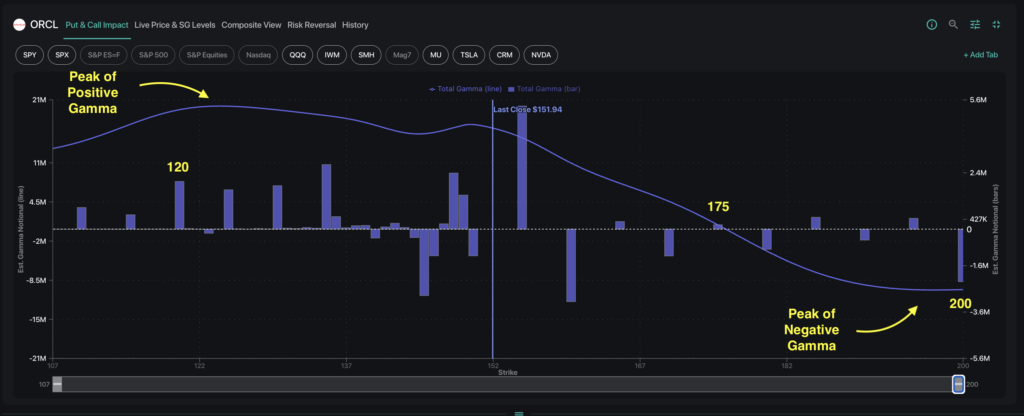
For traders who are bullish on the stock, an entry while ORCL sits in positive gamma would likely provide cushion to the downside, with negative gamma above 175 fueling upside. Knowing the headwinds faced by ORCL, we encourage traders to continually monitor both dealer gamma and key levels, with defined risk positions.
While not every constructive dealer gamma setup resolves the same way, the setup in ORCL looks encouraging. Combining fundamentals and known event catalysts with options positioning and dealer gamma profiles creates an informative framework for evaluating potential trades.